CEOs at Milken: Don't worry, keep investing

Add Axios as your preferred source to
see more of our stories on Google.
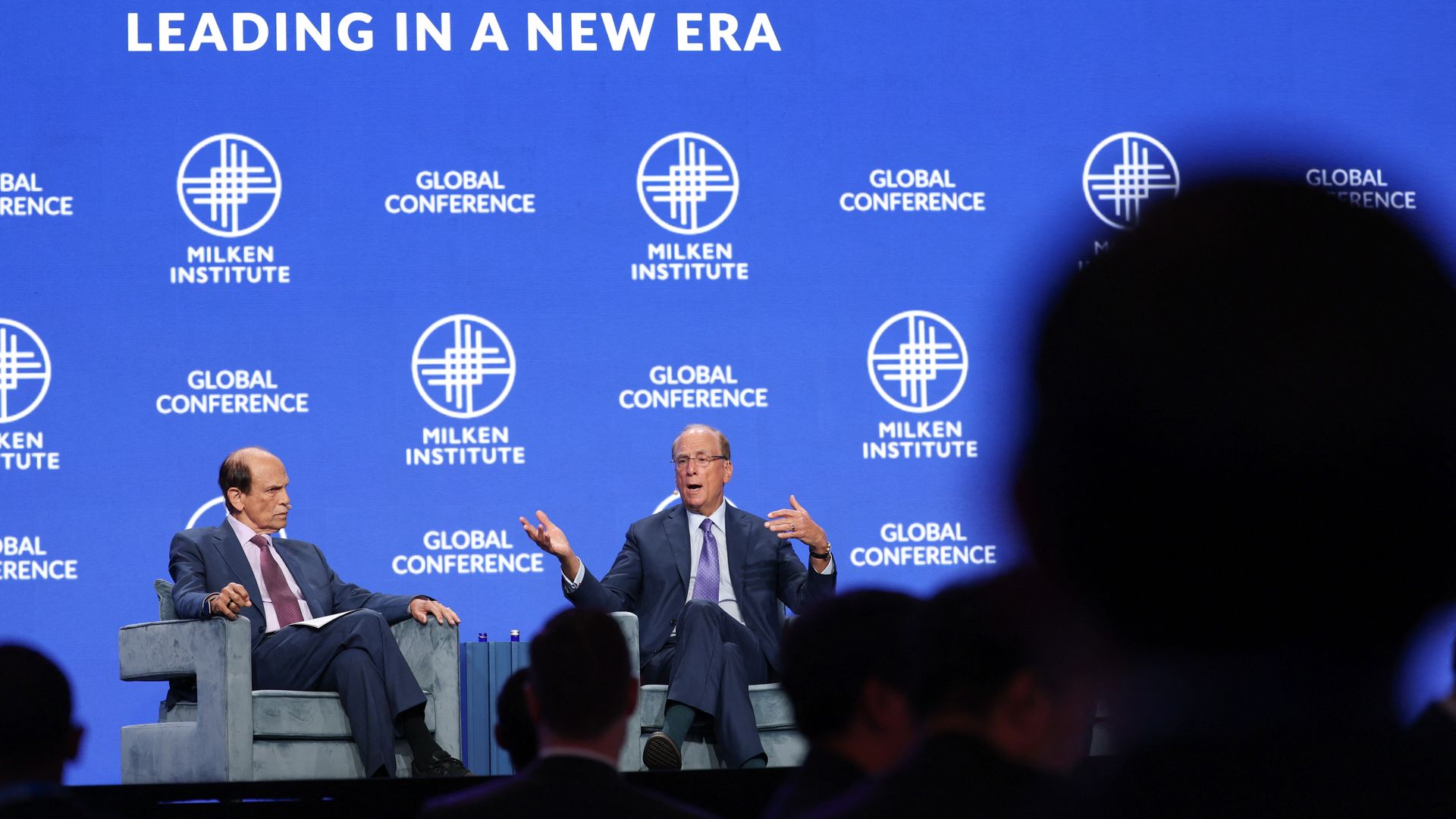
Michael Milken and Larry Fink at the Milken Institute Global Conference in Beverly Hills, Calif. Photo: Patrick T. Fallon / AFP via Getty Images.
The movers and shakers at the Milken Institute Global Conference in Beverly Hills, California, this week — ranging from CEOs and investors to celebrities (Shaq!) and politicians like Sen. Ted Cruz (R-Texas) and Rahm Emanuel — are all navigating a complex landscape, in a couple of ways.
The big picture: The global economy is going through a historic transformation, creating a range of challenges.
- Also: The Beverly Hills Hilton, longtime home to the 29-year-old conference, is under construction — leaving less room for schmoozing and some weird logistics.
Zoom in: These include a windowless tunnel connecting the building to another luxury hotel, the Waldorf Astoria, which also hosted some of the conference's panels and meetings.
- Mutterings from attendees scuttling through the tunnel were frequently overheard: "It's not usually like this," "This is so weird" and the like.
- "It's such a logistical nightmare," Kate Moore, chief investment officer at Citi Wealth, tells Axios.
Between the lines: In many ways, the global economy is also under construction.
- The world of free trade, where money and resources flowed to the countries and companies that made the best and cheapest stuff, is fading.
- If President Trump's tariffs didn't already make that clear, the Iran war is now shining a spotlight on the new reality. No longer can other countries be relied upon to facilitate the open and free flow of resources.
- Things are gummed up — by conflict and increasing nationalism. Nations need to increasingly rely on their own resources, build them out or turn to trusted allies.
"The world has shifted to where the paradigm of 'let's just have integration and do things in the cheapest possible place' is just not going to work without you feeling like you could be taken advantage of or that will be weaponized against you," Karen Karniol-Tambour, co-chief investment officer at Bridgewater Associates, the world's largest hedge fund, said on a panel.
The intrigue: It's a take echoed around the conference, but it doesn't seem to have dampened investors overall optimism about the economy.
- Again and again, folks remarked to Axios that there was little concern among attendees — among them some of the richest people on the planet — about the Iran war.
- Any anxiety over the conflict and its supply disruptions and inflationary pressures seemed dwarfed by immense optimism, particularly around AI.
What they're saying: "It's very optimistic," says Seema Shah, chief global strategist at Principal Asset Management, summarizing what she's been hearing.
- Things like: "There's a lot of capital. There's a lot of liquidity, and don't worry about private credit. Don't worry about AI. Don't worry about geopolitics."
Case in point: When uncertainty is high, there's typically a significant decline in risk appetite, says Andrea Guerzoni, global vice chair at EY-Parthenon.
- That's not happening at the moment — instead, dealmaking is thriving, he says.
- "We have reached really a level that is similar to the peaks we observed immediately after the COVID crisis, which is quite striking."
State of play: AI optimism was everywhere — a change from last year's conference when there was a lot more talk about an AI bubble, noted Michael Zeltkevic, managing partner and global head of capabilities at Oliver Wyman.
- "Everybody was concerned about the bubble infrastructure a year ago, and we put all of that to good use."
BlackRock CEO Larry Fink said on a panel: "This is not an AI bubble. There is the opposite. We have supply shortages. Demand is growing much faster than anyone ever anticipated."
The bottom line: The economy's power players are feeling good about the economy, even as it's going through extensive renovation.
