Kevin Warsh's challenges become clear after Fed chair Powell's last hurrah

Add Axios as your preferred source to
see more of our stories on Google.
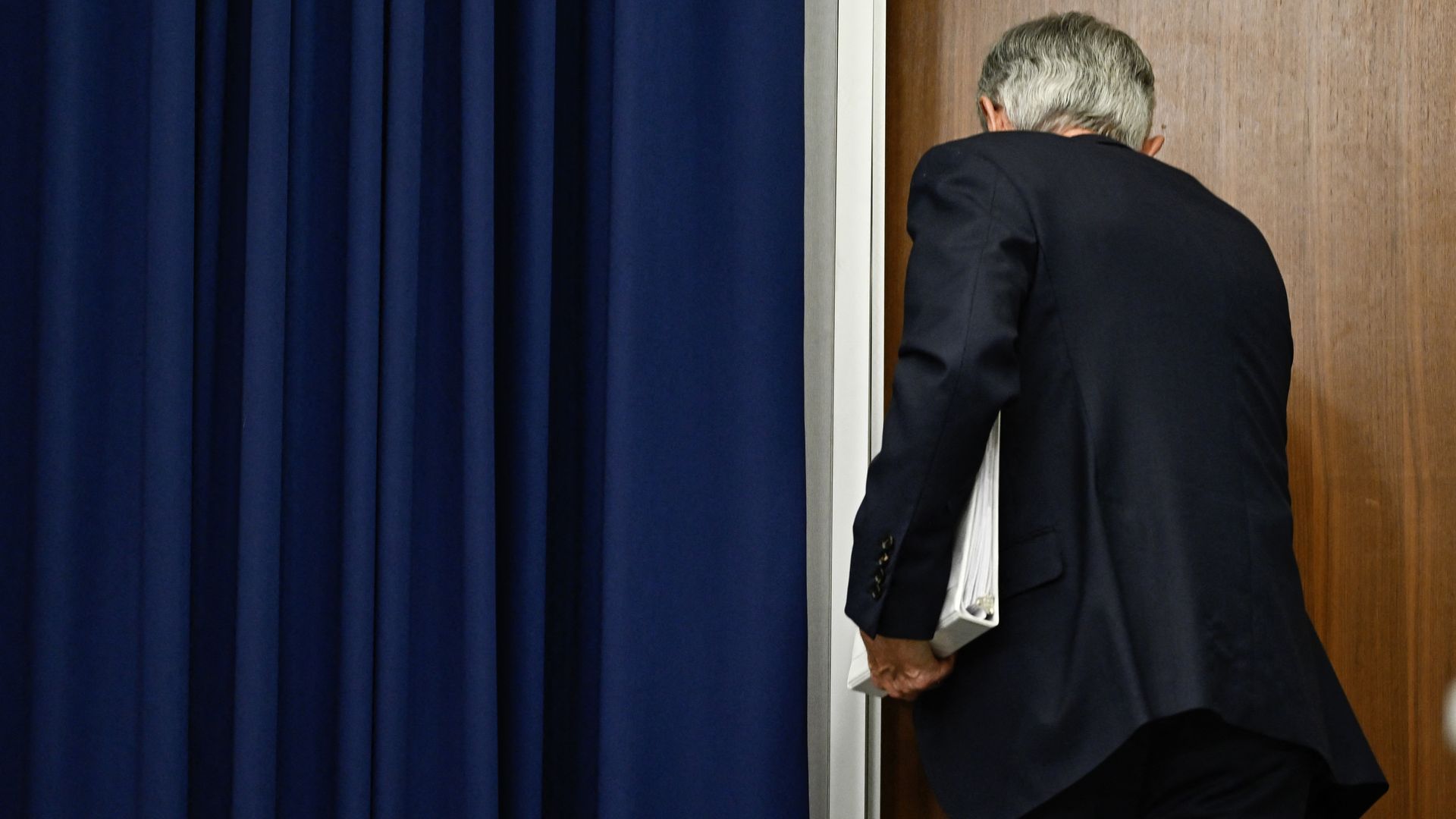
Federal Reserve chair Jerome Powell exits his final press conference. Photo: Kent NISHIMURA / AFP via Getty Images
When Kevin Warsh takes over as Federal Reserve chair, he will face vocal internal opposition to any attempts to cut rates prematurely.
- His predecessor will also still be roaming the halls.
Why it matters: Taken together, Wednesday's news out of the William McChesney Martin Jr. Building means that Warsh will face serious constraints if he wants to rapidly steer the Fed in ways that its current leadership believes unwise.
- He will have to achieve his goals of rewiring how the Fed operates and potentially cutting rates through persuasion, not a writ from the chair's office.
- That has always been true, but the outbreak of dissent to Wednesday's policy statement, combined with Jerome Powell's move to block President Trump from immediately filling his governor's slot, now make it particularly vivid.
Driving the news: On monetary policy, three presidents of reserve banks dissented against language in the Fed policy statement implying the next move will be an interest rate cut.
- Beth Hammack (Cleveland), Neel Kashkari (Minneapolis) and Lorie Logan (Dallas) evidently preferred more symmetrical language that would preserve the possibility that the next move will be a rate hike.
- Combined with governor Stephen Miran's dovish dissent (favoring a rate cut), the four dissents were the most since October 1992.
Between the lines: Hawkish sentiment has bubbled beneath the surface of the Federal Open Market Committee for months, including in November-December, when several officials expressed serious misgivings about a rate cut.
- At the December meeting, Powell was able to bring all but two officials (Chicago Fed's Austan Goolsbee and Kansas City's Jeff Schmid) on board for a rate cut, but fears that the central bank is overly focused on easing boiled over Wednesday.
- With inflation in its sixth year tracking well above the Fed's 2% target — even before the energy price surge due to the Iran war — they see a risk that the underlying path of inflation is resetting higher, particularly given solid growth and a stable job market.
- If three committee members were ready to dissent over subtleties of language in the policy statement, it implies that Warsh would face substantial opposition if he sought rate cuts absent a turn in the data to more clearly justify them.
What they're saying: "Intellectually one can argue the Fed should ignore tariff and oil induced inflation, but in practice Warsh will be hard pressed to get a majority of the FOMC to vote for rate cuts when core and headline PCE are running above 3% and GDP growth is holding firm at 2%," Stephen Coltman, head of Macro at 21shares, wrote in a note.
- "The dissents in the FOMC statement [Wednesday] were a clear message for Warsh in this regard."
Zoom out: Powell couched his decision to remain on as a governor for an unspecified period of time as being about guarding the Fed's vaunted independence.
- Staying will give him leverage in the event the Trump administration reopens its criminal investigation over building renovations that a federal judge has called a blatant pretext or finds some new ways to pressure the central bank.
- And Powell made clear that he intends to keep a "low profile." He even physically mimicked shrinking behind his lectern in maybe the funniest moment ever to occur at a Fed press conference. He does not envision becoming a dissident thorn in Warsh's side.
Yes, but: His continued presence prevents a new Trump appointment, leaving Biden appointees with a 4-3 majority on the Board of Governors for the time being (counting Powell, who was appointed chair by both Trump and Biden, as in the latter category).
- Powell and the other Biden-appointed governors are likely to show deference to the new chair, but it won't be unlimited.
The bottom line: Warsh is about to step into one of the most powerful jobs on earth.
- But his ability to achieve his goals will come down to his ability to persuade the holdover Board of Governors and FOMC that they're on the right path for the economy and the institution he will soon lead.
