What to expect from Fed chair Kevin Warsh


Add Axios as your preferred source to
see more of our stories on Google.
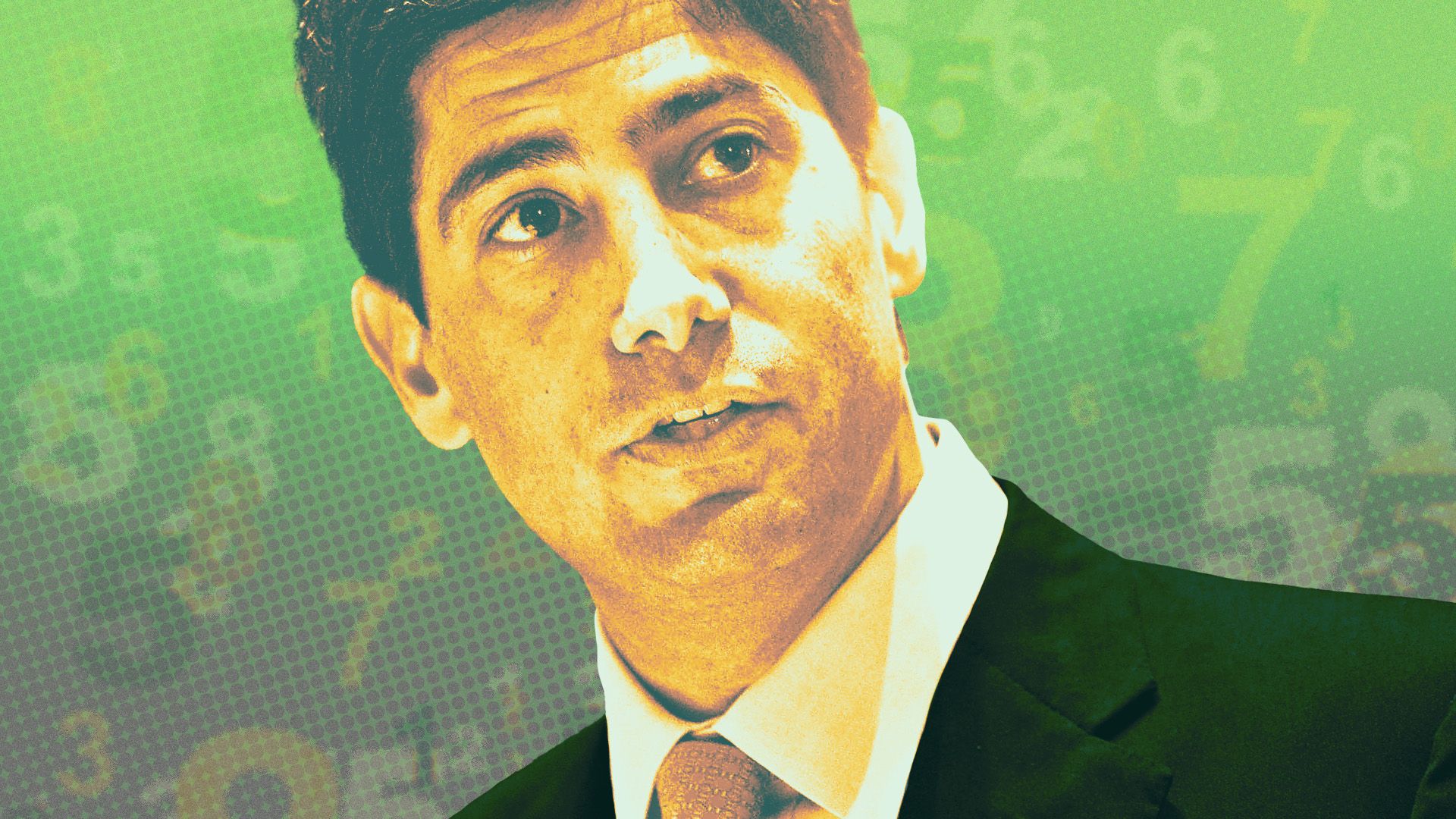
Photo illustration: Sarah Grillo/Axios. Photo: Jin Lee/Bloomberg via Getty Images
Deeply skeptical of what he sees as groupthink at the Federal Reserve, Kevin Warsh wants to shrink its multitrillion-dollar imprint in the financial system and sees a growth-driven reason to cut short-term interest rates.
The big picture: If President Trump's pick to lead the Fed is confirmed, expect Warsh to challenge central banking orthodoxy.
- "The Fed is an institution whose reach has extended far beyond its grasp," Warsh wrote in November.
- In a speech last year, he criticized the notions of "data dependence," "near-term forecasting" and "forward-guidance" — all key elements of how modern central banks do their work.
Flashback: Warsh resigned as a Fed governor in 2011 as the central bank undertook its second quantitative easing program, buying hundreds of billions of dollars in bonds to try to prop up a faltering recovery.
- The Fed returned to the QE strategy in both the years that followed and again when the COVID-19 pandemic hit in 2020.
- Opposition to the central bank's swelling balance sheet — now at $6.6 trillion — has been a through line of Warsh's commentary on that period.
- He has been critical of the rationale for those programs, which he characterizes as a kind of false precision by central bankers who were overly confident in their ability to fine-tune the economy.
Zoom out: He blames the inflation outbreak of 2021-2022 on the Fed, seeing it as a consequence of the pandemic QE program and the vast fiscal spending it helped accommodate.
- "When the Federal Reserve prints trillions, especially in benign times, it changes everything," Warsh said in a podcast interview last summer, "And it is almost a signal to the rest of Congress, 'We're doing it, and so can you.'"
Zoom in: A smaller balance sheet would clear the way for lower short-term interest rates without allowing excessive inflation, he contends.
- "The Fed's bloated balance sheet, designed to support the biggest firms in a bygone crisis era, can be reduced significantly," he wrote in November. "That largesse can be redeployed in the form of lower interest rates to support households and small and medium-size businesses."
- He further believes that the Trump administration's tax and deregulatory policies, along with AI advances, are unleashing huge productivity gains that give the Fed room to cut interest rates without stoking inflation.
Reality check: Much of the Fed's balance sheet — $2 trillion as of this week — consists of mortgage-backed securities. If the Fed aimed to unload them more quickly than it has already, it would drive home mortgage rates higher.
- Moreover, in the Fed's current policy framework, excessive balance sheet shrinkage can lead to disruption in the money markets and cause the Fed to lose control of the short-term rates it targets.
- This happened in 2019. In the last two months, the Fed has expanded its balance sheet to keep it from happening again.
- In other words, to achieve the balance sheet reduction he seeks without disrupting the economy, Warsh will need some creative answers and will need to persuade his colleagues at the Fed that there is a better way to execute monetary policy.
The defining moments of Warsh's career were as a Fed governor during the 2008 financial crisis, when he was at the side of then-chair Ben Bernanke as first responders to a global catastrophe.
State of play: Warsh has since become a stark critic of the central bank interventionism that crisis unleashed, seeing it as having sent the Fed down an unfortunate path.
- He has cited the Fed's rescues during the pandemic in 2020 and of regional banks in 2023 as examples of mission creep.
What they're saying: "Each time the Fed jumps into action, the more it expands its size and scope, encroaching further on other macroeconomic domains," he said in a speech last year.
- "More debt is accumulated, more capital is misallocated, more institutional lines are crossed, risks of future shocks are magnified, and the Fed is compelled to act even more aggressively the next time," he told the Group of 30 global financial leaders.
- "Simply stated, path dependency is driving policy," Warsh continued. "We need to be careful that it's not driving into a ditch."
Between the lines: Those convictions could be put to the test if Warsh, as Fed chair, encounters a crisis of his own, whether a popping of the AI bubble or the collapse of a major cryptocurrency.
- In hypothetical scenarios like those, it's easy to imagine key Trump allies seeking help from the Fed — and thus testing Warsh's anti-bailout convictions.
