Supreme Court narrows voting law, lifting GOP odds of keeping House

Add Axios as your preferred source to
see more of our stories on Google.
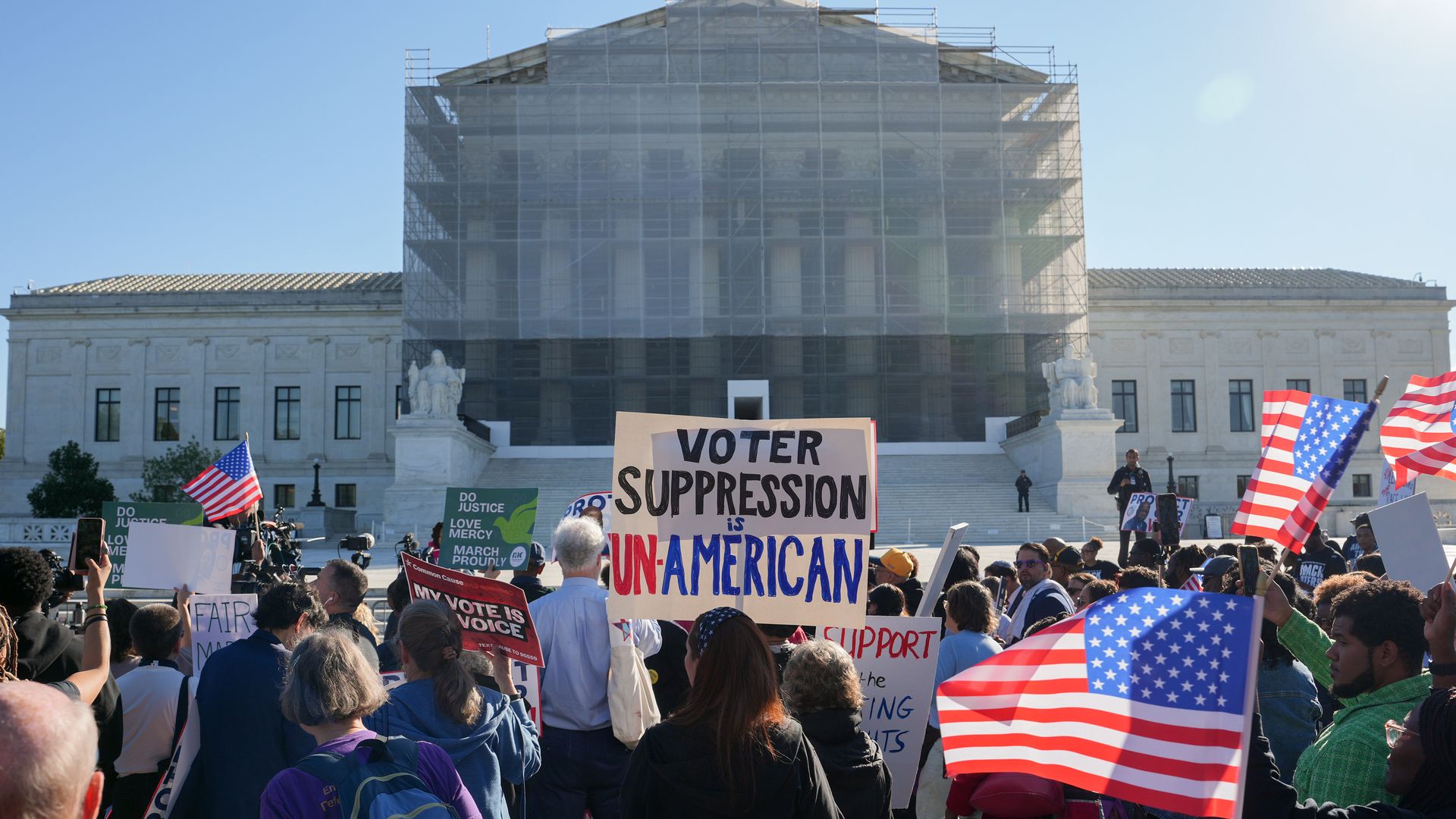
Demonstrators outside the US Supreme Court in Washington, DC, US, on Wednesday, Oct. 15, 2025. Photo: Eric Lee/Bloomberg via Getty Images.
The Supreme Court limited a key provision of the Voting Rights Act Wednesday, handing a loss to civil rights groups.
Why it matters: The ruling could reshape voting all across the South and could boost the Republican majority in the House by an additional 19 seats when compared to 2024 maps.
- The Louisiana v. Callais ruling does not erase Section 2 of the Voting Rights Act, but it effectively neuters it. The court rewrote the test used to apply Section 2 in such a way that it can only take effect as long as protected seats don't infringe on the right of state lawmakers to draw partisan gerrymanders.
Driving the news: In a majority opinion, Justice Samuel Alito said that "because the Voting Rights Act did not require Louisiana to create an additional majority-minority district, no compelling interest justified the State's use of race in creating SB8, and that map is an unconstitutional racial gerrymander."
The big picture: The court effectively narrowed Section 2 of the civil rights law, which prohibited racially-discriminatory gerrymandering.
- Section 2 helped end Jim Crow laws and expanded voting protections for people of color across the South, particularly for Black Americans.
Yes, but: Some opponents of the law have said that because the 14th Amendment limits the use of race in redistricting, using Section 2 to remedy racially discriminatory maps is, in fact, racial gerrymandering.
- Partisan gerrymandering was already a shield in racial-gerrymandering cases: Lawmakers could argue they drew GOP maps, not anti-Black ones.
- The Callais decision goes further. It says partisan goals can also help protect maps against Voting Rights Act lawsuits.
Catch up quick: Louisiana has been locked in a bitter court feud over its congressional maps since 2020, with civil rights groups, lawmakers and other interested parties jockeying to implement new districts.
- Black voters, which make up roughly 30% of the state's population, successfully sued to add a second majority-Black district in Louisiana in 2022, arguing that they were underrepresented.
- Lawmakers updated their maps in response, but a group of non-Black voters sued the state after, accusing lawmakers of relying too heavily on race to create the new maps.
- A three-judge panel agreed in 2024, setting the stage for the High Court's ruling.
Zoom in: "Section 2 of the Voting Rights Act of 1965 was designed to enforce the Constitution — not collide with it," Alito wrote.
- "Unfortunately, lower courts have sometimes applied this Court's §2 precedents in a way that forces States to engage in the very race-based discrimination that the Constitution forbids."
The other side: In a dissent, Justice Elena Kagan argued that the majority opinion "threatens a half-century's worth of gains in voting equality."
- "Under the Court's new view of Section 2, a State can, without legal consequence, systematically dilute minority citizens' voting power," she wrote.
- "The Callais requirements have thus laid the groundwork for the largest reduction in minority representation since the era following Reconstruction."
Worth noting: Florida Gov. Ron DeSantis was betting on the Supreme Court's decision to aid his own mid-decade redistricting push, assuming the high court would strike down the civil rights law before it even issued its ruling.
- The ruling doesn't erase Florida's separate ban on partisan gerrymandering.
- Unlike in other states, Florida lawmakers can't simply defend a map by saying they drew it for partisan gain — unless state courts also accept DeSantis' broader argument that the entire Fair Districts Amendment no longer applies.
What they are saying: The Voting Rights Act "was the guardrail," April Albright, of advocacy group Black Voters Matter told Axios' Chelsea Brasted in December.
- Its demise means that "there's nothing left, because most of these red states also don't have robust protections for voting rights in their own state constitutions."
Go deeper: How a Supreme Court case could reshape the South's congressional representation
Editor's note: This story has been updated with additional reporting throughout.
