Trump-aligned think tank goes after hospitals

Add Axios as your preferred source to
see more of our stories on Google.
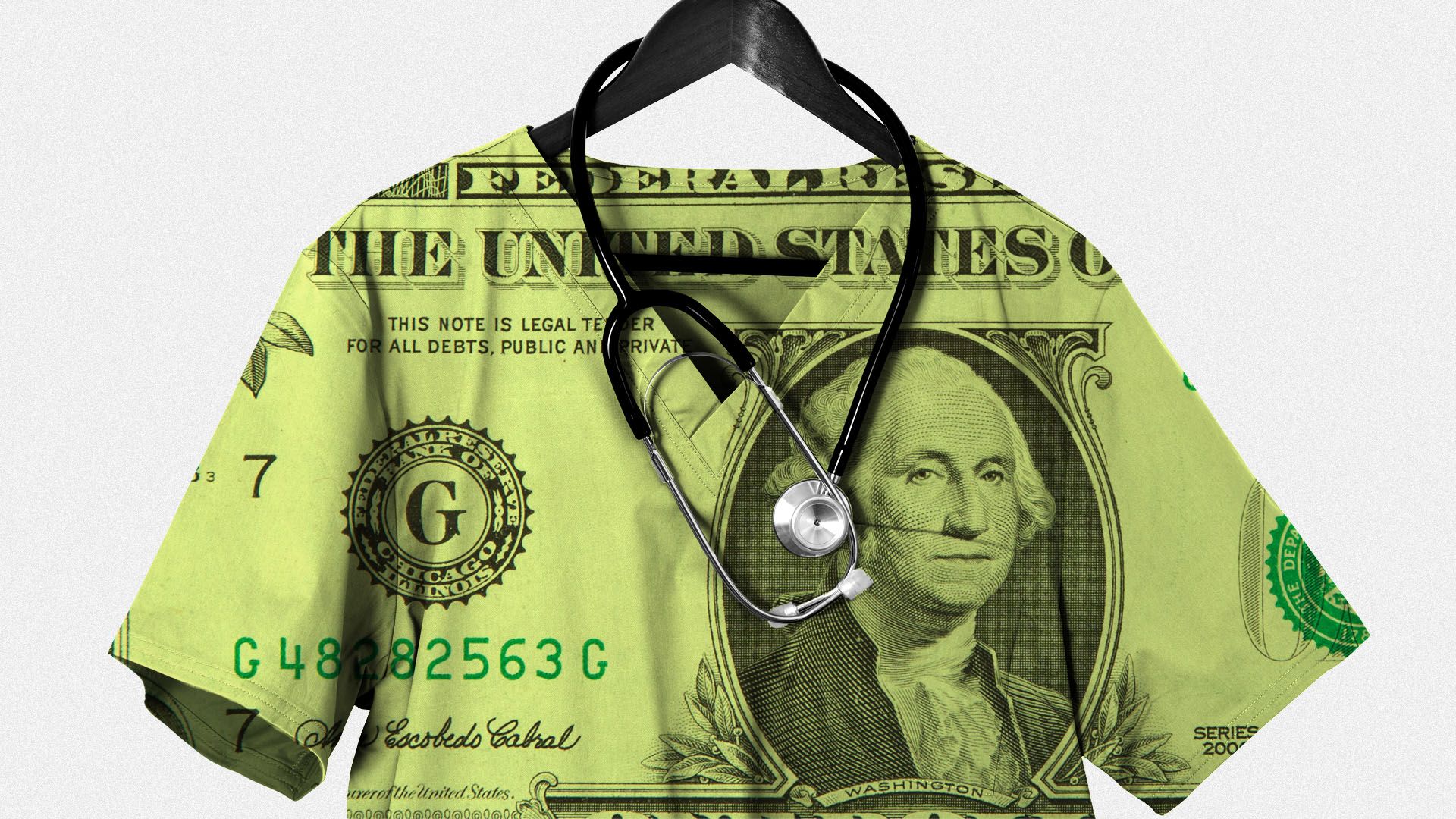
Illustration: Sarah Grillo/Axios
Washington's anti-hospital animus is gaining momentum with new calls to crack down on federal financing of hospitals coming from a think tank with close ties to the Trump administration.
Why it matters: It's becoming apparent on both sides of the aisle that addressing health care costs means addressing their largest driver: Hospitals.
Driving the news: The Paragon Health Institute, a conservative think tank led by first-term Trump health official Brian Blase, released a report on Wednesday titled, "The Hospital Cost Crisis: How Government Policies Drive Consolidation, Undermine Competition, and Fuel Soaring Prices."
- It dismantles several of hospitals' most common arguments about their finances, concluding that "hospitals are not broadly financially distressed."
- It also disputes the industry's longtime claim that facilities lose money treating Medicare and Medicaid patients — an argument often used to justify charging commercially insured patients more for services.
- And it argues that in many cases, federal policy overpays hospitals, gives them a competitive edge against other health industry players, and encourages consolidation while promoting inefficiencies.
- Paragon played a significant role in shaping the Medicaid overhaul that was included in last year's Republican budget bill, in a sign of its clout on Capitol Hill.
Details: The paper calls for greater scrutiny of "direct subsidy programs" like provider taxes, state-directed payments, and certain Medicare and Medicaid payments, saying such programs are "extensive, opaque and poorly targeted."
- It also calls for the enactment of site-neutral payment changes in Medicare, so that hospital-owned outpatient departments aren't paid any more than doctors' offices not owned by hospitals. And it calls for overhauling the federal 340B drug discount program.
- And it suggests that Congress should tie nonprofit hospitals' tax-exempt status to "measurable and actual charity care instead of vaguely defined 'community benefit.'"
Between the lines: Paragon's view is that excessive government intervention has created lasting problems in hospital markets that call for at least partially scaling back federal intervention.
- Left-leaning groups like the Center for American Progress have countered that more intervention — including price controls — is necessary to remedy market failures, especially consolidation.
- Both approaches would potentially have a drastic impact on hospitals' finances.
The other side: Hospitals have a dramatically different view, generally arguing that the industry as a whole is strained and highly sensitive to the kinds of changes that Paragon is pushing.
- The most recent report from Kaufman Hall, a hospital-friendly consulting firm, concluded from February data that "cost pressures are driving a tenuous financial outlook," though there's "significant variation in hospital performance by size, geography, and market position."
- And there are plenty of examples of hospitals around the country that have closed or eliminated business lines like maternity care or behavioral health care.
What we're watching: Voters' concerns with health care affordability are forcing the policy world to at least consider what can be done to lower costs.
- But think tank white papers or even congressional hearings are easy compared to actual legislating, especially when nearly every member of Congress has a hospital in their district that they have an interest in keeping open.
- Even the threat of disruption to constituents' care — regardless of how realistic that threat is — means talk of change is sure to meet tremendous political resistance.
