Your tax dollars are helping House members get reelected

Add Axios as your preferred source to
see more of our stories on Google.
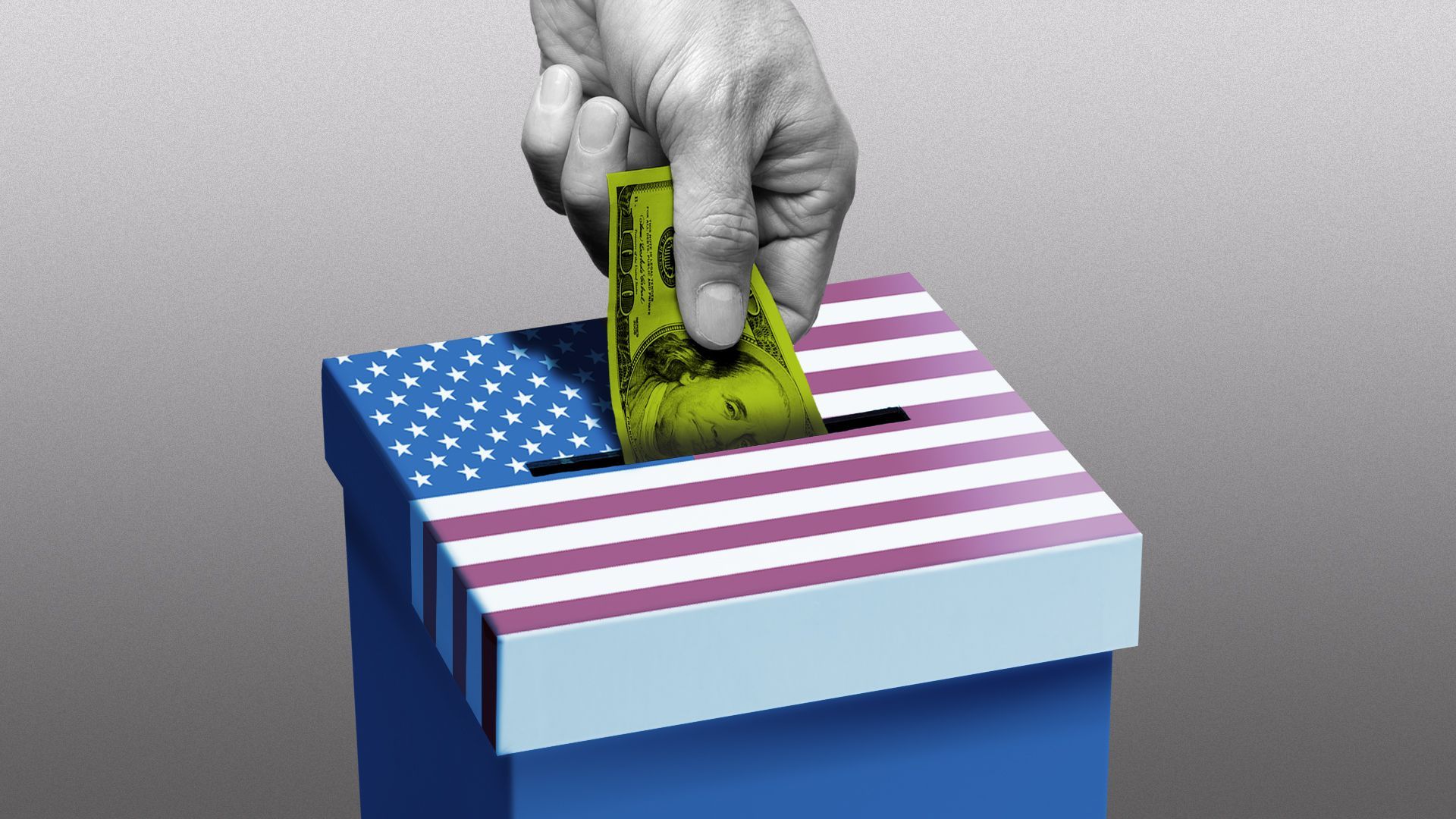
Illustration: Sarah Grillo/Axios
Keep a close eye on the ads that inundate your screens as the 2026 midterm elections heat up. You, the taxpayer, paid for some of them.
Why it matters: Each election cycle, incumbent House members use a privilege called "franking" to put millions in taxpayer dollars towards giving their reelection campaigns a thinly veiled boost.
- In the 2024 election cycle, House offices spent a combined $44 million on franked mail and another $19 million on other forms of franked communications such as ads, an Axios analysis of congressional disbursement forms found.
- According to the advertising spending tracker AdImpact, around $5 million of that was spent on television and digital ads, which are marked as "paid for with official funds authorized by the House of Representatives."
- Franking is a practice that dates back to the founding as a means of letting lawmakers keep constituents informed about their work. But increasingly the biggest spenders are running in hotly competitive elections.
State of play: Most House members who have blanketed the airwaves with taxpayer funded ads this election cycle fall into one of three groups.
- Battleground-district members: Reps. Tom Barrett (R-Mich.), Laura Gillen (D-N.Y.), Mariannette Miller-Meeks (R-Iowa), Henry Cuellar (D-Texas), Nick Begich (R-Alaska), Sharice Davids (D-Kansas) David Valadao (R-Calif.), Kristen McDonald-Rivet (D-Mich.) and Susie Lee (D-Nev.).
- Higher office seekers: Reps. Robin Kelly (D-Ill.), Wesley Hunt (R-Texas), Mike Collins (R-Ga.), Josh Gottheimer (D-N.J.) and Nancy Mace (R-S.C.).
- Primary targets: Reps. Shri Thanedar (D-Mich.) and Reps. Grace Meng (D-N.Y.), Brad Sherman (D-Calif.), John Larson (D-Conn.), Dan Goldman (D-N.Y.) and Steve Cohen (D-Tenn.).
Does this sound like an official congressional communication, or a political campaign spot?
How about this one?
By the numbers: House members have spent nearly $1.4 million in official congressional funds running ads like those since the start of the 2026 cycle, according to AdImpact.
- That number is poised to increase drastically ahead of competitive primaries and the Nov. 3 general election date.
- It's not just not just video ads: House members can use franked funds to pay for billboards, digital ads, robo-calls, texts and radio ads.
- Under federal law, members can send out these unsolicited mass communications until 60 days before their next election — called a "blackout period."
Yes, but: Even then, there are tricky little work-arounds.
- Former Rep. Carolyn Maloney (D-N.Y.) faced public scrutiny for sending just under 500 franked mailers a day in the run up to her 2022 primary — narrowly skirting the limit that would qualify them as prohibited mass communications under blackout rules.
- Ethics experts concluded Maloney's actions, commonly known as the "499 rule," were in line with the letter of the law if not the spirit of it.
What they're saying: Ethics watchdogs told Axios this practice hurts Congress' extraordinarily low standing in the public eye.
- "While PSAs about constituent services have their place, it's unlikely that many taxpayers would want politicians to spend public funds on shameless self-promotion," said Michelle Kuppersmith, the executive director of Campaign for Accountability.
- Stuart McPhail, director of campaign finance litigation at Citizens for Responsibility and Ethics in Washington, told Axios the mandatory disclaimer for franked communications was even watered down in 2021 from "paid for at taxpayers' expense" to "paid for with official funds."
- "Using franked mail for campaign purposes would be the same as walking down to the treasury and taking a few gold bars to contribute to your campaign," McPhail said. "It's stealing ... and should be prohibited."
The other side: "All members have the same budget, and I just put a lot of weight on communications because when I was a constituent I always felt I didn't really hear much from my member of Congress," Thanedar told Axios.
- The Michigan Democrat added that "people are very hungry for information, especially when there is so much concern about prices going up and what are we doing with ICE, the corruption."
- Constituent calls spike in response to franked ads, according to Thanedar, who said his voters "appreciate that and thank me all the time."
What to watch: House Administration Committee ranking member Joe Morelle (D-N.Y.) told Axios this issue has been on his radar and will be on his agenda if Democrats take the House in November.
- "People will say, 'This is an ad paid for by the United States Congress?'" Morelle said of the franked ads some of his colleagues are running.
- "Next year ... I want a review of this, in a bipartisan way, to see if we can't tighten up what I think are some things that are really on the edges of what is appropriate."
