Trump says he won't call Iran conflict a war. He keeps doing it anyway.

Add Axios as your preferred source to
see more of our stories on Google.
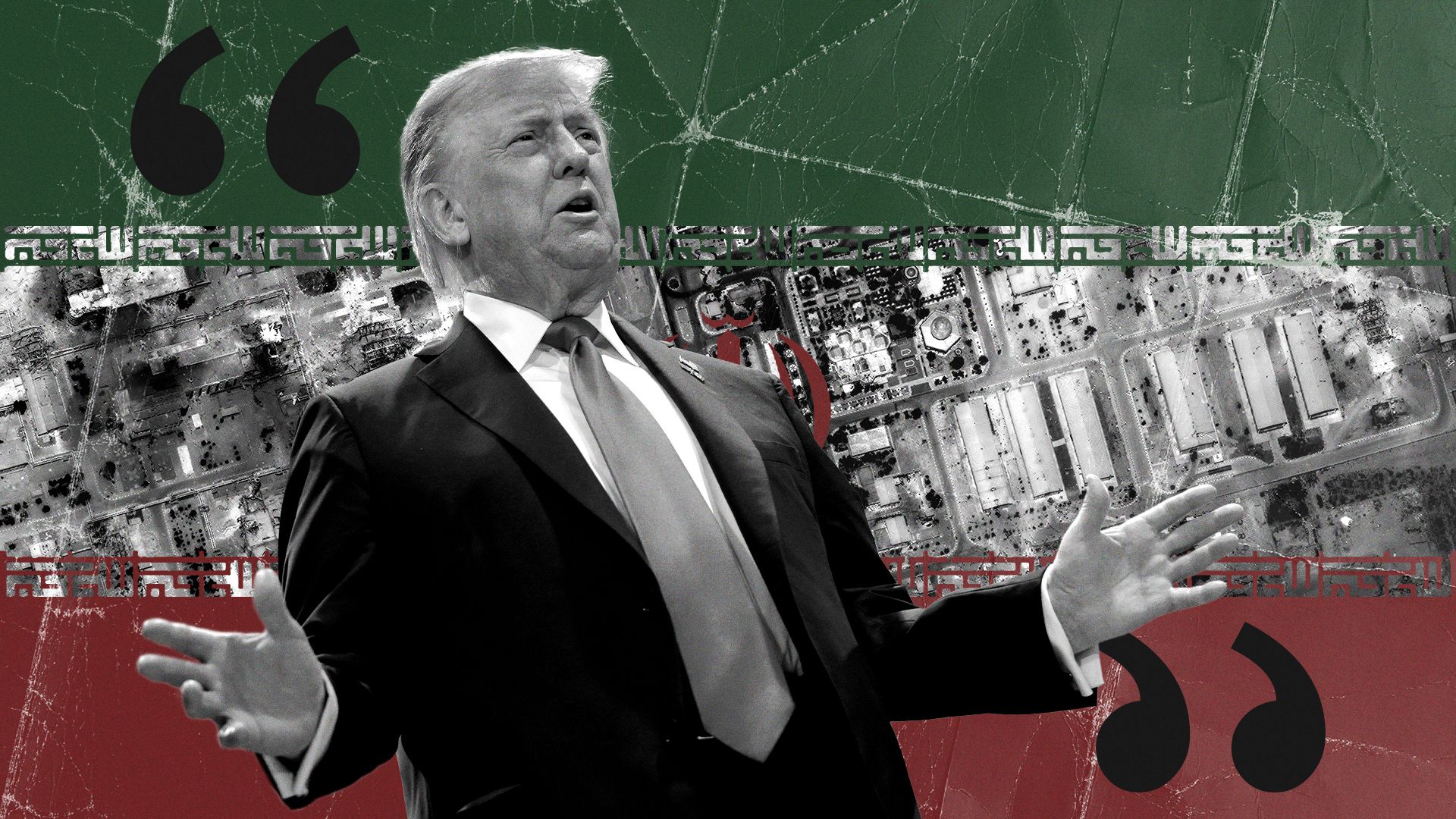
Photo illustration: Allie Carl/Axios. Photos Chip Somodevilla and Maxar/Getty Images
President Trump said Wednesday he won't call the conflict in Iran a "war" because "you are supposed to get approval," suggesting the label itself could trigger congressional authority the administration says it doesn't need.
The big picture: But the fiery operation has been widely characterized as a war (one that's cost hundreds of lives and billions of dollars), including by the president himself as recently as Thursday.
- The comment is the latest example of the administration sending mixed signals about the U.S. goals and timeline of the war.
Driving the news: "They say, 'if you use the word 'war', that's maybe not a good thing to do,'" he said at an event for House Republicans' campaign arm, instead calling the conflict a "military operation" and a "military decimation."
- But in that same speech, he used the word "war" to describe the military offensives in Venezuela and Iran, saying the Iran "war essentially ended a few days after we went in."
- During Monday remarks in Memphis, Trump said Democrats call it "a war," and "we call it a military operation."
- He also applauded his team's decision to rebrand the secretary of defense to the secretary of war, saying "we like the sound of it better."
Friction point: Behind the semantics scuffle is a broader debate over war powers playing out on the Hill.
- Congress has the sole power to declare war, but presidents have initiated military action without formal congressional approval — and have faced lawmaker pushback for doing so.
- The War Powers Resolution requires the president notify Congress within 48 hours of deploying troops without a declaration of war or other authorization. It generally limits unauthorized military action to 60 days.
Lawmakers have tried, and so far failed, to rein in Trump's ability to wage war with Iran.
- Trump has said the "War Powers Act is Unconstitutional," and Vice President JD Vance has painted it as "fundamentally … fake."
Zoom out: Press secretary Karoline Leavitt said Wednesday that a congressional authorization was unnecessary because "we're currently in major combat operations in Iran" on a four- to six-week timeline.
- House Speaker Mike Johnson has also rejected the idea that the U.S. is at war, arguing the operation is narrowly tailored.
- Rep. Cory Mills (R-Fla.) argued on "CNN This Morning" Thursday that Operation Epic Fury is "not actually a war."
- But others have used the W-word. Rep. Nancy Mace (R-S.C.) wrote on X Wednesday, "The longer this war continues, the faster it will lose the support of Congress and the American people."
Worth noting: Trump has used a number of words to describe the mission, including:
- "Major combat operations," as he said in a video announcing initial strikes;
- "A little excursion" as he told Fox News' Brian Kilmeade;
- "Both" an excursion and a war, or, "an excursion that will keep us out of a war," he said in response to a reporter inquiry earlier this month;
- "OUR HOSTILITIES [with Iran] IN THE MIDDLE EAST," as he wrote on Truth Social;
- A "war" that "has been won," as he said Tuesday, and that is "going great," as he told Axios' Barak Ravid.
What they're saying: White House spokesperson Anna Kelly didn't directly answer Axios' question on if the president believes the U.S. is "at war" with Iran. However, she said Trump has answered that question in his own remarks.
- She also said the "operation will conclude" once Trump believes the military has met benchmarks.
The bottom line: Trump's war messaging has been fractured across his many public statements.
- Earlier this month, he told CBS News the war was "very complete." But on Wednesday, he wouldn't even call it a war.
Go deeper: Trump's Iran war messaging is all over the map
Editor's note: This story has been updated with comment from the White House.
