Minneapolis training facility is a key test for police reform settlement

Add Axios as your preferred source to
see more of our stories on Google.
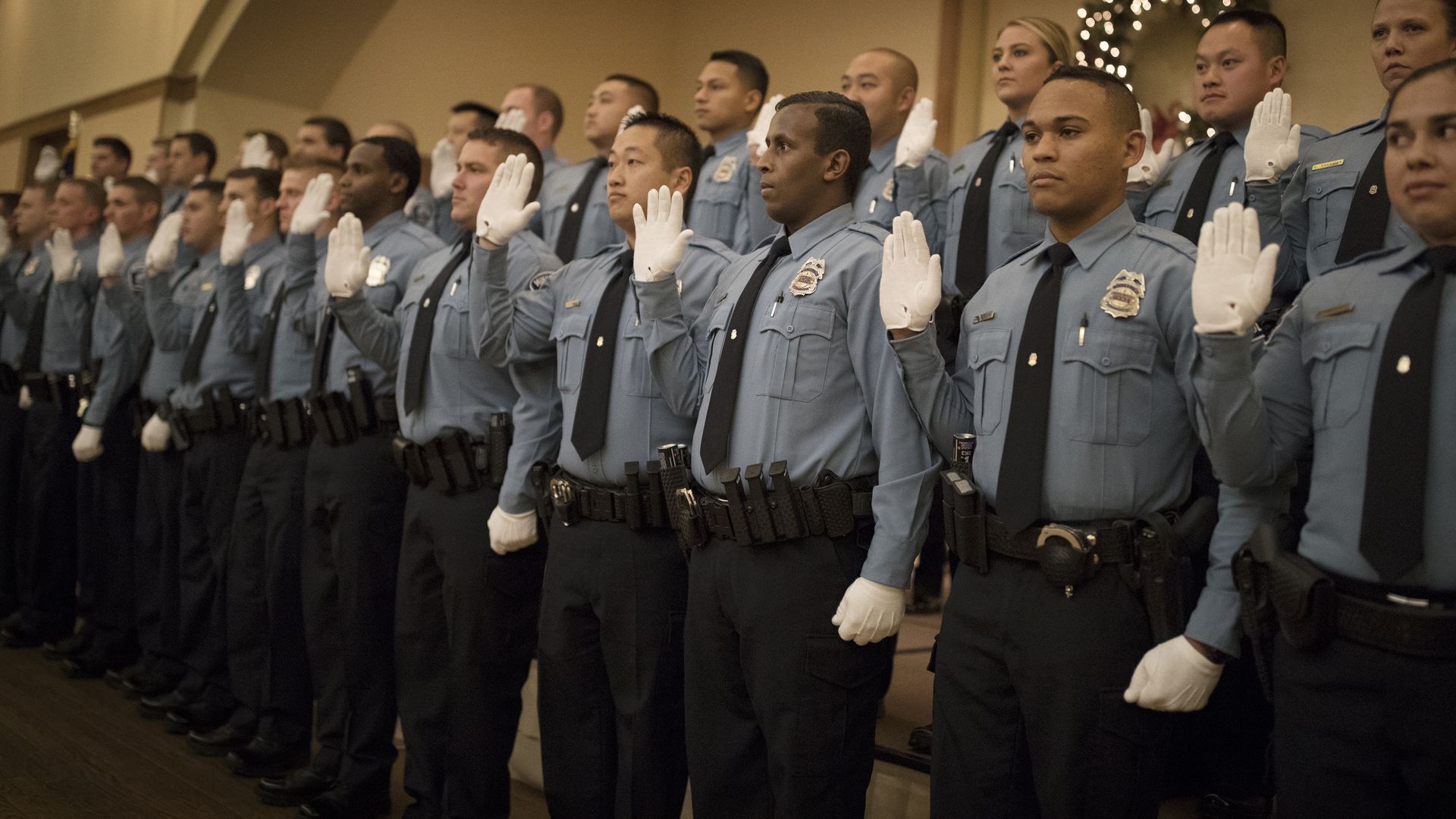
Members of a 2016 Minneapolis Police Department Academy graduating class are sworn in. Photo: Jerry Holt/Star Tribune via Getty Images
Minneapolis City Council members will consider a $38 million training facility for police, firefighters and other first responders on Tuesday.
Why it matters: The proposal is shaping up to be the hardest lesson yet on what a court-enforceable MPD reform plan — meant to reshape the department in the wake of George Floyd's murder — will cost Minneapolis.
- Opponents are digging in. They're calling the proposal "Cop City 2.0," echoing a moniker for a similar facility in Atlanta that sparked years of lawsuits, protests and violent clashes that drew national attention.
State of play: This week, Mayor Jacob Frey's administration is asking the council to kick off the project by approving $6.1 million to buy an industrial parcel near the former Wild Mind brewery, in the Windom neighborhood.
What they're saying: Proponents argue the project would tick two huge boxes in MPD's reform settlement, which calls for improved training and wellness facilities.
- "Looking 10 years down the road — where you're trying to sustain the reform — I don't know how you do that without this facility," Minneapolis Community Safety Commissioner Toddrick Barnette told Axios.
The other side: Many council members already voted against the project during December's budget markup, and reversing themselves would require clawing back money they already allocated for pedestrian safety initiatives.
- "There are more cost-effective ways to actually get at the needs, not the wants, of the police department," Council Member Robin Wonsley told reporters last week.
Between the lines: In a narrow legal sense, MPD's court settlement does not require the new training facility.
Reality check: Practically, the city is "fairly boxed into it," said Alex Uballez, a former U.S. Attorney for New Mexico who briefly oversaw Albuquerque's police reform plan.
- Uballez noted Minneapolis' settlement ordered outside reviews that found MPD's training academy is "not conducive to modern police training" and recommended building a "one-stop shop for all training activities."
- Minneapolis could build, retrofit or lease other facilities to address deficiencies — but the city's court-appointed monitor has already said the proposed all-in-one training center would bring MPD into compliance.
The big picture: The proposal highlights a common critique of reforming police through the courts: Nationally, legal settlements have spurred many tangible purchases for departments that don't guarantee cultural change.
- "Training is not a waste of time," University of St. Thomas law professor Rachel Moran told Axios. "But I do question when we only focus on training … as opposed to improving accountability systems or improving the way we handle discipline and complaints."
Uballez shares this concern, but he also noted better training can improve police department culture.
Zoom in: Current facilities limit MPD's ability to stage the "scenario-based" trainings the reform settlement envisions.
- Uballez noted this "crucial" training is meant to allow trainees to develop "the muscle memory of correctly responding in high-stress scenarios" before they go into the field.
Plus: "The better you are at cross-training" first responders, Barnette told Axios, "the better response you will have."
Friction point: Despite the inclusion of other frontline agencies, council critics call the current proposal a "pet project of MPD" that's been on the police department's wish list for years.
- Wonsley argued MPD could address the settlement's requirements by leasing space in existing police training centers in the metro.
Yes, but: Barnette visibly bristles at the "Cop City" critique.
- He argues that the city's inclusion of other agencies in the training center goes beyond what the settlement agreement requires.
- "They can't get their heads around the fact that having one facility for all of the community safety departments is the national trend," Barnette said.
