Trump faces limited gas-price options on Iran

Add Axios as your preferred source to
see more of our stories on Google.
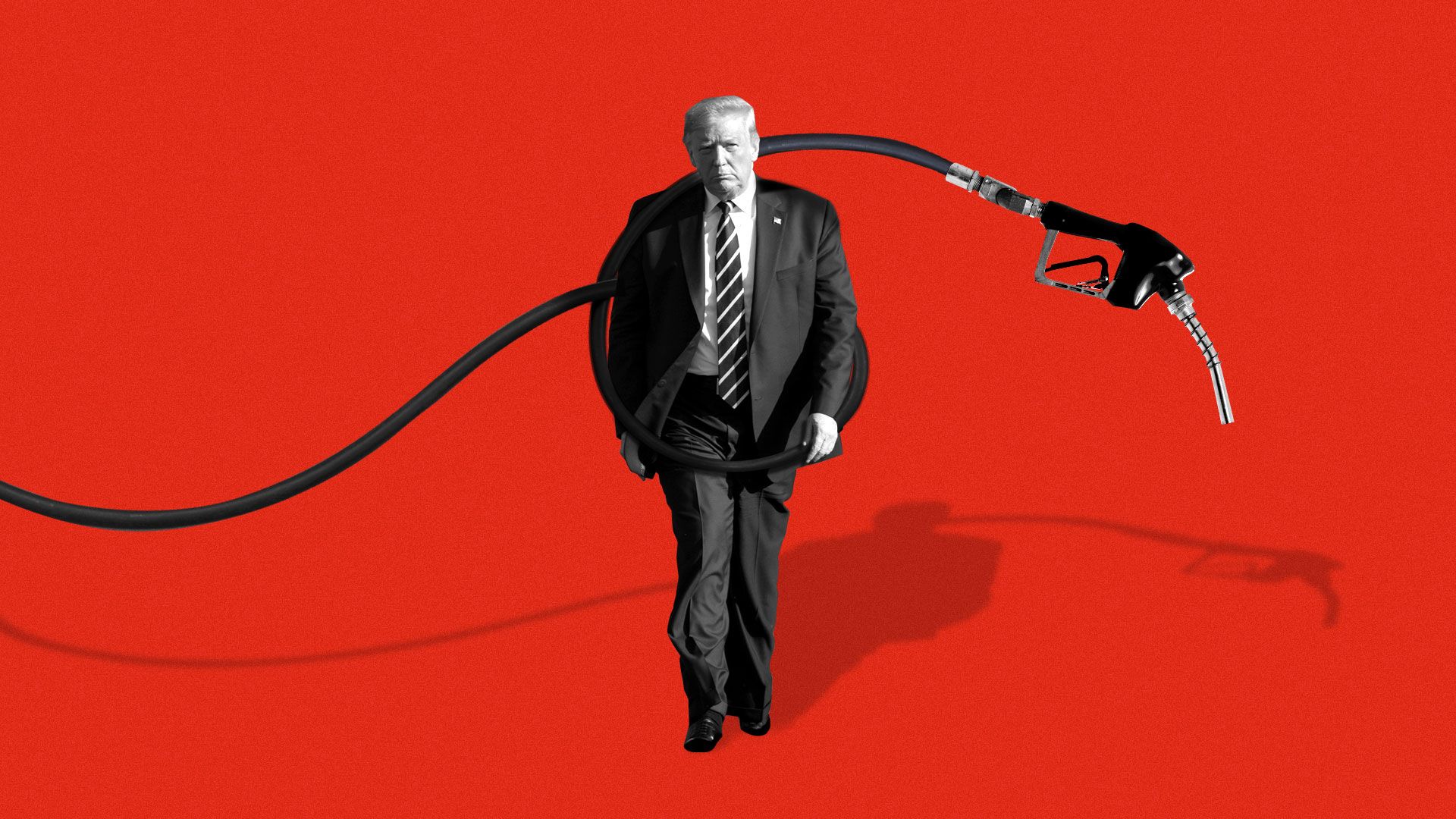
Illustration: Eniola Odetunde/Axios
Plans for historically large releases from emergency oil stockpiles reveal the scope of the energy crisis — and the market response reveals President Trump's limited options for tackling it.
Why it matters: The 400-million-barrel infusion over time from International Energy Agency member countries — including a big dose from U.S. holdings — likely won't push prices down by itself.
- It's one part of a toolkit that can help put more supplies on the market.
- But nothing will approach normal until the resumption of large-scale tanker traffic through the Strait of Hormuz, off Iran.
Tapping reserves "will slow rather than stop rising oil prices and offer a temporary salve to the searing burn of rising gasoline prices," RSM Chief Economist Joe Brusuelas said in a blog post.
- Average U.S. gas prices on Wednesday were $3.58 per gallon, up 38 cents over the last week, per AAA.
Catch up quick: The IEA-coordinated initiative is over twice as large as 2022 releases after Russia invaded Ukraine, the biggest ever at the time.
- But oil prices ended higher Wednesday after more volatile trading, despite IEA's morning announcement.
- That reflected "official recognition that the Hormuz crisis has become serious enough for the industrialized world to liquidate one-third of its oil insurance policy," ClearView Energy Partners said in a note.
State of play: The U.S. contribution will be 172 million barrels from the Strategic Petroleum Reserve starting next week and lasting for roughly 120 days, the Energy Department said.
- The specifics of other countries' plans under the IEA initiative are still coming into focus.
Zoom in: The U.K. is planning a 13.5-million-barrel release, and France said its contribution would be 14.5 million.
- The WSJ, citing a European energy minister, reported that Japan will provide 30.5 million barrels, Canada 23.6 million and Germany 19.5 million, with other IEA members offering smaller volumes. Japan's planned release from private and national stockpiles combined will reportedly be larger.
- Emergency supplies will come into the market "over a timeframe that is appropriate to the national circumstances" of IEA members, the agency said.
What we're watching: Other ongoing or potential White House efforts to loosen up the market.
- That includes offering U.S.-backed tanker insurance, limited waivers of sanctions on Russia, pledges of eventual military escorts through the Strait, and jawboning U.S. producers to pump more.
- Trump could also invoke a Cold War-era law to allow Sable Offshore to quickly resume production off California, Bloomberg reported while noting the amounts would be relatively modest.
Reality check: It's an unprecedented energy shock.
- There's no getting around the loss of roughly 15 million barrels per day of crude and another 5 mbd of oil products that move through the waterway — about 20% of the global market.
- And that de facto closure is also prompting several Gulf producers to cut output as storage space gets tight.
- "The U.S. consumes roughly 20 million barrels of oil per day. Even the most aggressive release, like in 2022, amounts to only a few weeks of supply, making it insufficient to offset pressures working to push up prices," writes Brusuelas, the RSM economist.
The bottom line: "The coordinated emergency stock release provides a significant and welcome buffer, but in the absence of a swift resolution to the conflict, it remains a stop-gap measure," IEA said this morning.
Sign up here for Axios' Future of Energy newsletter.
