War tests Dubai as safe space for the super rich

Add Axios as your preferred source to
see more of our stories on Google.
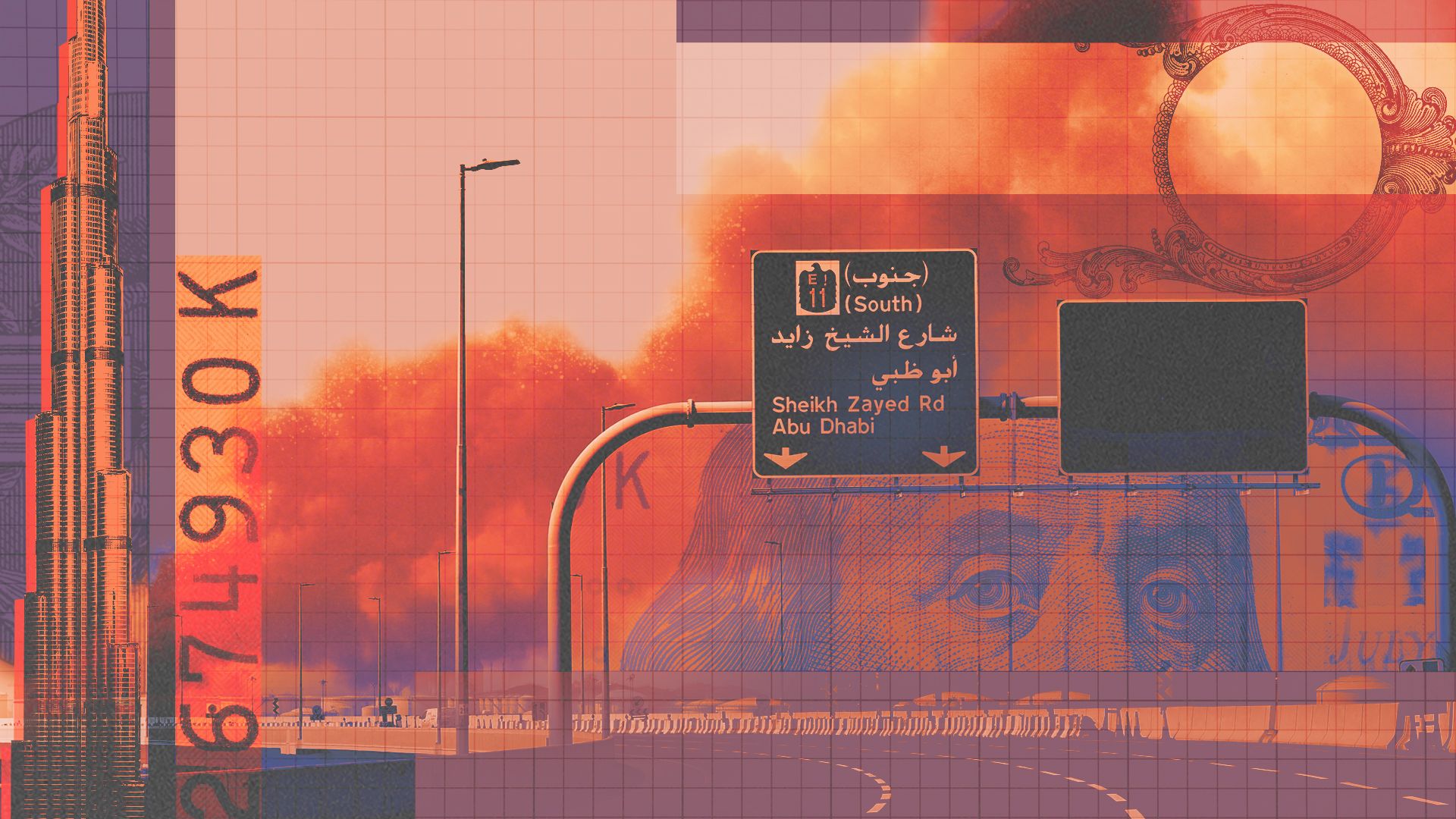
Illustration: Sarah Grillo/Axios. Photo: Fadel Senna/Agence France Presse via Getty Images
The role of Dubai as a global finance hub and favored landing spot for the global elite faces its first big test in the Iran war.
The big picture: Dubai is the flagship city of oil power United Arab Emirates, but the war is fueling economic repercussions well beyond energy.
- Along with neighbors Qatar and Saudi Arabia, the Emirates has spent years diversifying away from oil, using trillion of dollars in sovereign wealth to grease the wheels of global finance.
Zoom in: Dubai was probably most successful in its rebrand, not only in terms of investing abroad, but in drawing the super rich to settle there with the promise of no taxes — not on income or capital gains or inheritances — and exceptional safety.
- Until now, the city was seen as a great place for the wealthy to set up family offices to manage their money.
Between the lines: "Dubai has not itself been a target before," says Karen Young, senior fellow at the Middle East Institute. "That's what's new and different."
- The city is known for ultra-low crime rates. People leave their cars and homes unlocked. But now there's danger overhead.
- "Sure, you can walk around with a Rolex on, but now there is the worry of what may be falling from the skies," Michael Stephens, senior fellow at the Royal United Services Institute, told the Wall Street Journal.
By the numbers: Nearly 10,000 millionaires moved to Dubai last year, and with them $63 billion in wealth, according to data from Henley & Partners, an advisory firm for ultra-high-net-worth individuals.
- The Dubai International Financial Centre has 120 family offices collectively managing assets valued at roughly $1.2 trillion.
Zoom out: Dubai has become the place where a lot of deals and investments involving Persian Gulf sovereign wealth get done, and the number of hedge funds with offices in the city doubled last year.
- Even as M&A dealmaking fell globally last year, it rose in these Middle Eastern countries, which invested billions of dollars in AI, data centers and other technology.
- Dubai serves as a strategic hub for companies seeking to access to all of that capital. The city is where the bankers, lawyers and fund managers who execute Gulf deals are based.
Where it stands: The rich are now trying to get out of town, scared of Iranian attacks.
- A fire last week at the five-star Fairmont the Palm Hotel was perhaps the most high-profile incident, but the Dubai airport, the U.S. Consulate and other critical infrastructure were also hit by Iranian strikes that made it through the city's missile deterrence technology.
The other side: There are some rich folks clamoring to get back into Dubai to avoid big tax bills for violating residency requirements, the Financial Times reported.
Reality check: Living in a financially powerful city comes with the danger of being a potential target.
- Think New York in September 2001 or London on July 7, 2005. Each time a big city faces a crisis like this, residents are forced to readjust their risk calculus.
The bottom line: In the past, a spike in oil prices would be an upside for the regional petro-states.
- Now, the calculus is more complicated. Not only are these economies more complex, it's not clear if they'll benefit from rising energy prices.
- "There is no benefit in high oil prices if you have shut-ins and no way to export to customers because the Strait of Hormuz is blocked," Young says.
