House retirements tied for most this century


Add Axios as your preferred source to
see more of our stories on Google.
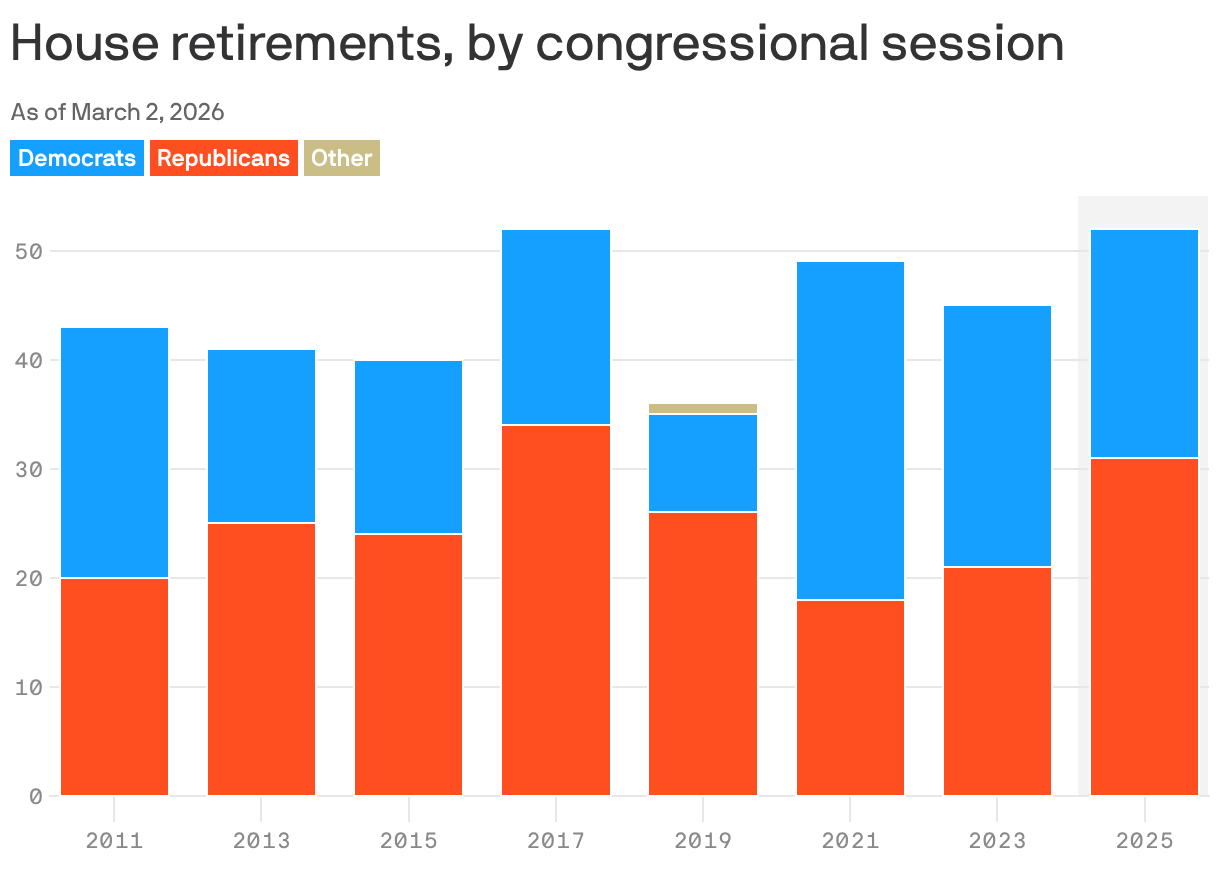
House retirements are now tied with 2018, a midterm election that handed Republicans 40 losses and Democrats the majority.
Why it matters: The House is on the cusp of breaking the record set eight years ago for the most retirements this century (you'd have to go back to 1992 to find more).
- Historically, the party with more departures tends to lose seats, and often the majority.
Driving the news: Rep. Ryan Zinke (R-Mont.) announced Monday he won't seek reelection, bringing total House retirements to 52 — roughly 1 in 8 lawmakers.
- That's a troubling sign for Speaker Mike Johnson (R-La.), who is already navigating a razor-thin majority he hopes to expand.
By the numbers: 31 House Republicans are retiring or running for another office, compared with 21 Democrats.
- In 2018, 34 House Republicans decided not to run for reelection, compared to only 18 Democrats before their party wrested control from the GOP.
- In 2022, an opposite pattern occurred. By the end of the year, 31 Democrats had retired, versus 18 Republicans, ahead of a GOP takeover.
Between the lines: Most vulnerable incumbents are staying put, with the exception of Reps. Jared Golden (D-Maine) and Don Bacon (R-Neb.).
- There's been a concerted, and so far successful, effort from GOP leadership to persuade battleground members, like Reps. Mike Lawler (R-N.Y.) and Zach Nunn (R-Iowa) to stick around.
The bottom line: The record number of exits also guarantees that the next Congress will look considerably different than the current one, forcing leaders of both parties to contend with fresh faces and new challenges.
