Trump pushes for the "Dalilah Law" at SOTU. Here's how getting a CDL works

Add Axios as your preferred source to
see more of our stories on Google.
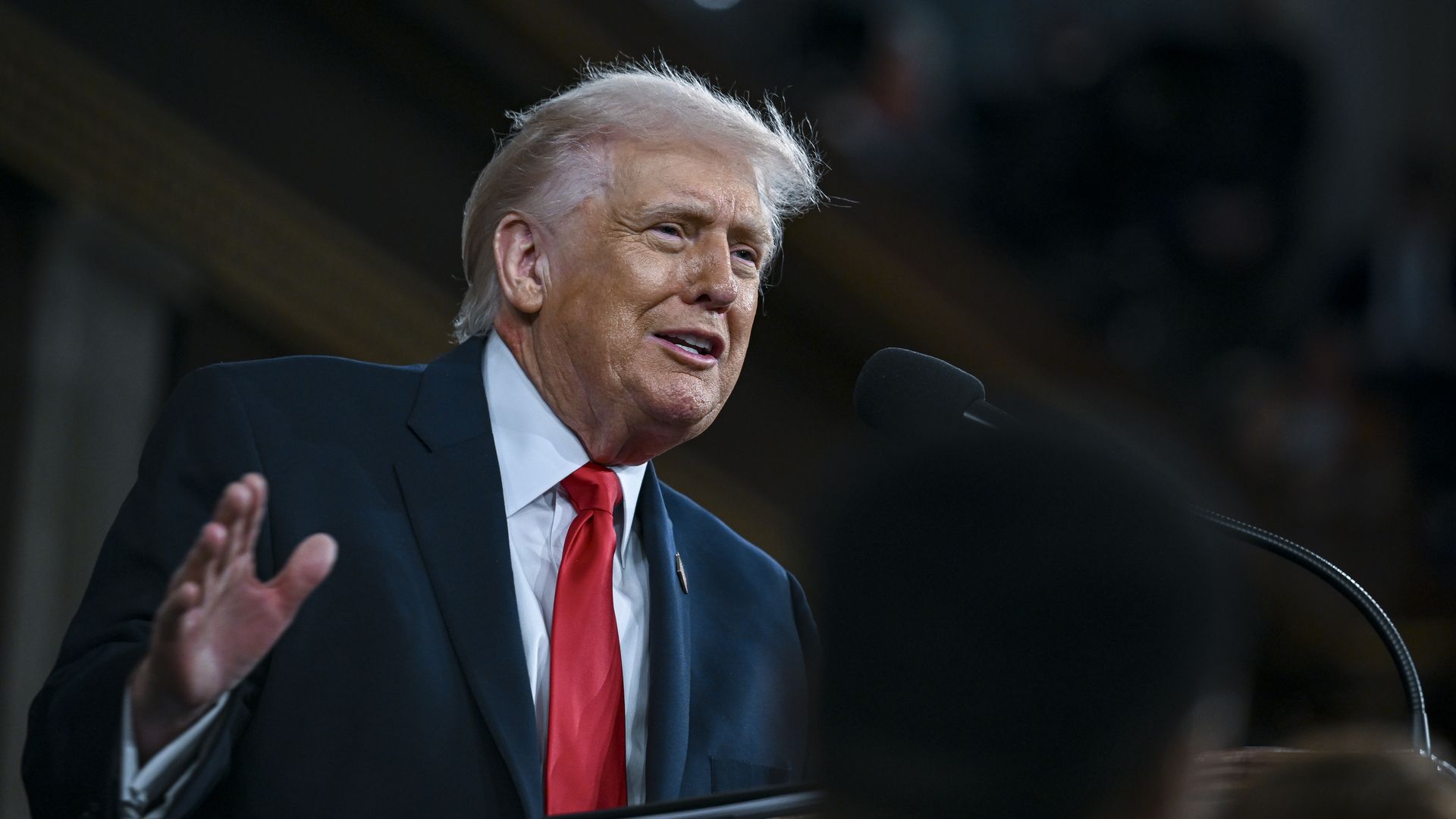
President Trump delivers the State of the Union address during a joint session of Congress at the U.S. Capitol on Feb. 24, 2026, in Washington. Photo: Kenny Holston-Pool/Getty Images
President Trump urged Congress on Tuesday to pass a new law to make it harder for immigrant truck drivers to obtain commercial driver's licenses.
The big picture: The Trump administration has targeted truck drivers and undocumented immigrants' license applications as part of its wider immigration crackdown policy.
Driving the news: "Many, if not most, illegal aliens do not speak English and cannot read even the most basic road signs as to direction, speed, danger, or location," Trump said in his SOTU speech.
- "That's why tonight, I'm calling on Congress to pass what we will call the Dalilah Law, barring any state from granting commercial driver's licenses to illegal aliens."
- "President Trump is again embracing common sense with his push to make sure that illegal aliens who have limited English comprehension are not driving 16-wheeler heavy-duty commercial trucks on roads shared by everyday American families," White House spokesman Kush Desai said in a statement Wednesday.
Reality check: Undocumented immigrants can't legally obtain CDLs, but some non-citizens can obtain a non-domiciled CDL, which still requires proving they are legally in the U.S.
- Some states generally offer standard driver's licenses — not commercial driver's licenses — to citizens regardless of immigration status, Tanya Broder, senior counsel of health economic justice policy at the National Immigration Law Center, told Axios.
Here's more about the law and how getting a CDL works.
What is the Dalilah Law?
The "Dalilah Law" would effectively override any remaining state-level procedures for CDLs.
- The law is named after Dalilah Coleman, who was severely injured in 2024 when an 18-wheeler driven by an undocumented immigrant from India crashed into her family's vehicle, according to the Department of Homeland Security.
- Coleman's father shared on X that the law would require commercial vehicles "to have a permanent business name that is reflective, can be visible up to 100' and is not magnetized without a permit."
There is no indication that "Dalilah Law" has been formally introduced to Congress.
How getting a CDL works
CDLs are regulated by state and federal guidelines.
- Prospective drivers are required to meet requirements for safety, testing and residency under the Commercial Motor Vehicle Safety Act and Federal Motor Carrier Safety Administration regulations.
- Though states issue non-domiciled CDLS to non-citizens, the Transportation Department has moved to tighten those requirements, but a D.C. court has temporarily blocked the restrictions.
Trump's policy on CDLs and immigrant drivers
The big picture: The Trump administration has been cracking down on CDL distribution after a number of fatal traffic incidents that officials said were caused by immigrant truck drivers.
- Trump signed an executive order in April 2025 requiring all commercial truck drivers to demonstrate proficiency in English. It took effect last June.
CDL rules and changes under Trump
The latest: Transportation Secretary Sean Duffy announced last week that all truckers and bus drivers would need to take their CDL tests in English under a new regulatory change.
- Some states, like California, had previously allowed drivers to take their tests in another language — though they were still required to show proficiency in English.
Between the lines: The Federal Motor Carrier Safety Administration's new rules, which take effect in March, include restrictions on which non-citizens can be issued a non-domiciled CDL.
- But under the Dalilah Law, all undocumented immigrants would be banned from obtaining CDLs.
What's next: It's unclear when, or if, the Dalilah Law will be introduced to Congress.
- The White House said Wednesday it "will be working closely with Congress to swiftly pass this legislation," but did not offer a specific timeline.
