More pregnant Americans are skipping prenatal care, CDC finds

Add Axios as your preferred source to
see more of our stories on Google.
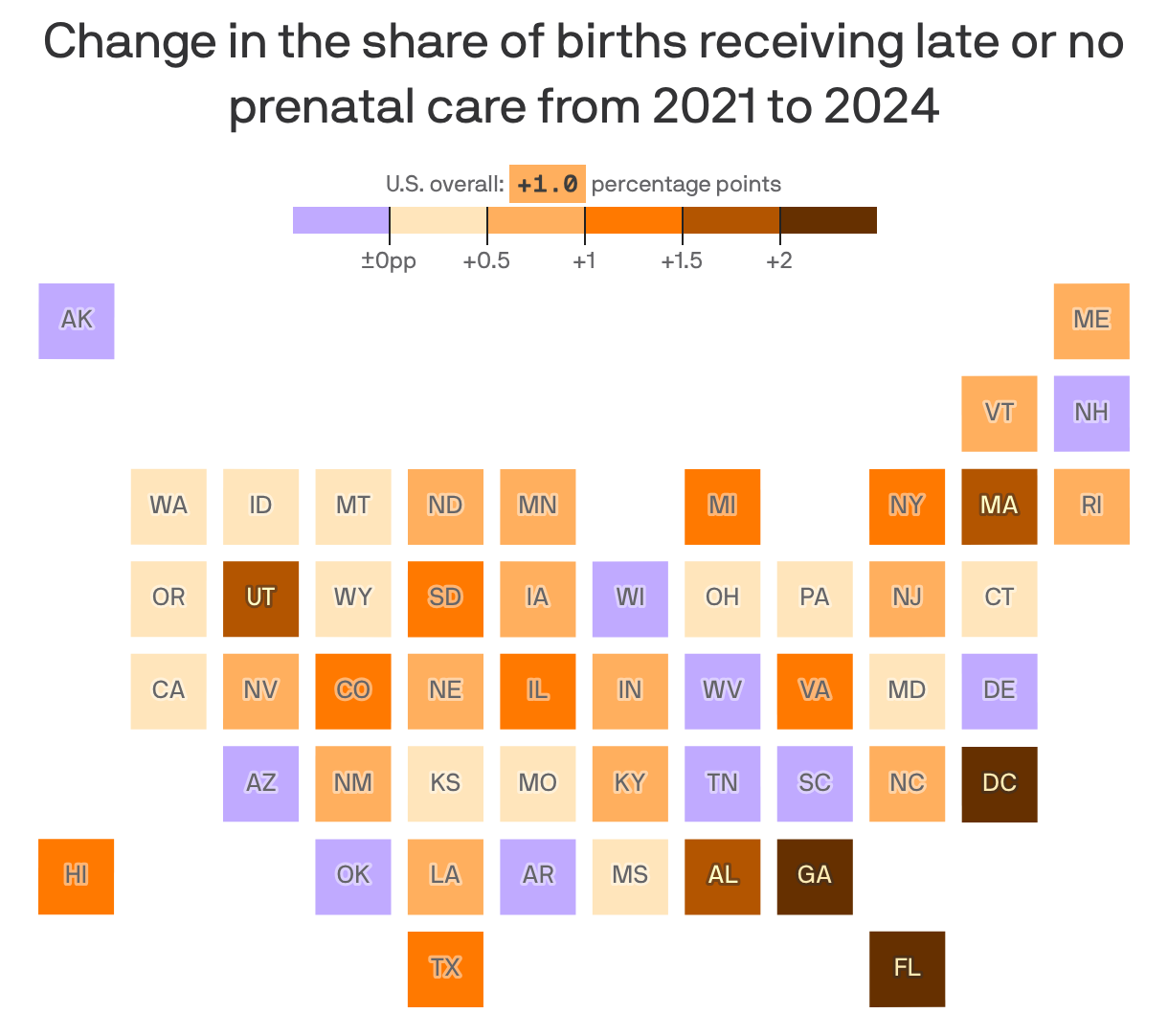
Fewer pregnant Americans are getting prenatal care in the first weeks of pregnancy — or at all — reversing years of progress, new CDC data show.
Why it matters: Skipping first-trimester care raises the risk of preventable complications for moms and babies.
By the numbers: First-trimester prenatal care rose from 77.1% of U.S. births in 2016 to 78.3% in 2021 — but slid to 75.5% in 2024, per a CDC analysis of birth certificates.
- Late or no care increased in at least 36 states and D.C. in that same period — rising nationally from 6.3% to 7.3%.
- The shift spanned every age group and nearly all racial and ethnic groups.
What we're hearing: If caught early, conditions like diabetes and high blood pressure can often be managed to lower risks for mom and baby — sometimes with "easy interventions" like starting aspirin, says Alex Peahl, OB-GYN and ACOG Fellow.
- As more patients enter pregnancy with chronic conditions, early treatment becomes even more critical.
- These are therapies "we know make a big difference in patients' lives," she says, "but they're most effective if they're started in that first trimester."
Between the lines: The report doesn't identify causes, but growing maternity care deserts and insurance coverage gaps are a concern for patients and providers.
- Rural hospitals have closed, practices have scaled back obstetric services, and there are Medicaid patients who struggle to get appointments covered.
- In some cases, Peahl says, patients need proof of pregnancy to enroll in Medicaid but can't obtain that proof without an appointment, creating a catch-22.
What we're watching: Whether health systems respond to access pressures by adopting any of ACOG's new tailored prenatal care guidance — coauthored by Peahl — such as streamlining prenatal care for low-risk patients into only eight to nine visits.
