Tariff ruling traps GOP leaders


Add Axios as your preferred source to
see more of our stories on Google.
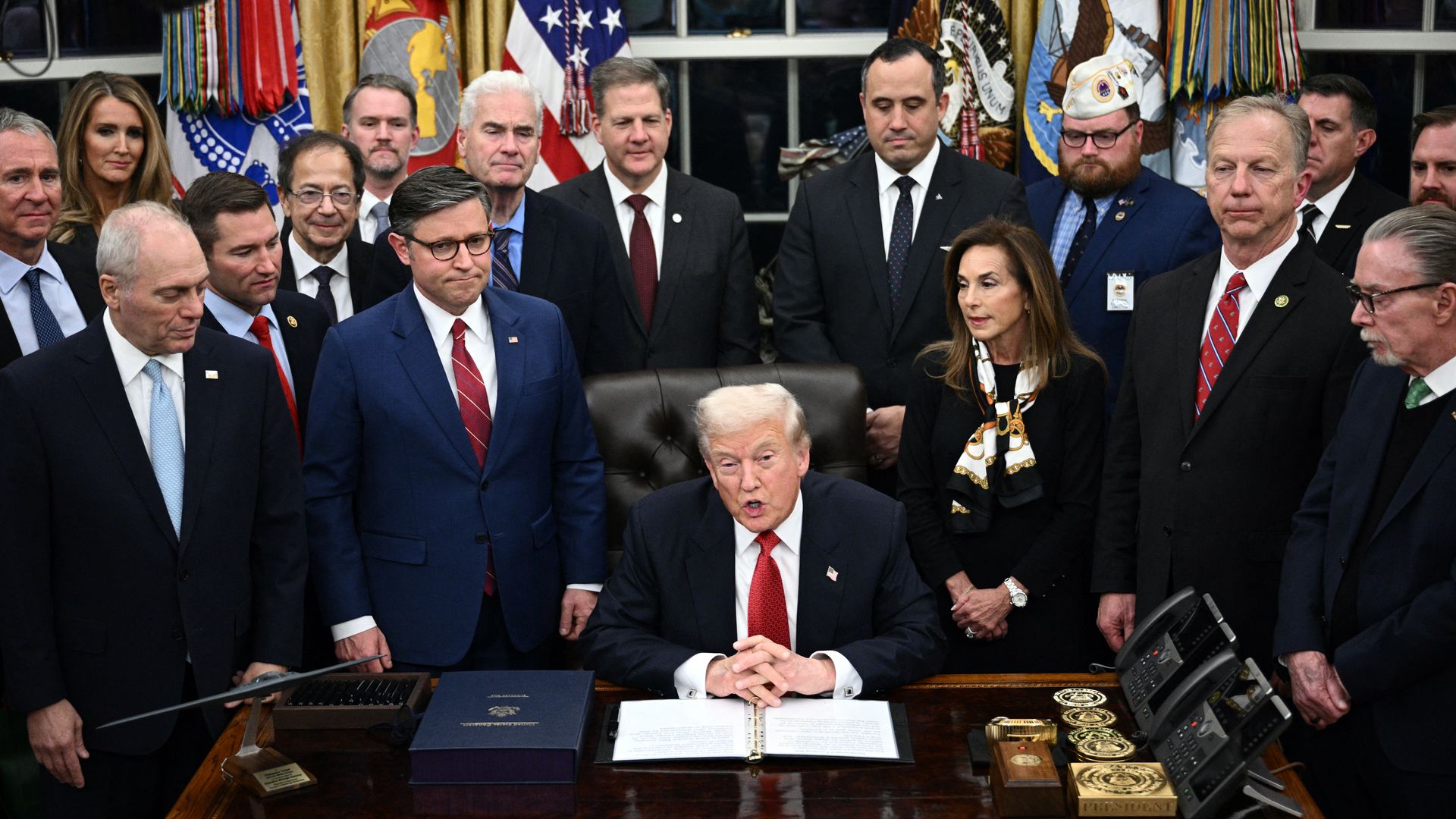
President Trump and House Republicans during a bill signing on Nev. 12, 2025. Photo: Bremdan Smialowki/AFP via Getty Images
Rank-and-file Republicans are demanding Congress codify President Trump's tariffs after the Supreme Court struck them down Friday.
Why it matters: Congressional votes on tariffs will no longer be symbolic.
- House Speaker Mike Johnson and Senate Majority Leader John Thune will be forced to squarely confront a deep divide in their party over tariffs.
- They'll be choosing between protecting vulnerable incumbents — and their own narrow majorities — or standing with a president whose help they'll need in the midterms.
Driving the news: Johnson was the first Republican leader to hit send on a statement, but he was much more effusive on the effectiveness of tariffs than on his desire to instate them.
- "No one can deny that the President's use of tariffs has brought in billions of dollars and created immense leverage for America's trade strategy," Johnson posted. He said Congress and the administration will find "the best path forward in the coming weeks."
- Thune acknowledged that tariffs worked in a post on X, without saying if he supported returning the power to impose them to Trump.
The intrigue: For most of Trump's presidency, Johnson has kept his party's divide on tariffs largely hidden with a procedural trick.
- But his rules committee's ban on tariff disapproval resolutions cracked this month when a small group of Republicans revolted against leadership's effort to keep it in place.
- Half a dozen Republicans voted with Democrats this month to repeal tariffs on Canada, and House Democrats prepared several resolutions to challenge other tariffs.
Zoom in: Sen. Bernie Moreno (R-Ohio) was quick to call today for a second reconciliation package to restore Trump's tariffs power.
- Rep. Adrian Smith (R-Neb.) echoed calls for Congress to lock in Trump's trade agenda, posting that "only Congress can ensure that these agreements provide lasting stability beyond any single administration."
- And further complicating matters, Trump announced Friday that he'll impose a 10% global tariff under Section 122, which requires congressional approval for any time period beyond 150 days.
Yes, but: A handful of congressional Republicans publicly welcomed the court's decision. A reconciliation package would face an uphill battle, especially in the House, where the margins are tighter.
- Rep. Don Bacon (R-Neb.), who voted to overturn Trump's tariffs on Canada, said he feels "vindicated" by the court's ruling.
- Sen. Rand Paul (R-Ky.), who led resolutions in the Senate to repeal Trump's tariffs, posted: "The Supreme Court makes plain what should have been obvious: The power to impose tariffs is very clearly a branch of the power to tax."
- "If tariffs are necessary, Congress should debate them and vote on them directly. That is how our constitutional system is designed to function," Rep. Jeff Hurd (R-Colo.), who also voted to overturn the Canada tariffs, posted.
Zoom out: The Constitution grants Congress the power to set tariffs, but Trump used the International Emergency Economic Powers Act to declare a national emergency and skirt around that authority.
- The Court ruled Friday that Trump exceeded his authority under IEEPA in imposing the sweeping levies.
The bottom line: Democrats framed the ruling as a rebuke of executive overreach and a win for consumers.
- "He tried to govern by decree and stuck families with the bill. Enough chaos. End the trade war," Senate Minority Leader Chuck Schumer posted on X.
- It's "another crushing defeat for the wannabe King," House Minority Leader Hakeem Jeffries posted.
