Trump pledges $10 billion for Board of Peace in inaugural meeting on Gaza

Add Axios as your preferred source to
see more of our stories on Google.
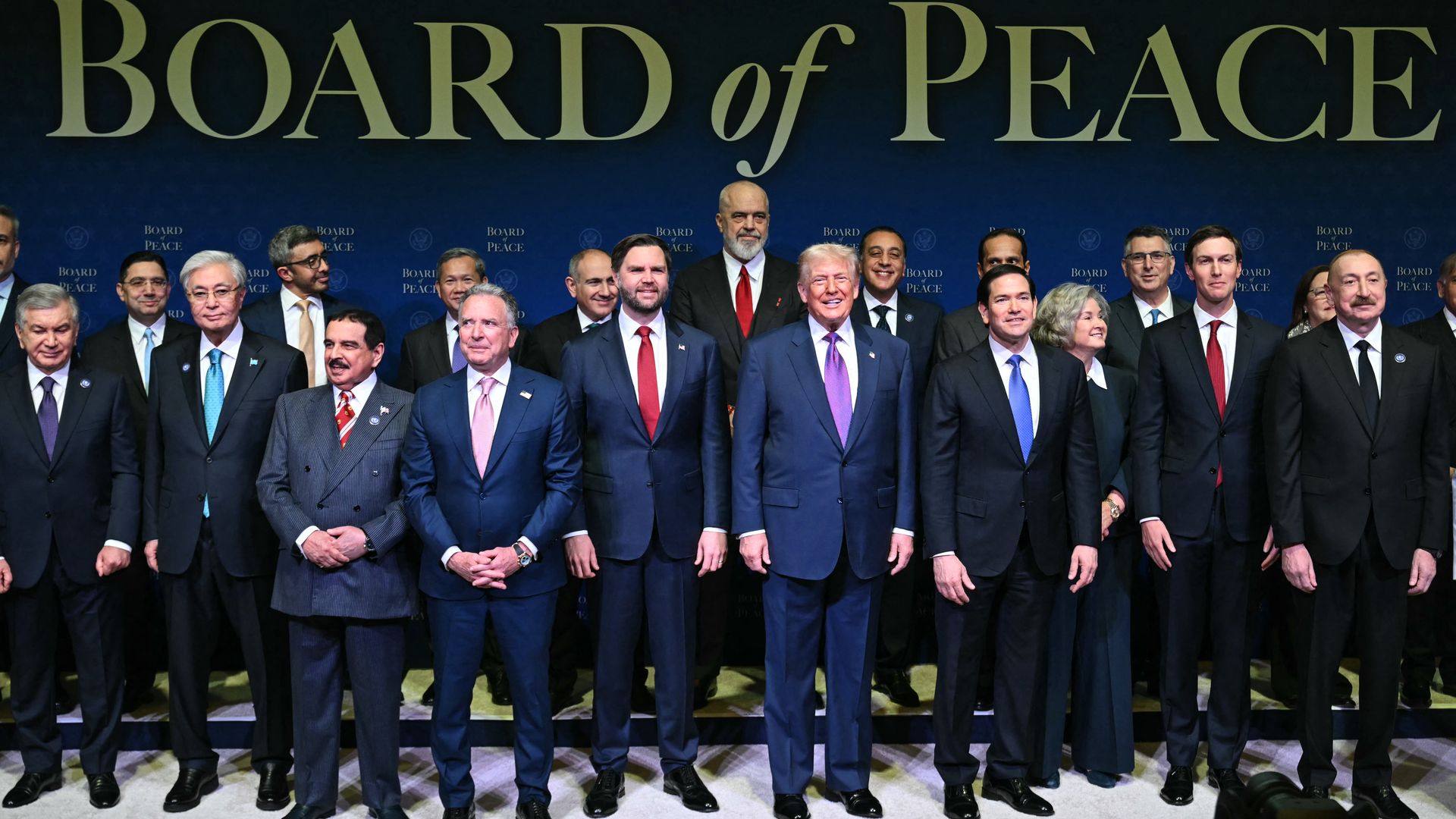
The inaugural Board of Peace meeting in D.C. Photo: Saul Loeb/AFP via Getty
The inaugural meeting of the Trump-led Board of Peace included a $10 billion pledge from Trump and $7 billion in additional pledges for relief and reconstruction in Gaza.
Why it matters: The package of steps announced on Thursday, which also included plans to deploy thousands of soldiers and police for new security organizations in the enclave, appears to be the most ambitious U.S.-led security and humanitarian effort in the Israeli-Palestinian conflict in at least a decade.
- But with the ceasefire still highly fragile, success hinges on Hamas' willingness to start disarming and Israel's willingness to facilitate and support the new government in Gaza and gradually withdraw its forces.
- Many U.S. allies are also wary of Trump's ambitions to extend the board's mandate beyond Gaza to other global conflicts.
Driving the news: Trump was joined at the Board of Peace meeting by more than 20 leaders or foreign ministers of member states. Several Western countries that are not members sent along observers.
- In addition to the $10 billion Trump pledged to the board — which would require congressional approval — $7 billion more was promised for Gaza, mainly by Gulf countries. The money will be moved to a special World Bank account.
- Trump said in his speech that the UN had pledged to raise another $2 billion for humanitarian aid, that Japan would convene an Asian donors conference to raise more funds, that even FIFA would give $75 million for soccer projects in the enclave. The UN has estimated $70 billion will be needed to rebuild Gaza.
- An initial reconstruction plan was also presented at the meeting. The objective is to start in the city of Rafah in southern Gaza, which is in the area still controlled by the Israeli military.
Zoom in: Several Muslim and Arab countries — including Indonesia, Morocco, Kosovo, Kazakhstan and Albania — also agreed to send troops and police to the International Stabilization Force (ISF) that will be deployed in Gaza in the next few months.
- The commander of the ISF, U.S. Gen. Jasper Jeffers, said at Thursday's meeting that Indonesia, which is supplying the most troops, would hold the position of deputy commander.
- He said the ISF will eventually include 20,000 troops in five brigades, each deployed to a separate part of Gaza, starting with Rafah in the south and then expanding.
- The head of the Palestinian technocratic government, Ali Shaath, said a new Palestinian police force would deploy soon, with the goal of having 5,000 trained members within 60 days, and a total of 12,000 policemen eventually.
- Recruitment recently opened and Board of Peace high representative Nikolay Mladenov said 2,000 Palestinians had already applied. Egypt and Jordan said they would train the recruits on their soil.
Zoom out: Trump said in his speech that he believes Hamas will abide by its commitments to disarm, but there will be consequences if not.
- Mladenov said the process of disarming and decommissioning weapons will be conducted by the new Palestinian police force so that "all weapons are put under the control of one civilian authority."
- He said a framework for how to conduct the demilitarization process has been agreed by the U.S. and the other mediators — Turkey, Qatar and Egypt.
- "We now need to move forward on communicating it and negotiating the details with the factions on the ground. I ask all of you that we have one message: There is no other option except the full demilitarization of Gaza for reconstruction to begin," Mladenov said.
Yes, but: While the U.S. and the mediators say they're confident Hamas will agree to start disarming its missiles, rockets, tunnels and weapons factories, the group has been sending mixed messages.
- Hamas issued a statement after the Board of Peace meeting accusing Israel of violating the ceasefire and calling on board members to put the onus on Israel.
- Israel took part in Thursday's meeting, but some members of the right-wing government are eager to scrap the ceasefire and resume the war.
