D.C. helicopter, jet collision fueled by array of failures, NTSB say

Add Axios as your preferred source to
see more of our stories on Google.
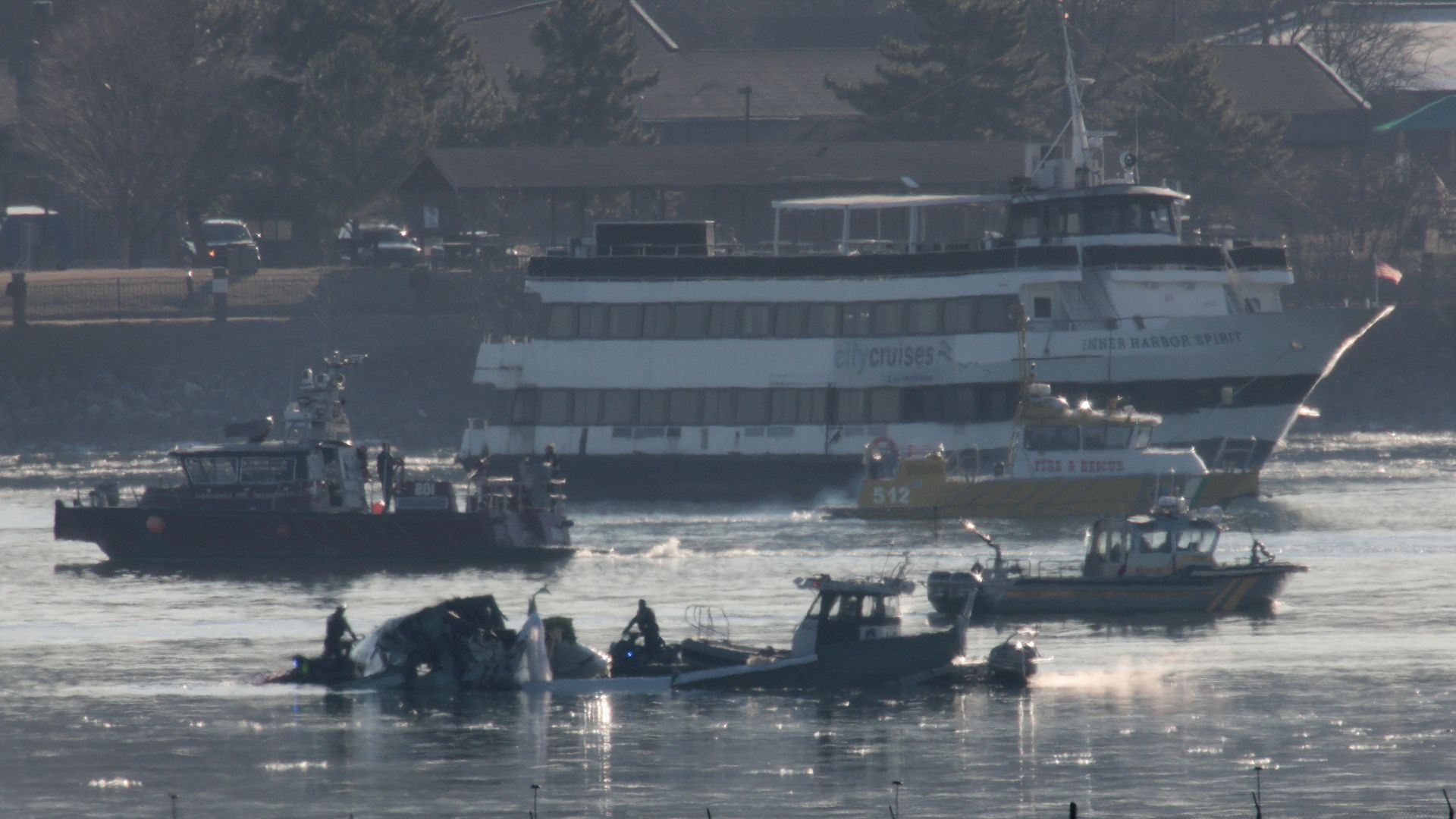
Emergency responders search the crash site after January 2025's midair collision near DCA. Photo: Alex Wong/Getty Images
A dizzying range of factors led to last year's deadly collision between an Army helicopter and a regional jet over the Potomac River, per the final National Transportation Safety Board report out Tuesday.
Why it matters: As is often the case with major aviation disasters, many smaller issues — each perhaps benign on their own — added up to a tragedy of the grandest scale, leaving 67 people dead.
Driving the news: The NTSB's final report cites a wide array of causal factors, including the FAA's placement of a helicopter route so close to an aircraft approach path into Ronald Reagan Washington National Airport, also called DCA.
Other factors, per the NTSB...
- Air traffic's over-reliance on visual separation (when pilots keep a safe distance from other aircraft on their own — which is particularly tough at night in busy airspace, when the DCA midair occurred).
- High workload at DCA's control tower, which fueled a loss of situational awareness and "degraded performance."
- An "unsustainable airport arrival rate" at the ever-busy DCA.
- The FAA's failure to strengthen requirements for ADS-B In, a technology that helps pilots maintain awareness of nearby aircraft.
- The U.S. Army's "lack of a fully implemented safety management system."
Between the lines: Also notable is the NTSB's finding that blocked radio transmissions between pilots and controllers contributed to the disaster.
- Controllers' radio frequencies are often busy with many pilots at once. Vital communications can be blocked if pilots or controllers "step" on one another by transmitting simultaneously.
What's next: The report comes with a litany of recommendations for the FAA, Army and other stakeholders.
- But the NTSB can only investigate and make suggestions. It's up to the FAA and others to implement its ideas — often a lengthy and bureaucratic process.
The bottom line: "Sometimes there is progress, but it takes years. Other times, decades. All that's to say: Enduring change can take time. Making the system-wide changes we need doesn't come easy, but we must make them," NTSB chair Jennifer Homendy said in a statement accompanying the report.
- "And we should do so BEFORE people die."
