A pilot's take on the DCA midair collision

Add Axios as your preferred source to
see more of our stories on Google.
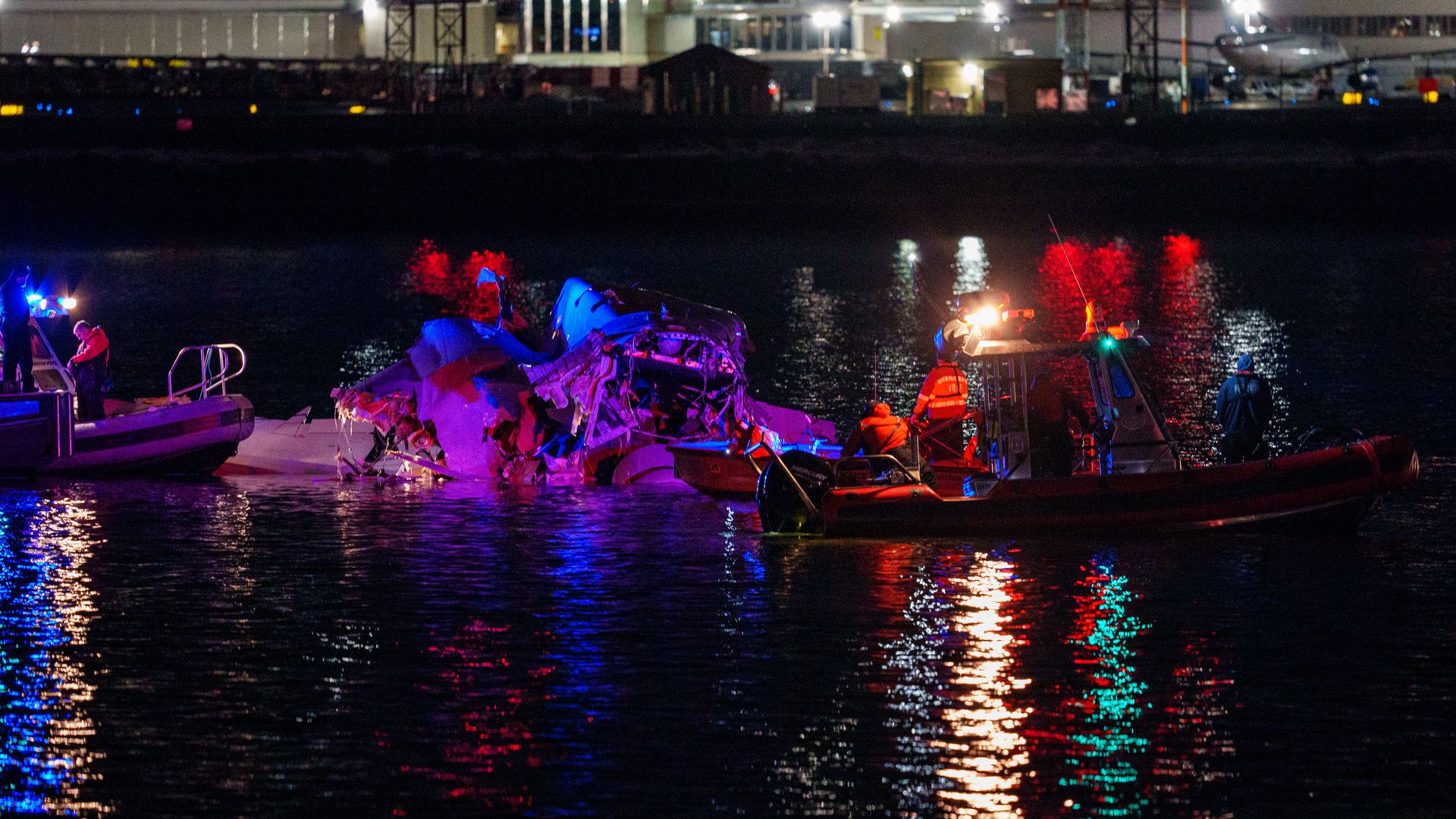
For some of us in aviation, last night's midair collision just a few hundred feet over our nation's capital was a simmering fear made real in tragic fashion.
The big picture: Aviation safety experts have been warning that air traffic controllers are overloaded and overworked, and that the airspace is increasingly busy with record travel — a combination fueling a grim sense that it was only a matter of time.
Driving the news: 67 people are feared dead after an American Airlines flight operated by PSA Airlines and a U.S Army helicopter collided late Wednesday near Ronald Reagan Washington National Airport, also called DCA.
- 64 were aboard the jet, three on the helicopter.
- There are no signs of survivors as of Thursday afternoon — but let's leave room for miracles.
Air traffic control audio suggests the helicopter, which was on a training mission, was instructed to see and avoid the jet, which was approaching to land at DCA.
- That didn't happen, for reasons only a thorough and professional investigation may reveal. (Controller staffing was "not normal for the time of day and volume of traffic" during the incident, the New York Times reported Thursday based on an internal FAA preliminary report.)
- Those investigations can be lengthy. The final report on TWA Flight 800, for example, took four years.
Even still, political finger-pointing began almost immediately.
- President Trump blamed, without justification, diversification efforts at the FAA — an increasingly common refrain among those who don't believe anyone other than a straight white man has the skills required to fly an airplane or staff a control tower.
- Former Transportation Secretary Pete Buttigieg retorted that one of Trump's first acts "was to fire and suspend some of the key personnel who helped keep our skies safe."
This hobbyist pilot's perspective: President Biden's FAA took safety concerns seriously, but even an agency tasked with overseeing near-supersonic air travel can only move at the speed of government.
- At the same time, DEI doesn't bring down airliners. Mistakes do, and anyone can make those — even well-trained pilots and controllers, of any race, gender or creed.
- And aviation disasters rarely come down to a single mistake by a single person. Instead, they're often attributable to multiple factors that meet at a point in space and time with terrible consequences.
The bottom line: U.S. air travel is so remarkably safe, on the whole, because we learn from every mistake — from small mishaps to absolute horrors.
- Any lessons from this tragedy will take time to surface. But they will be a gift to the rest of us, however involuntary, from 67 souls who took off for routine flights that were anything but.
