"Parkour!" isn't just for "The Office" — it's a rising workout trend

Add Axios as your preferred source to
see more of our stories on Google.
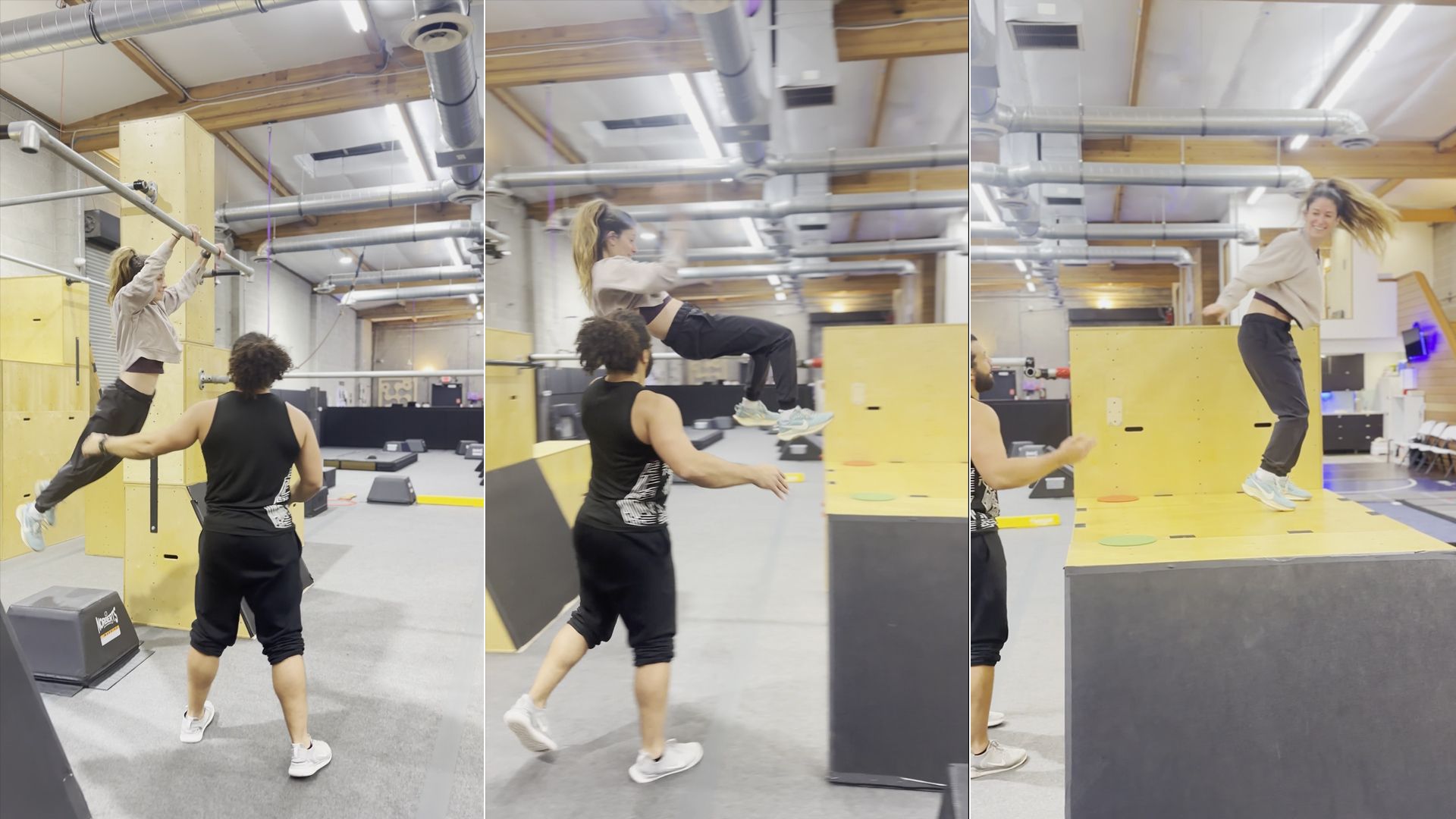
Fr3running Society owner Christian Elijah Mayo helps reporter Carly Mallenbaum face her fears. Photos: Carly Mallenbaum/Axios
Parkour — once synonymous with an outlaw, fence-hopping subculture — became one of the fastest-growing fitness trends in the U.S. last year, according to ClassPass.
Why it matters: The sport all about moving freely through space has gone mainstream, which means even this reporter tried it out.
- And it is thrilling.
Catch up quick: Parkour was created in the '90s by a Parisian teenager who ran on rooftops and scaled walls with his friends. Visibility grew in the U.S. in the early 2000s as videos circulated online.
- Then freerunning — a more expressive style that added tricks — branched off from it.
- In recent years, the popularity of obstacle-course TV shows like "American Ninja Warrior" helped fuel broader interest in movement-based workouts and training gyms that incorporate parkour-style skills.
The sport also went viral after "The Office" Season 6 made "Parkour!" a punchline.
What they're saying: Parkour is "everything I used to do as a kid that I was told not to do," says Christian Elijah Mayo, owner and operator of parkour gym Fr3running Society in Los Angeles.
- Mayo trained as a gymnast, but was turned off by the rules and point deductions.
- As a teenager, he decided to quit gymnastics "but keep flipping." He'd get in trouble for walking on top of the monkey bars and swinging onto the slide, and vowed to eventually create a parkour safe space.
- Mayo opened his first gym five years ago — after working in stunts — and a second location last year.
How it works: At Fr3running Society, you wipe your shoes on a sticky mat, then step into a vast, industrial space — a maze of wooden platforms, metal pipes, black mats and rock-climbing walls.
- For my class, the equipment was arranged into stations for drilling specific movements.
- The section that made my eyes widen: I had to leap from a block to catch a bar, swing through the air, and then release and land on a raised platform that looked very, very far away.
I was scared. And said as much. But Mayo brushed it off.
- I wasn't "afraid," per se, he said — but "your central nervous system was taking over and saying 'don't get hurt' and preventing damage." I wasn't sure I understood the distinction.
- He recommended breathing through it, and continuing to expose myself to more challenging scenarios — like higher jumps and swings — in a controlled environment. That helps "sharpen the blade in your brain" and expand your comfort zone, he said.
- My nerves didn't go away, but after swinging and not jumping, I finally did let go. I barely made it.
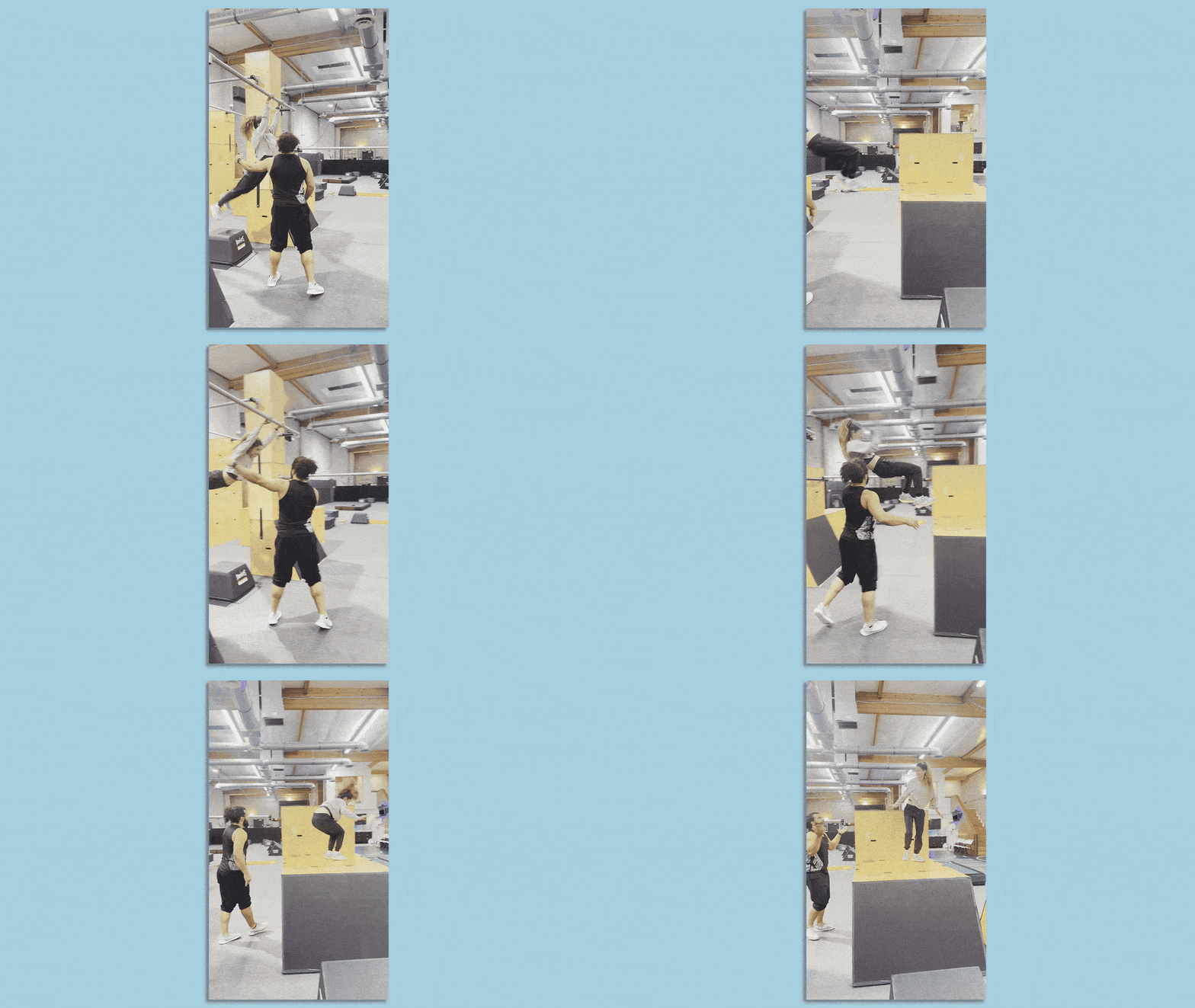
I was euphoric. Sure, it feels good to do any kind of workout, but this was different.
- In this class, I felt myself pushing physical limits — and tapping into a kind of play I hadn't experienced in years. It ended in a game of tag, for goodness' sake. (Being chased has a way of quieting second thoughts.) And there was a camaraderie you don't usually get in Pilates.
Yes, but: Writing this days later, my palms are blistered, my shins bruised, I can barely put my hair in a ponytail because my arms are so sore, and I think I tweaked my ankle. At 36, I'm feeling especially old today.
- Mayo says that done over the long-term, though, parkour functions as an injury-prevention class because it strengthens smaller muscles and tendons, while also increasing mobility. I'll see how I feel next week.
My state of play: I will definitely be back soon — first, with my toddler for more "ninja tots" classes.
