These services are at risk if the government shuts down again

Add Axios as your preferred source to
see more of our stories on Google.
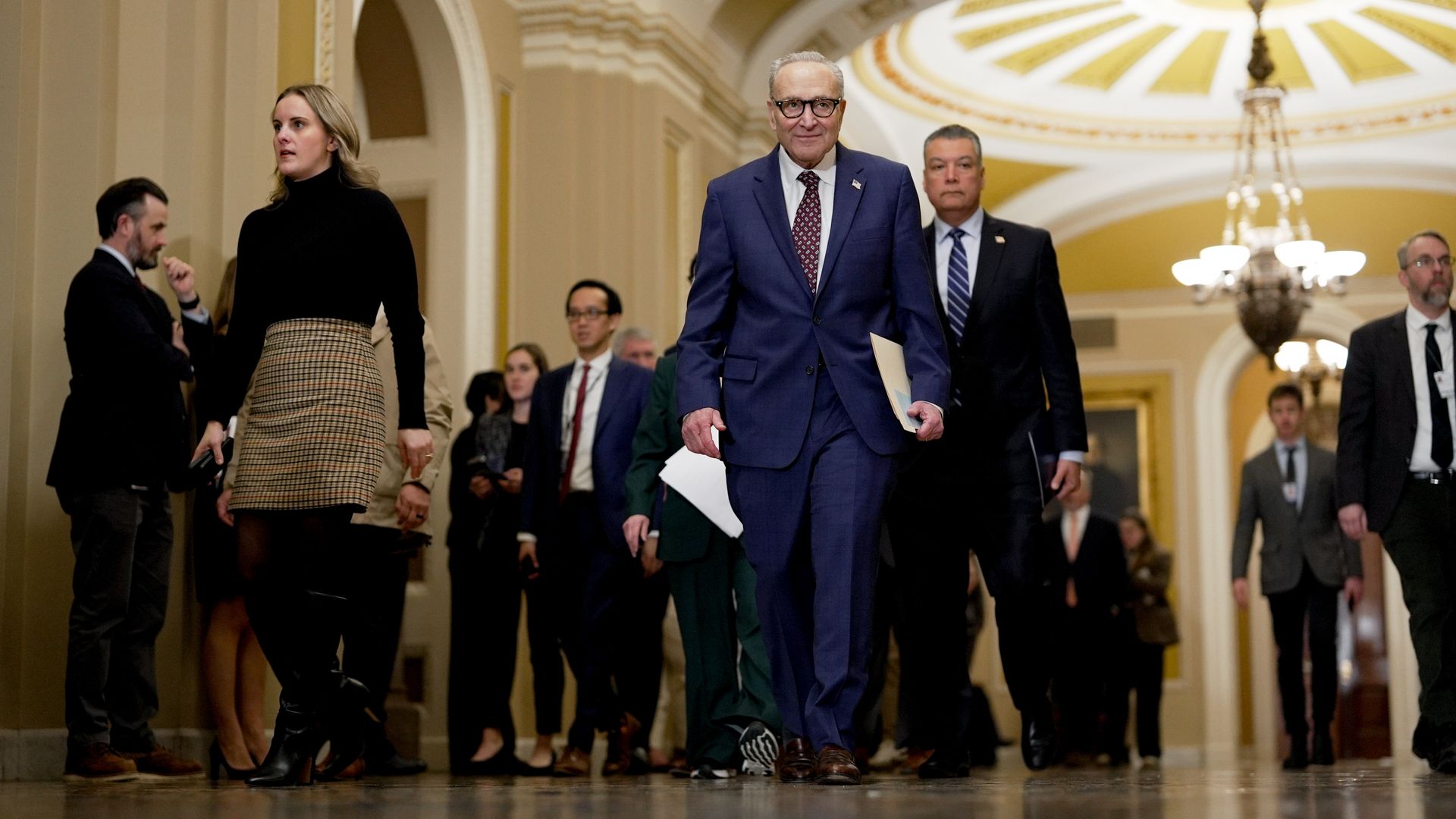
Senate Minority Leader Chuck Schumer and Sen. Alex Padilla. Photographer: Al Drago/Bloomberg via Getty Images
The longest shutdown in U.S. history ended less than three months ago, but the government is already bracing for another one.
The big picture: The government shutting down this time, however, would largely impact a different set of services than those last fall.
- SNAP funding is safe this time around, but federal workers could miss paychecks and travelers would again be at risk of airport delays.
Driving the news: Democrats are leveraging a package of funding bills to secure ICE and Customs and Border Protection reforms, after federal law enforcement killed two protesters in Minnesota as part of the Trump administration's unpopular immigration crackdown.
The latest: Senate Democrats on Thursday blocked the funding bills from advancing, but Minority Leader Chuck Schumer (D-N.Y.) inched toward a deal with President Trump to cinch those reforms in exchange for averting a shutdown.
- That Homeland Security stopgap is meant to give lawmakers and the White House time to negotiate reforms and changes to the department, Axios' Stephen Neukam writes.
- A partial shutdown is set for midnight Friday if Congress can't reach a deal.
What government programs could be impacted
Reality check: The scope of this shutdown would be smaller than that of this fall's, as half of the annual appropriations bills that fund the government have already been signed into law.
- The still-unfunded departments are on the chopping block, however, including: Defense, Education, Health and Human Services, Homeland Security, Housing and Urban Development, State, Transportation, Treasury and Labor.
- Vulnerable departments account for more than three-quarters of federal discretionary spending, Rachel Snyderman, managing director of economic policy at the Bipartisan Policy Center, told CNN.
By the numbers: A shutdown would affect about 45% of the roughly 2.2 million civilian federal workers, per Snyderman.
- That means more than 500,000 federal workers could be working without pay, while another 480,000-plus could be furloughed.
Zoom in: While Social Security and Medicare payments won't be impacted, benefit verification and card issuance would cease, per the nonpartisan Committee for a Responsible Federal Budget.
- Although unlikely to happen again, more than 10,000 Medicare applicants were temporarily turned away every day of the 1995-1996 shutdown, the committee noted.
Air travel is considered "essential," so the Transportation Security Administration (TSA) and air traffic controllers continue working without pay during a shutdown.
Yes, but: Travel issues are likely. Flight delays soared as controllers missed their first paychecks during last year's shutdown.
The National Institutes of Health (NIH) would be prevented from admitting new patients or processing grant applications, the CRFB said.
- In 2013, states were forced to cover money for formula grant programs such as Temporary Assistance for Needy Families, the committee noted.
What government services are safe
Congress last year passed legislation fully funding several agencies, which will not be affected by a partial shutdown.
- These departments include Agriculture, Commerce, Energy, Interior, Justice and Veterans Affairs.
- National Parks, which are overseen by the Interior Department, will remain open.
What we're watching: The IRS could experience some hiccups.
- "In 2013, a backlog of 1.2 million income and Social Security number verification requests delayed mortgage and other loan approvals, and billions of dollars of tax refunds were also delayed," the CRFB said.
- "At least 26,000 furloughed IRS employees were recalled to work during the 2018-2019 shutdown in preparation for tax season, but 14,000 did not show up to work without pay."
- IRS CEO and Social Security Commissioner Frank Bisignano insisted on Wednesday that a partial shutdown would not impact refunds this tax season.
Mail operations will also remain unaffected.
- "As an independent agency that is almost entirely self-funded, postal operations will continue as usual with no disruption in pay for employees," the American Postal Workers Union said ahead of October's shutdown.
