How Minnesota, Illinois are trying to use the 10th Amendment to block ICE

Add Axios as your preferred source to
see more of our stories on Google.
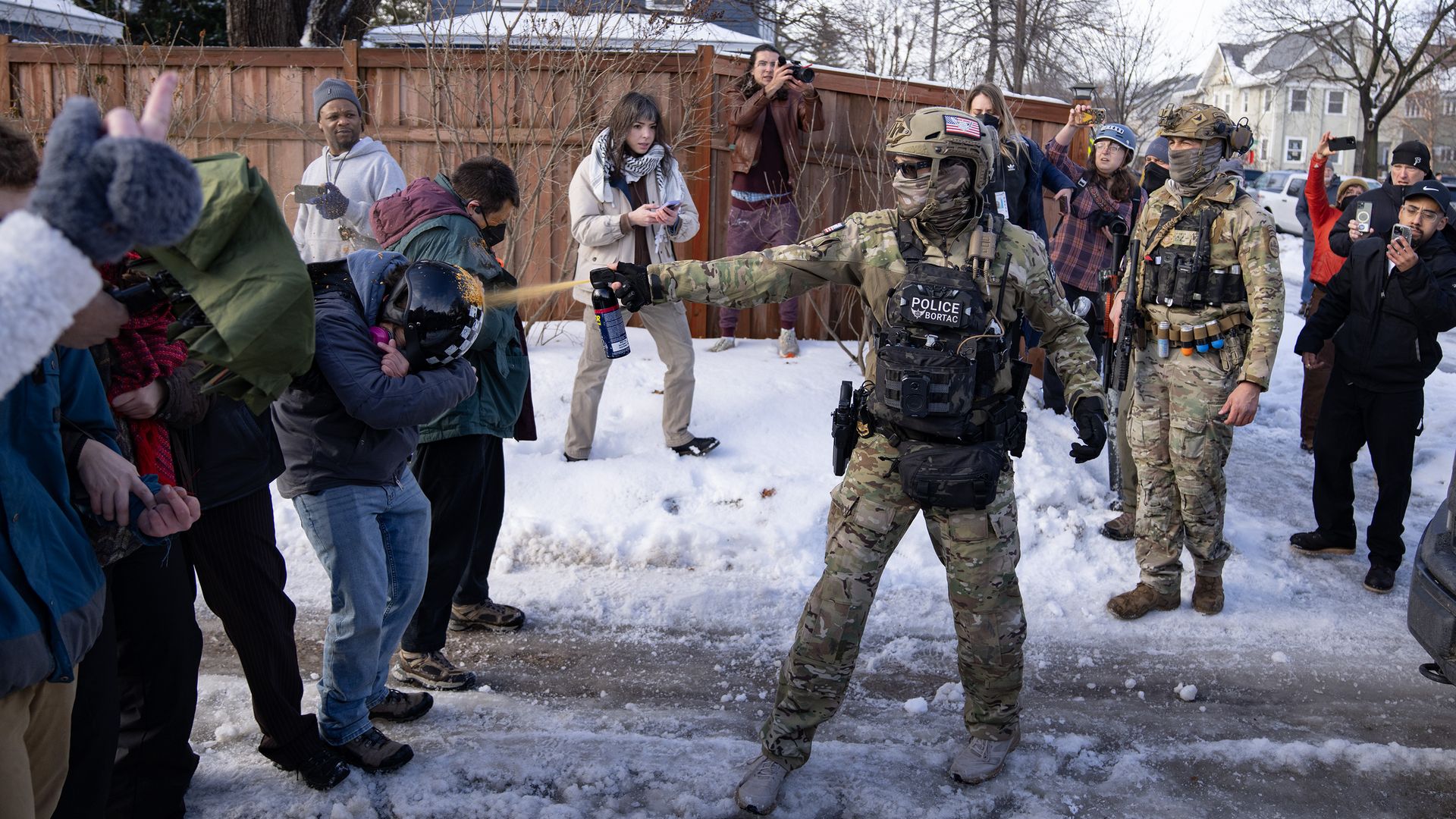
A Border Patrol agent pepper-sprays a protester in Minneapolis at the scene of where a federal agent fatally shot Renee Nicole Good earlier on Jan. 7. Photo by Alex Kormann/The Minnesota Star Tribune via Getty Images
The 10th Amendment is key to Minnesota and Illinois' lawsuit to block ICE agents from the states.
The big picture: Illinois and Minnesota have been major sites of Trump's deportation efforts and expansion of ICE, with both states citing the 10th Amendment's limitation of federal powers in their efforts to curb the White House's powers.
Driving the news: Minnesota Judge Kate M. Menendez declined on Wednesday to rule immediately on a request by state and local officials to temporarily block agents to the Minneapolis area.
- The Minnesota Attorney General's Office on Friday had requested a temporary restraining order that would block agents from the state, citing "immediate harm," such as an ICE officer shooting and killing Renee Nicole Good last week.
- Menendez gave the Justice Department until Monday to respond in writing to the state's lawsuit.
By the numbers: The Department of Homeland Security said it has arrested more more than 2,400 people in Minnesota since November 29.
- About 3,000 federal agents have been sent to the state.
What they're saying: Minnesota leaders have called the deployment a federal "occupation."
Catch up quick: Border Patrol and ICE agents "have acted as occupiers rather than officers of the law," Chicago and Illinois attorneys said in their lawsuit.
- The suit says that "military-trained personnel, carrying semi-automatic firearms and military-grade weaponry, have rampaged for months through Chicago and surrounding areas, lawlessly stopping, interrogating, and arresting residents, and attacking them with chemical weapons."
- Minnesota's suit describes the crackdown as "driven by nothing more than the Trump Administration's desire to punish political opponents and score partisan points."
The other side: The Justice Department and Department of Homeland Security didn't respond to Axios' requests for comment earlier this week.
Here's what to know about the 10th amendment and the states' lawsuits:
What the lawsuits say about the 10th amendment
Context: The 10th amendment says that "the powers not delegated to the United States by the Constitution, nor prohibited by it to the States, are reserved to the States respectively, or to the people."
- "If it isn't listed, it belongs to the states or to the people," according to the National Archives.
Zoom out: Both Illinois and Minnesota argue that the administration's immigration crackdown violates their sovereignty by disrupting the lives of residents, the health of businesses, and the power of the state governments.
Zoom in: "Illinois and Chicago sovereign interests include regulating public health, establishing and implementing a system of education for Illinois residents, defending the state's economy, providing public safety and administering a judicial system, protecting property within its borders, enforcing state statutes implementing state programs, and ensuring that Illinois residents receive the full benefits of state and federal law," per the suit.
- The suit also noted that raids "have forced restaurants to shutter" and "dine-in sales to plummet," as well as dissuading tourism, immigration into the state, and use of public benefits by residents.
Minnesota's examples are similar.
- The state also noted that it guarantees "a right to public education" but said that public schools cancelled classes for multiple days "due to safety concerns" after ICE killed Good, as well as "an enforcement action at a Minneapolis high school."
Whether the 10th amendment can work as a defense
Craig Futterman, a clinical law professor at the University of Chicago, told CNN that Minnesota and Illinois' argument is novel.
- "What the state's theories are, both in Minnesota and in Illinois, is that the federal government is using immigration laws as a ruse to target (Democratic-led) states and cities to retaliate against them and interfere with their local policies; to interfere with their sovereignty," he said.
- "It feels like the politics are being flipped. Traditionally state's rights arguments have been launched often as a defense to federal attempts to enforce civil rights laws to ensure equal protection for all people under the law," Futterman said.
- "And here states are saying 'Hey what's going on is the opposite – it's the federal government that's actually targeting states for protecting vulnerable populations.'"
