Democratic state officials erupt over Trump threat to child care funds


Add Axios as your preferred source to
see more of our stories on Google.
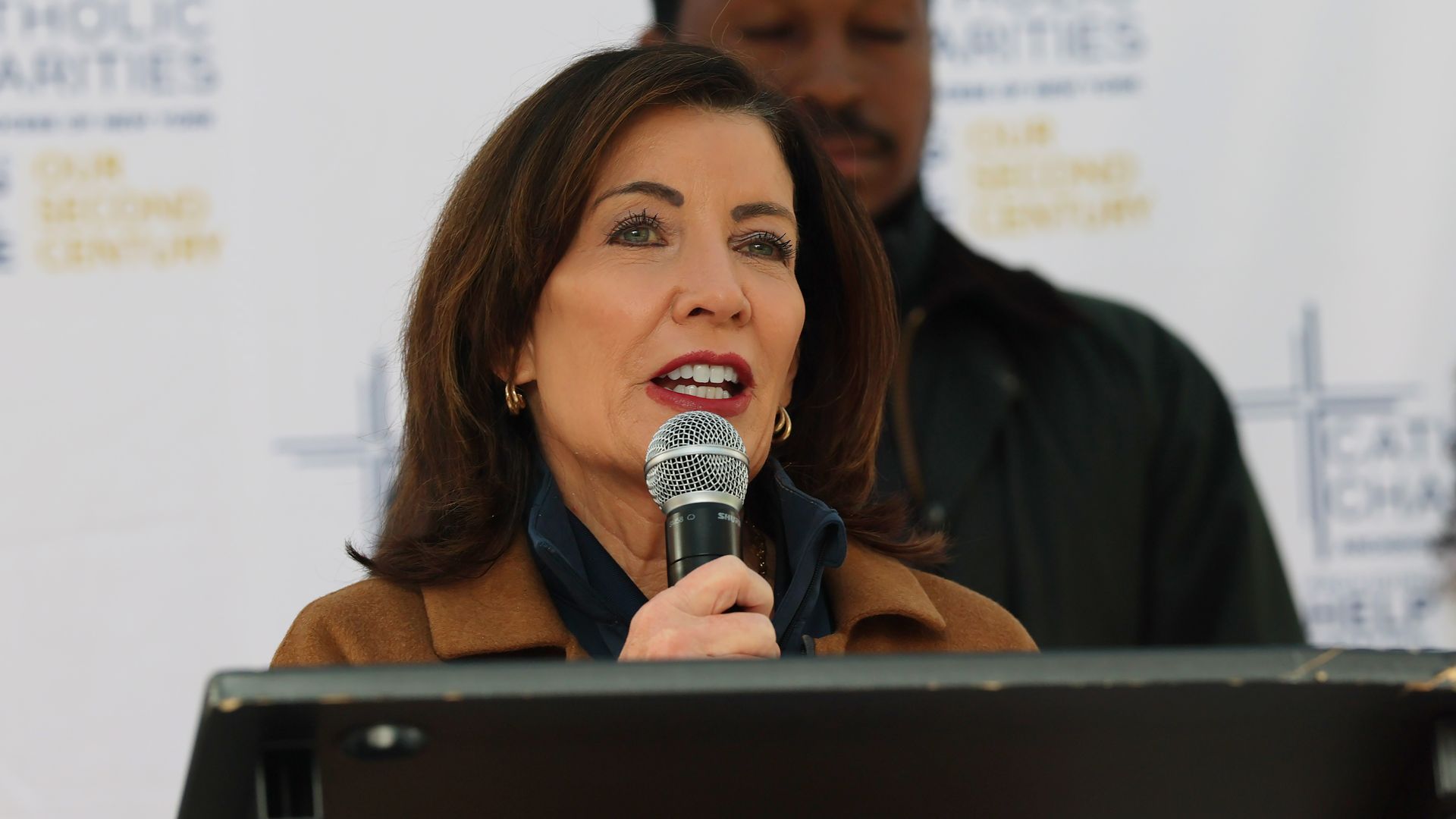
New York Gov. Kathy Hochul. Photo: Michael M. Santiago/Getty Images
Democratic leaders and officials are calling out the Trump administration for threatening to freeze billions of dollars in funding for child care and assistance for the poor.
Why it matters: The livelihoods of millions of families and the health of an already fragile child care system are at stake, officials and advocates say, while the Trump administration says it is merely shoring up the integrity of the system.
- The administration is moving to create new rules and restrictions around federal child care funding, claiming that there's widespread fraud.
Driving the news: On Monday, federal officials said they were halting $10 billion in child care and social assistance funding for five Democratic-led states: Minnesota, California, Illinois, Colorado and New York.
- An administration official tells Axios that letters to these states would go out later on Tuesday with more details.
Zoom in: The administration isn't just going after these five states. It's also adopting a so-called Defend the Spend policy throughout all 50 states, asking officials to further justify any spending on child care.
- State officials across the country got more details on the policy late Monday afternoon via a short memo.
- Now when states try to draw down funds for child care they must provide information justifying the spending and attesting to the integrity of the request, per the memo.
- A Georgia state official confirmed that its request for funding is "pending," as a result of the new policy. "We have received the new guidance and we will comply with these requirements," the official said.
Friction point: If New York does get a notification of a funding freeze, the state will fight it in court, Gov. Kathy Hochul told the Associated Press on Tuesday.
- "Our kids should not be political pawns in a fight that Donald Trump seems to have with blue state governors," Hochul said.
The other side: The administration official pointed to three incidents of fraud in New York, which led to arrests in 2019 and 2023 — as evidence of the state's problems.
- "For too long, Democrat-led states and governors have been complicit in allowing massive amounts of fraud to occur under their watch," said Andrew Nixon, a spokesman for the Department of Health and Human Services. "Under the Trump Administration, we are ensuring that federal taxpayer dollars are being used for legitimate purposes."
What they're saying: Sen. John Hickenlooper (D-Colo.) posted on X Tuesday: "Colorado families are paying the price for the President's reckless pursuit of political retribution."
Between the lines: For some states the change will be easy, just a few more words typed in a box. For others, things might get complicated.
- There's also worries over getting caught in a bureaucratic maze that slows funding to child care programs already operating on thin margins.
- A similar Defend the Spend policy, briefly put in place last spring, did lead to funding delays for some providers — reportedly resulting in layoffs and delays in paying staff at child care centers in Ohio.
Yes, but: The process shouldn't be an additional burden, Nixon of HHS tells Axios.
- "It should be a very quick process," he says. "We are not here to hinder the flow of funding for centers operating legitimately."
What to watch: There are already signs of funding delays, says Kelly Davydov, a child care consultant who works with states and nonprofits.
- Two states she works with — not the five under threat — are already having difficulties drawing down funds allocated for child care.
- That's due to the Defend the Spend policy, Nixon says.
The bottom line: State officials and child care advocates say that while it is important to fight fraud, they caution that the process should be handled delicately.
- "Disruptions in child care have the potential to impact not just kids and families, but think about employers, think about the broader economy," Davydov says. "Handle this poorly and you risk destabilizing the entire U.S. workforce."
