Why ISIS is back on the radar as Trump launches attacks in Nigeria

Add Axios as your preferred source to
see more of our stories on Google.
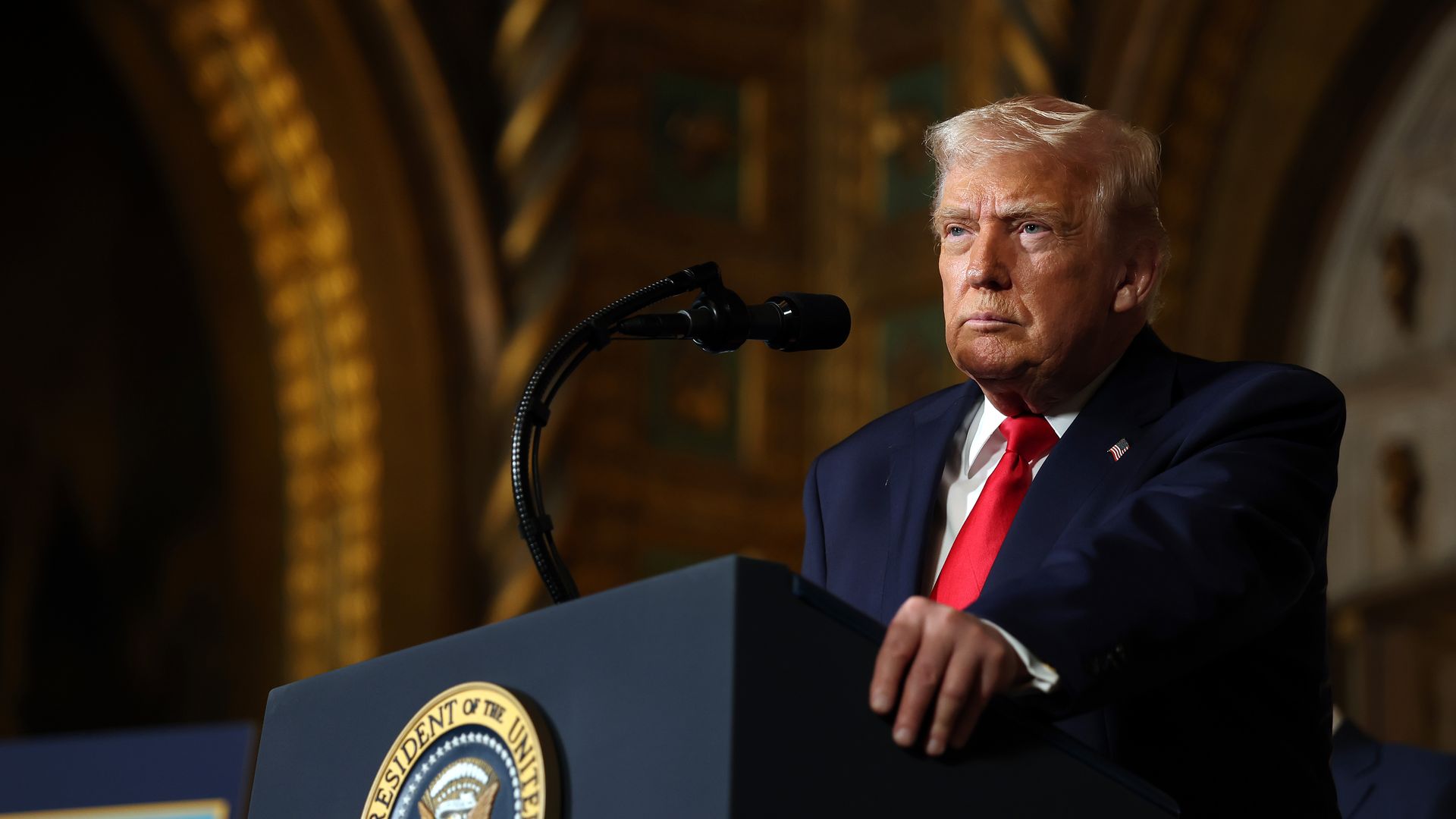
Photo: Tasos Katopodis/Getty Images
President Trump said the U.S. military launched strikes against ISIS in Nigeria on Christmas Day because "Islamic terrorists" are attacking Christians in the region.
The big picture: The situation is more nuanced than Trump claims, with analysts and data underscoring that Christians are targets in a small percentage of religiously motivated attacks in the country.
Driving the news: The U.S. military's Africa Command said in a statement that it coordinated the strike in Sokoto State on Thursday with Nigerian authorities and killed "multiple ISIS terrorists."
- Nigerian Foreign Minister Yusuf Maitama Tuggar told BBC News the strike was a joint operation targeting terrorists, but denied it had anything "to do with a particular religion."
- It's unclear how many fatalities there were or what prompted the attack, although it follows months of Trump and evangelical Christians rallying around the alleged persecution of Christians in Nigeria.
- The U.S. military's AFRICOM deleted an earlier X post saying it conducted a strike "at the request of Nigerian authorities."
Catch up quick: Trump wrote on Truth Social that he directed the strike on the "Terrorist Scum," whom he said "have been targeting and viciously killing, primarily, innocent Christians, at levels not seen for many years, and even Centuries!"
- "Under my leadership, our Country will not allow Radical Islamic Terrorism to prosper. May God Bless our Military, and MERRY CHRISTMAS to all, including the dead Terrorists, of which there will be many more if their slaughter of Christians continues."
- Defense Secretary Pete Hegseth said on X he's "grateful for Nigerian government support & cooperation" and his department "is always ready, so ISIS found out tonight."
When asked for a response to analysts pointing out that Christians aren't disproportionate targets of violence in Nigeria, the White House directed Axios to Trump's and Hegseth's social media comments.
Flashback: Trump has previously threatened military intervention in the country.
How many Christians are in Nigeria
State of play: Pew Research Center estimates that Muslims make up 56.1% of Nigeria's population of over 220 million and Christians 43.4%, though the think tank notes the politically secular country's religious composition is a subject of debate.
Zoom out: Both Christians and Muslims have faced violence in targeted attacks across Nigeria, according to a 2024 report from the U.S. Commission on International Religious Freedom.
- Analysts say that the situation is complex, noting that while Boko Haram and Islamic State West Africa Province (ISWAP) have launched deadly attacks across the country, many of their targets have been Muslims.
- A Nigerian government official wrote in an October Al Jazeera op-ed that while Christians had "suffered horrific attacks," a "significant portion of the violence" is conflict over land that is mischaracterized as religious persecution.
- Conflicts in the country "are multi-faceted, driven by ethnic rivalries, land disputes and criminality, with religion often secondary," the official wrote.
By the numbers: 52,915 civilians have been killed in Nigeria through targeted political violence since 2009, with both Christian and Muslim victims, according to ACLED, an independent conflict monitor.
- Violence specifically targeting Christians accounts for only 5% of reported civilian targeting events, per ACLED.
- "It is important to note that while attacks against Christians are both real and deeply concerning, communities across religious lines are affected," Ladd Serwat, senior Africa analyst at ACLED, told PBS.
Of note: In northern Nigeria, which is the most impacted by Boko Haram and ISWAP attacks, most victims are Muslim because most people living there are Muslim, according to the Council on Foreign Relations.
What to know about ISIS, the Islamic State
Context: Trump and the U.S. military have linked terrorist activity in the region to ISIS, though it can be difficult to trace the affiliations of different groups.
What they're saying: James Barnett, a fellow at Hudson Institute, explained that "there are lots of different armed groups operating in northwestern Nigeria," most of whom are local "bandits."
- There are also jihadist groups attempting to establish a presence in the region, however.
- While Boko Haram often claims its attacks publicly, other groups typically don't, he said.
In parts of the northwest, including in Sokoto State, Nigerians refer to jihadists crossing over from neighboring Sahel countries as "Lakurawa," Barnett said.
- "The view of many analysts, myself included, and apparently the view of U.S. and Nigerian governments is that the so-called Lakurawa operating in Sokoto at least are part of the Islamic State's Sahel Province, which is quite active just across the border in southwestern Niger."
- "President Trump seems to be correct in this instance when he says that the strikes targeted ISIL, although that name can be a bit misleading since it's the Sahelian affiliate of the Islamic State that would have been targeted rather than the Iraq- and Syria-based group."
- "Nigerian officials sometimes confusingly refer to Lakurawa, ISIS, Boko Haram, and bandits in the same breath when talking about militants in the northwest," Barnett said.
What to know about the U.S. military strikes
Zoom in: Alkasim Abdulkadir, a spokesperson for Nigeria's Foreign Ministry, told the New York Times the government was on board with the airstrikes.
- The strikes followed a phone call between Secretary of State Marco Rubio and Tuggar "around bilateral issues and military cooperation."
- Abdulkadir said there were ongoing conversations with the U.S. about possible further military intervention, per the Times.
Reality check: The strikes hit the outskirts of Jabo, a town in Sokoto that analysts said was not known to harbor terrorist groups, the Times reported.
What we're watching: The Nigerian government hasn't released information about casualties or who it was targeting.
- Shehu Sani, a former Nigerian senator and human rights activist, told the Washington Post that Nigeria's situation must be blamed on its government, but that President Bola Tinubu has taken more action than his predecessor to reduce violence.
- If Trump launches further military action, Sani said, "it will trigger a religious and ethnic crisis in Nigeria."
- "He will create more problems than solutions," Sani said.
