Trump's peace deal without the peace between DRC and Rwanda

Add Axios as your preferred source to
see more of our stories on Google.
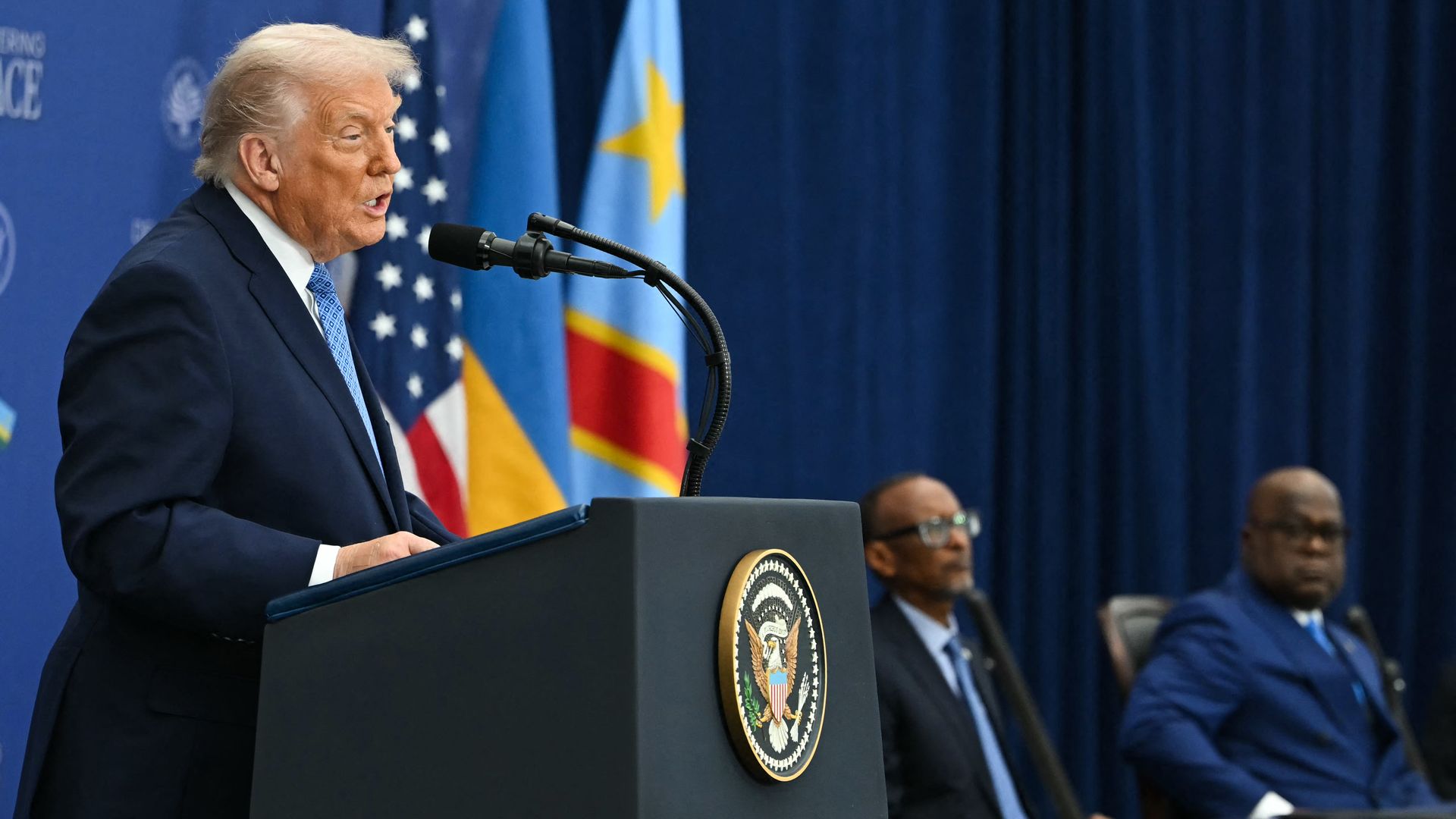
President Trump speaks at Thursday's ceremony as Rwandan President Kagame (c) and DRC President Tshisekedi look on. Photo: Andrew Cabellero-Reynolds/AFP via Getty
President Trump declared an end to the war in eastern Congo on Thursday at a signing ceremony alongside Congolese President Félix Tshisekedi and Rwandan President Paul Kagame.
Reality check: The agreement is largely aspirational, and the early signals are ominous. While Trump described the decades-old conflict as "the eighth war that we've ended," there's been fighting just this week between forces aligned with the Democratic Republic of Congo and Rwanda.
The big picture: Conflict in eastern Congo, including two full-scale wars, has killed an estimated four to six million people since the 1990s.
- The DRC accuses Rwanda of intervening on its territory with its own troops and by backing the M23 militia (Rwanda denies both charges, despite evidence to the contrary). M23 took a large swath of territory earlier this year, including the major border city of Goma.
- Meanwhile, Rwanda views the presence near its borders of the Kinshasa-backed FDLR militia — founded by Hutu extremists after the 1994 Rwanda genocide — as an existential threat.
Driving the news: As the delegations were heading to Washington earlier this week, there were fresh reports of fighting between forces aligned with the DRC and M23.
- Asked whether anything had actually improved on the ground as a result of the deal, Rwanda government spokesperson Yolande Makolo said "it hasn't dramatically changed, but there has been progress."
- "The ceremony is not a magic wand — we'll sign and magically, everything will be peaceful," Makolo told Axios in an interview. She added that despite the difficulties, it was helpful to have the U.S. actively engaged.
- The DRC's embassy in Washington did not respond to a request for comment.
What they're saying: While Tshisekedi and Kagame have exchanged barbs and accusations for months, Trump claimed during Thursday's ceremony that they actually liked each other.
- "They've spent a lot of time killing each other and now they're going to spend a lot of time hugging, holding hands," Trump said.
- Kagame was more measured but said the U.S.-mediated process provided "the clearest and most viable path forward that we have ever had."
- Tshisekedi described the agreement as "a turning point," though he cast some doubt on Rwanda's willingness to comply and said his country would remain "vigilant."
- The ceremony was held at the former U.S. Institute for Peace, which Trump renamed in his own honor this week.
Breaking it down: Under the deal, the DRC is to "neutralize" the FDLR, while Rwanda is to lift its own "defensive measures" and respect DRC's sovereignty.
- With peace secured, economic elements of the deal would kick in. The Trump administration is particularly interested in opportunities to tap the region's immense mineral riches.
Friction point: That peaceful and prosperous end state appears a long way off. In fact, the countries disagree profoundly about what it would actually look like.
- To the DRC, M23's growing foothold in eastern Congo is intolerable. Kinshasa has been holding parallel peace talks with the rebel group but fighting has continued.
- Makolo, meanwhile, claimed the situation had actually improved markedly in areas taken by M23. In Rwanda's view, the DRC and its allied forces are the ones driving destabilization.
What to watch: It's hard to envision a security environment in eastern Congo that's achievable in the near term and acceptable to both Kishasa and Kigali.
