Supreme Court takes up challenge to Mississippi mail-in voting law

Add Axios as your preferred source to
see more of our stories on Google.
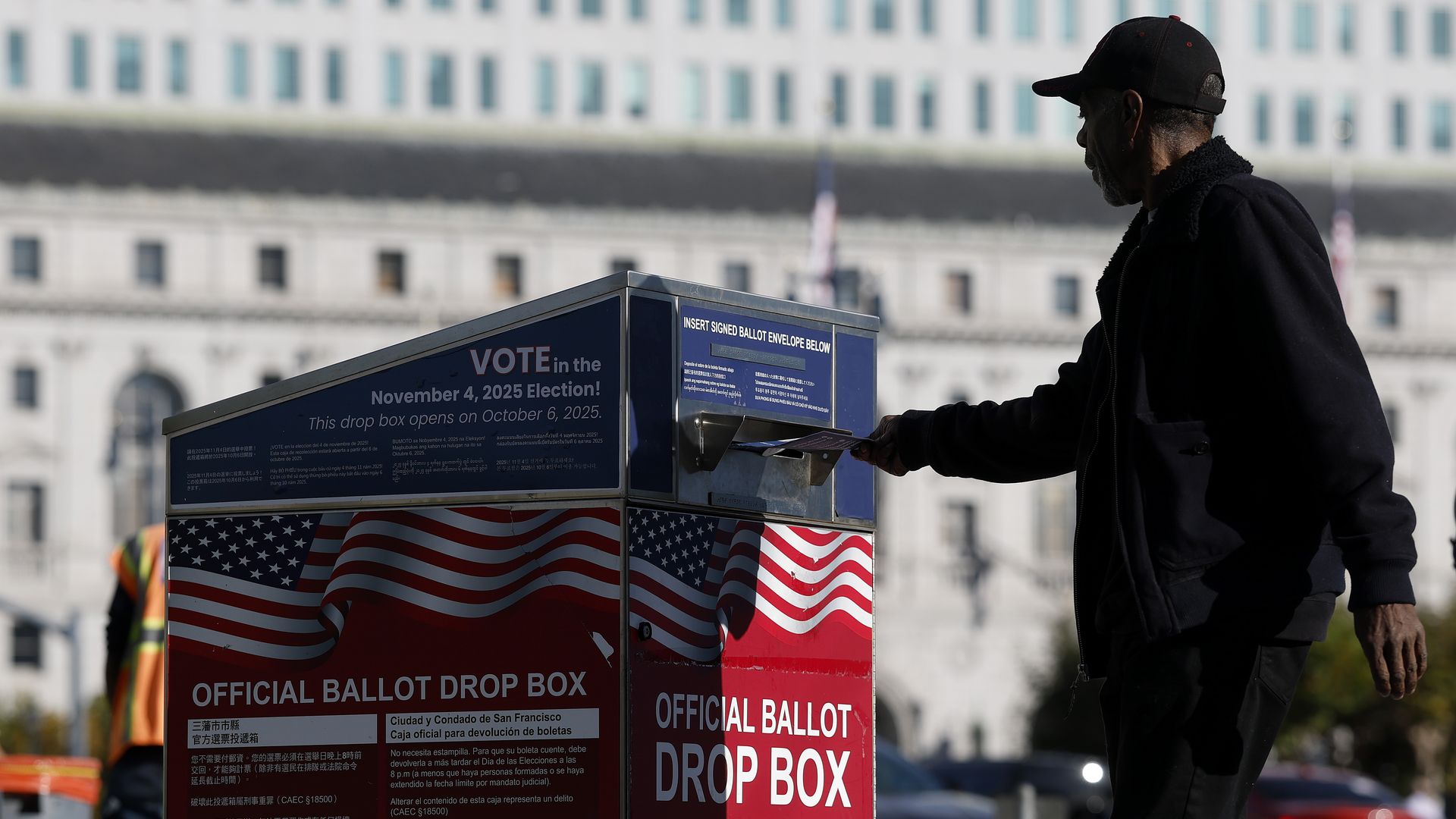
A voter drops his ballot in a drop box outside of San Francisco City Hall on Nov. 4, 2025. Photo: Justin Sullivan/Getty Images.
The Supreme Court on Monday took up a dispute over a Mississippi law allowing election officials to count mail-in ballots received up to five days after Election Day.
Why it matters: President Trump has spent the past five years railing against mail-in voting laws because he claims without evidence that they are part of the reason he lost the 2020 election. At least 28 states and the District of Columbia have similar ballot counting laws on their books.
- Mississippi secretary of state Michael Watson is defending the state's ballot law, which was challenged by the Republican National Committee and state Republican Party.
Context: Federal election law set Tuesday after the first Monday as Election Day for federal offices.
- The Fifth Circuit interpreted that to mean ballots must be cast and received by election officials by Election Day, therefore preempting the state's law.
What inside: "The decision… invites nationwide litigation against laws in most States—risking chaos in the next federal elections," Mississippi officials wrote in their 134-page petition to the court.
- The officials said if the circuits court's ruling is allowed to stay, it "will have destabilizing nationwide ramifications."
- "Federal law does not preempt Mississippi law… All that occurs after election day is the delivery and counting of ballots cast on or before election day."
What they're saying: "Elections must end on Election Day, which is why the RNC led the way in challenging this harmful state law," Republican National Committee chairman Joe Gruters said in a news release.
- "The RNC has been hard at work litigating this case for nearly two years, and we hope the Supreme Court will affirm the Fifth Circuit's landmark decision that mail-in ballots received after Election Day cannot be counted."
The other side: "This case is about whether millions of voters will be disenfranchised through no fault of their own," Marc Elias, whose firm is representing two of the organizations that are defending the state's grace period said.
- "The RNC's position would force states to throw away thousands upon thousands of lawful, valid ballots cast by eligible voters for no other reason than the U.S. Postal Service — which has been experiencing extensive and unpredictable mail delays, made worse under this administration — failed to deliver them by Election Day, something that is often entirely out of the voters' control."
- "That's not what federal law requires, and it's certainly not what voters deserve. Ballots cast on time and in accordance with the law should count."
Zoom in: The appeals court agreed with Mississippi's position that all ballots don't need to be counted by Election Day, but it concluded that all ballots need to be received by end of day.
- "While election officials are still receiving ballots, the election is ongoing," the majority of the circuit court said.
- "[T]he election is consummated when the last ballot is received and the ballot box is closed. [S]o long as the State continue[s] to receive ballots, the election [is] ongoing and ha[s] not been consummated."
By the numbers: Despite Trump's repeated attacks on mail-in voting, 58% majority of Americans support it, according to an August Pew Research poll.
- That includes 83% of Democrats and 32% of Republicans.
What we're watching: The court will likely hear oral arguments in early 2026, and will make a final decision by June.
Go deeper: Trump signs federal elections order with citizenship proof requirements
Editor's note: This story has been updated with a statement from Marc Elias.
