Here's who is getting grant money from colleges

Add Axios as your preferred source to
see more of our stories on Google.
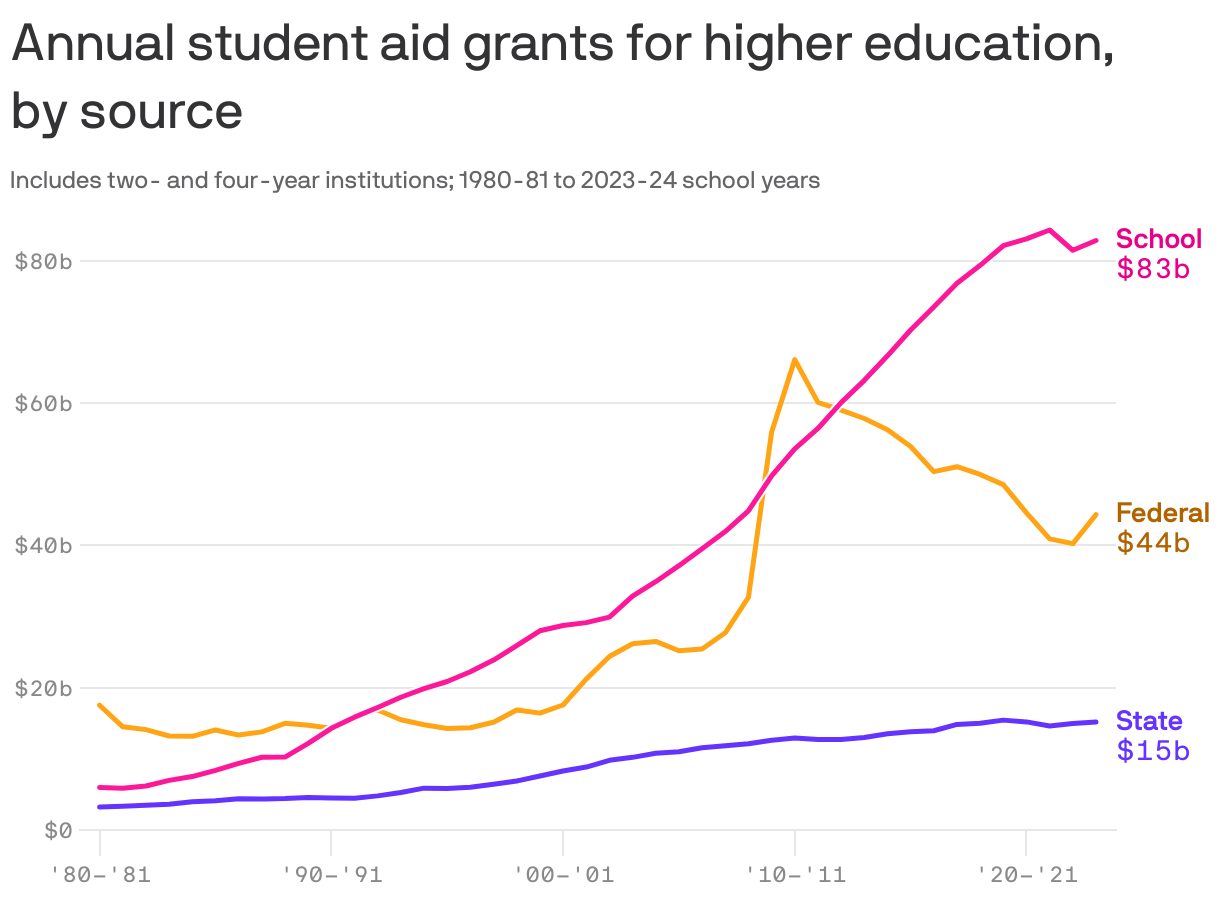
Colleges are throwing more and more money at kids to get them to choose their schools.
Why it matters: That grant money is going to families who need it the least, a new analysis of government data finds.
Zoom in: 56% of students from households in the top income quartile receive grants in excess of need — the cost of their attendance minus expected family contribution.
- That includes money from states, the federal government and the schools themselves.
- Just 0.2%, in the bottom quartile receive grants in excess of need, according to the research from the Century Foundation, a progressive policy think tank.
- There are racial disparities, as well. About three times as many white students (19%) receive grants in excess of need as do Hispanic students and Black students (5%).
The big picture: For the last decade, universities have been raising tuition prices sky-high while offering an increasing amount of grants — framed as merit aid.
- This "high-tuition, high-aid" framework is an experiment in psychology, write the authors of the report. Higher prices make the schools seem better, and the aid makes students feel more special.
- And that's happening as more Americans are questioning the value of going to college at all.
Colleges gave out $83 billion in grant aid in the last school year, up from $50 billion in 2010.
- Over that same period, the amount of aid from the federal government fell to $44 billion, from $56 billion.
- The federal government has pulled back on need-based Pell Grants.
Zoom in: "Groups that need the money less actually receive outsized shares of it," says Peter Granville, a fellow at the Century Foundation who co-authored the report.
The other side: Schools argue that merit awards bring in top students and can help those who don't qualify for financial aid but still can't afford published prices, as WSJ explained years ago when the trend began bubbling up.
Between the lines: Schools are competing for students with the best academic credentials, but that has the knock-on affect of benefiting upper-income kids to the detriment of lower-income students, Granville says.
- And the only way schools can keep offering these grants is by increasing tuition.
- Those higher sticker prices scare a lot of students away.
The bottom line: College is expensive for most families, to be sure. And they all scramble to make it work.
- But for low-income families, high tuition costs can rule out school altogether — financial burdens were cited by U.S. adults as the top reason for not pursuing an advanced degree in a Gallup survey this year.
- The system isn't set-up to attract lower-income students, Granville says. "There's very little working to benefit students who are on the fence about attending college at all."
