How Zohran Mamdani rose to NYC's mayor office after four years in politics

Add Axios as your preferred source to
see more of our stories on Google.
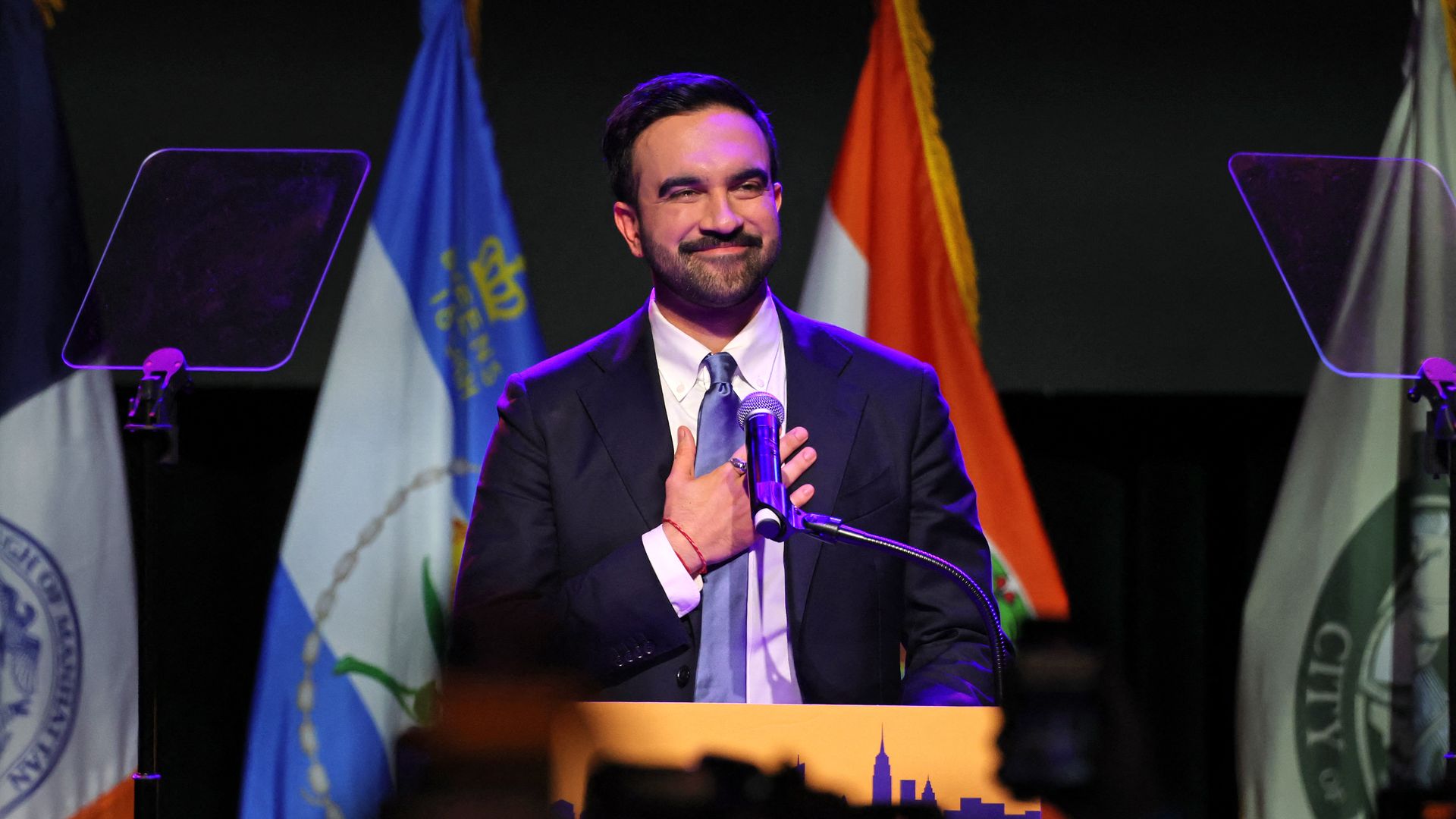
Zohran Mamdani is the first candidate in more than 50 years to win over one million votes in an NYC mayoral election. Photo by ANGELA WEISS / AFP) (Photo by ANGELA WEISS/AFP via Getty Images
Zohran Mamdani's triumph in New York City's mayoral election Tuesday night was a historic victory that could reverberate far beyond the five boroughs.
The big picture: Mamdani, the city's youngest mayor in at least a century, has catapulted into the national spotlight with a speed and popularity that echoes the trajectories of both Rep. Alexandria Ocasio-Cortez (D-N.Y.) and former President Obama.
- To great effect, Mamdani's massive grassroots campaign deployed social media to broadcast his affordability proposals — including a rent freeze and city-run grocery stores — as well as marathon in-person outreach to low-income New Yorkers and communities of color.
By the numbers: Mamdani went from notching 1% in primary polling to becoming the first candidate in more than 50 years to win over one million votes in a NYC mayoral election.
Driving the news: Mamdani's win makes him the city's first Muslim and South Asian mayor, as well as one of the highest-placed democratic socialists in the United States.
- About three-quarters of New York City voters under 30 voted for Mamdani, according to the Associated Press.
- Though young voters were a relatively small portion of the city's electorate, they were also much more likely than older voters to say it was their first time voting in a mayoral election, per the AP.
- Mamdani made huge inroads with low-income voters and voters of color as well.
Here's what to know about Mamdani's career:
Mamdani's early years, college
Mamdani was born in Kampala, Uganda, immigrating with his family to New York City when he was seven years old.
- Both of his parents, Mira Nair and Mahmood Mamdani, are from India originally. Nair is an acclaimed director, best known for her 1991 film Mississippi Masala, and Mahmood Mamdani is a professor of anthropology at Columbia University.
Mamdani attended the Bronx High School of Science, a specialized public school.
- There, Mamdani founded the school's first cricket team.
- "This act, though not ostensibly a political one, taught him how coming together with a few like-minded individuals can transform rhetoric into reality," according to the biography on his New York assemblymember website.
Mamdani earned a bachelor's degree in Africana studies from Bowdoin College in 2014, where he also founded the school's first Students for Justice in Palestine chapter.
He became a naturalized US citizen in 2018.
Housing counselor
Before entering politics, Mamdani worked as a foreclosure prevention housing counselor.
- As a counselor, per his bio, he helped "low-income homeowners of color across Queens fight off eviction and stay in their homes."
- "It was this job that led him to run for office. After having spent every day negotiating with banks that valued profits over people, he came face-to-face with the reality that this housing crisis – one which predated this pandemic – was not natural to our lives, but instead a choice."
Assemblymember
Mamdani was elected to the New York Assembly in 2020.
- He represents the 36th Assembly District and its neighborhoods of Astoria, Ditmars-Steinway, and Astoria Heights — all located in Queens.
- At the time of his election, Mamdani became the first South Asian man, the first Ugandan, and one of only three Muslims to ever serve in the body.
Zoom in: Mamdani's team frequently tied key campaigns as assemblyman to Mamdani's central mayoral economic proposals.
- One such campaign was a 2021 hunger strike among NYC taxi drivers — which Mamdani joined — advocating for debt relief for drivers who had been the victims of financial schemes.
- After 15 days of striking, then-Mayor Bill de Blasio agreed to cap debt loads and monthly payments for the drivers.
Mamdani has also frequently referenced a fare-free bus pilot that he championed.
- The pilot made a single bus route in each borough free for one year between September 2023 and 2024.
- A key policy proposal of his mayoral campaign is to expand that citywide, covering over 330 routes and about 1 million paid trips per weekday.
