These states have the highest shares of unauthorized immigrants

Add Axios as your preferred source to
see more of our stories on Google.
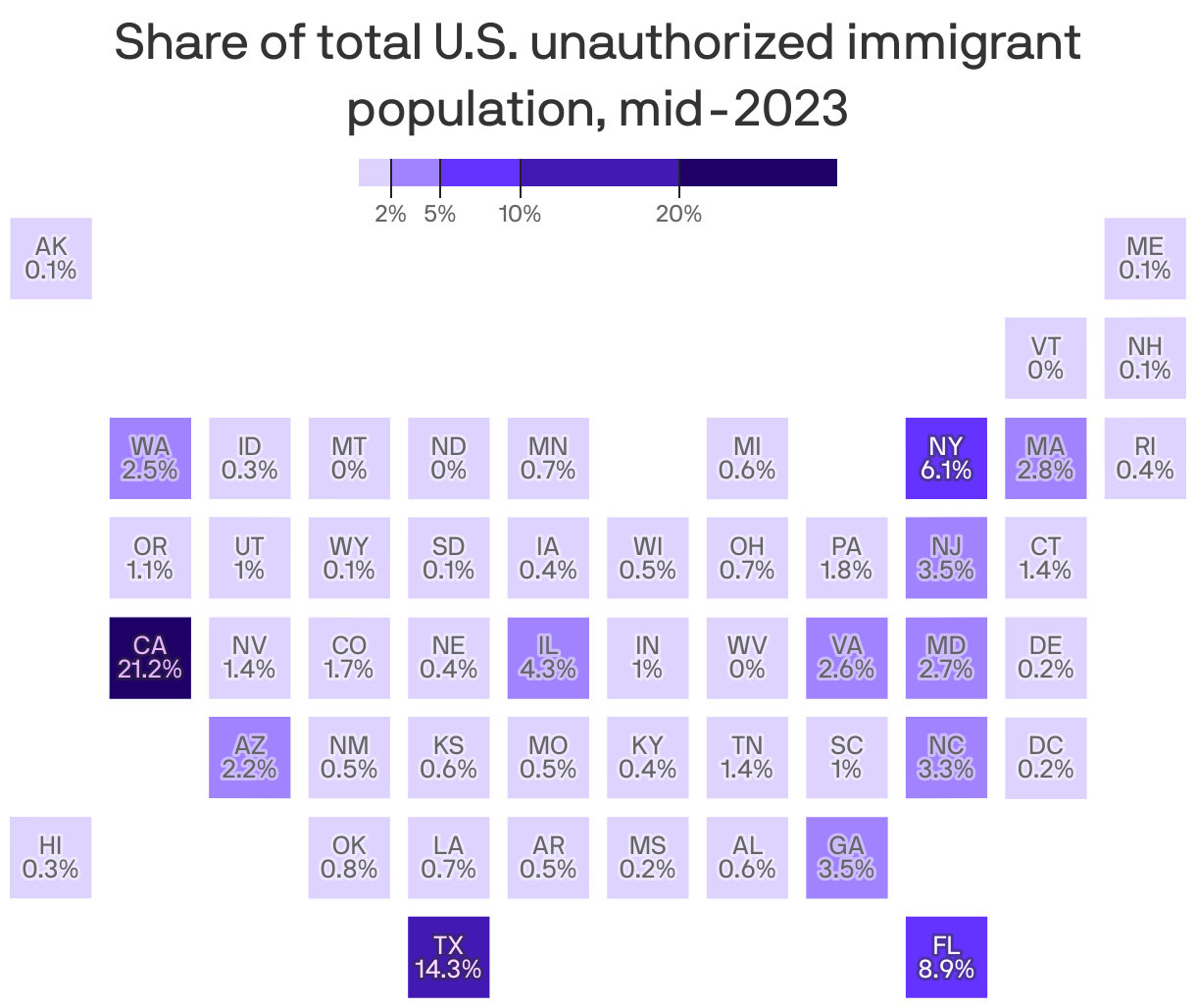
The number of unauthorized immigrants in the U.S. hit 13.7 million by mid-2023, per new estimates, yet growth has likely slowed (and perhaps even reversed) since then.
Why it matters: The report, from non-partisan think tank Migration Policy Institute (MPI), offers insight into a group that's notoriously hard to count — and thus understand.
The big picture: The overall U.S. unauthorized immigrant population grew by 3 million between 2019 and mid-2023, MPI found, noting the country "has not experienced a pace of change this rapid ... since the early 2000s."
Zoom in: As of mid-2023, unauthorized immigrants made up about a quarter of the country's total foreign-born population, per the report.
- Mexicans' share of the unauthorized immigrant population fell to 40% from 62% in 2010 amid more arrivals from South America and the Caribbean.
- "14 million U.S. citizens, green card holders, and temporary visa holders lived in a household with at least one unauthorized immigrant," the report notes.
Stunning stat: Some 6.3 million children — "all but 1 million of them U.S. citizens" — live with at least one unauthorized immigrant parent.
- "Such children are often strongly affected by their parents' limited employment opportunities and restrictions on eligibility for public assistance, as well as the threat of separation due to immigration enforcement," the authors write.
By the numbers: California (21.2%), Texas (14.3%), Florida (8.9%) and New York (6.1%) have the highest shares of the country's overall unauthorized immigrant population.
- Los Angeles County, California (8%); Harris County, Texas (4.4%) and Cook County, Illinois (2.7%) have the highest shares among U.S. counties.
How it works: The U.S. Census Bureau doesn't ask respondents about their legal status, and those in the country without authorization might not volunteer that information regardless.
- MPI's estimates are based on a methodology that "assigns legal status to noncitizens in the U.S. Census Bureau's annual American Community Survey using data from the Survey of Income and Program Participation," per the report.
- The group developed that technique alongside Penn State and Temple University demographers.
Context: A separate Pew Research Center report published in August found that the unauthorized immigrant population hit a record 14 million in 2023, Axios' Russell Contreras reports — a number that generally agrees with MPI's finding.
What's next: Unauthorized immigration probably stopped growing last year and potentially began reversing this year, MPI's report notes.
- That's "based on the very low numbers of U.S.-Mexico border encounters, heavy immigration enforcement inside the country, and an overall atmosphere intended to convince would-be migrants not to come and current unauthorized immigrants to leave."
Go deeper: Trump immigration plan may wipe out 15M jobs by 2035, study claims
