Supreme Court sounds skeptical of Trump's wide-ranging tariffs


Add Axios as your preferred source to
see more of our stories on Google.
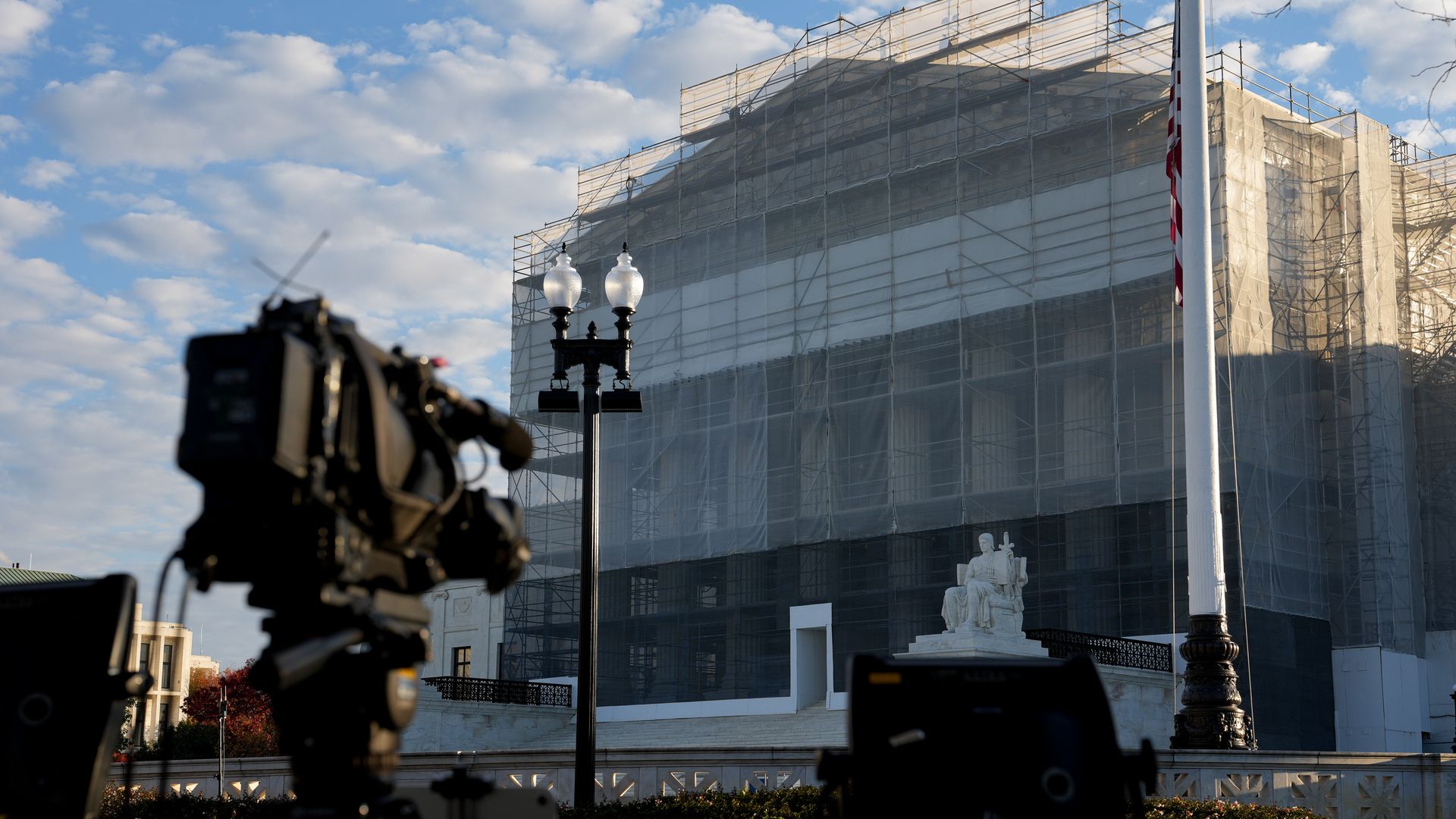
The Supreme Court building ahead of oral arguments in a case challenging the legality of a bulk of President Trump's global tariffs. Photo: Eric Lee/Bloomberg via Getty Images
President Trump's tariffs seemed to be in jeopardy on Wednesday at the Supreme Court, in a high-stakes case that will decide the fate of a critical aspect of Trump's economic and foreign policy agenda.
The big picture: Some of the conservative justices seemed skeptical that Trump has the power to impose such far-reaching tariffs. A ruling against Trump could be devastating to one of his signature second-term priorities.
Driving the news: The court heard oral arguments on Wednesday in a challenge to a slew of Trump's tariffs, including the "Liberation Day" levies and a separate set imposed on Canada, Mexico and China.
- At least two of the likely swing votes in this case — Chief Justice John Roberts and Justice Amy Coney Barrett — indicated they may be inclined to slap down, or at least curb, the lion's share of the tariffs.
- "The vehicle is imposition of taxes on Americans, and that has always been a core power of Congress," Roberts said during the arguments.
Catch up quick: A federal appeals court ruled that many of Trump's tariffs are illegal, leaning on the same basic logic that the Supreme Court used to strike down some of President Biden's most sweeping uses of unilateral authority.
- The Supreme Court's "major questions doctrine" holds that the executive branch can't enact programs that have "vast economic and political significance" without explicit authorization from Congress.
- The justices used that doctrine to strike down Biden's plan for student-loan forgiveness and a COVID-era eviction moratorium. Trump's tariffs have vastly bigger economic and political significance than either of those policies, courts in the tariff cases ruled, and therefore run afoul of the major questions doctrine.
What they're saying: Roberts noted that Trump is claiming "a power to impose tariffs on any product, from any country, for any amount, for any length of time."
- "It does seem like that's major authority," Roberts said.
Between the lines: The Justice Department argued first that Congress has, in fact, given the president sweeping tariff powers.
- But the statute it's relying on hasn't been used this way before, and some of the conservative justices seemed skeptical of the administration's rationale.
- "It's pretty clear that Congress was trying to constrain the emergency powers of the president," not expand them, Barrett said.
Yes, but: Oral arguments are an imperfect guide to how the justices are likely to rule, and the court's conservatives asked tough questions of all sides.
- Roberts questioned whether a ruling against Trump would unfairly tie the president's hands in foreign policy. Barrett also expressed concern about restricting trade too heavily, and about the process of reimbursing businesses for tariffs they've already paid.
- Justices Clarence Thomas and Samuel Alito seemed firmly on Trump's side, and Justice Brett Kavanaugh seemed to be leaning in that direction. The three liberal judges appeared united against Trump.
The intrigue: Solicitor General John Sauer, who argued on behalf of the government, tried to draw a distinction between the import tariffs imposed by Trump and taxes.
- But mainstream economists see them as one in the same — a view with which many justices appeared to agree.
Zoom out: Financial markets will be watching the outcome of the case closely, given how a potential ruling could impact the economy and the nation's fiscal outlook.
- As the case got underway, prediction markets assigned dwindling odds that the Supreme Court would uphold the tariffs — roughly 22% as of noon ET, down from about 40% before the hearings began on Wednesday, according to Polymarket.
