Scoop: Dem House nominee won't commit to backing Jeffries

Add Axios as your preferred source to
see more of our stories on Google.
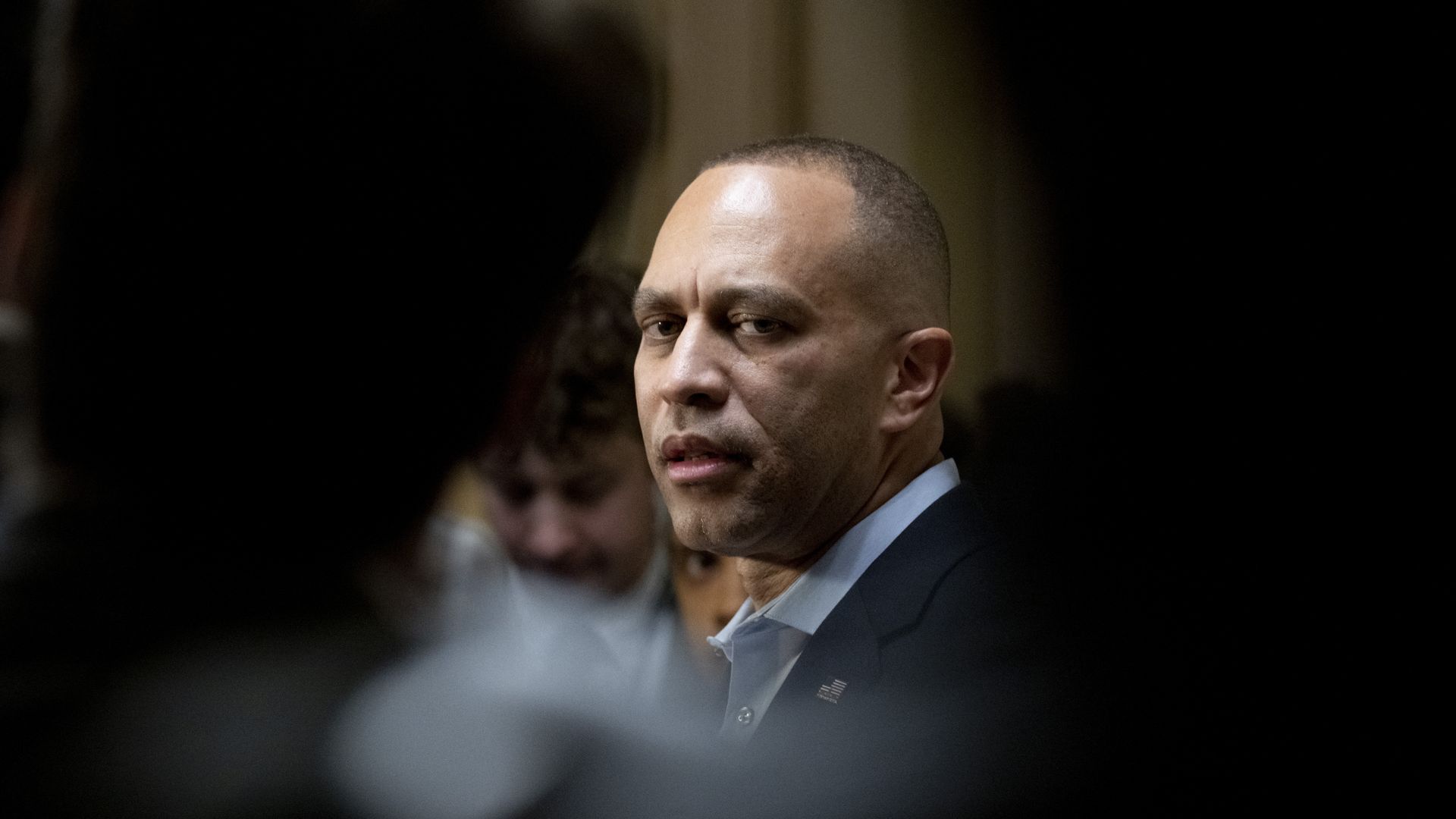
House Minority Leader Hakeem Jeffries speaks at a press conference at the U.S. Capitol on Nov. 3. Photo: Jim Watson/AFP via Getty Images
Democrats' nominee for a special House election in Tennessee declined to say whether she would vote for Minority Leader Hakeem Jeffries (D-N.Y.) as speaker or leader if elected.
Why it matters: Aftyn Behn represents a growing anti-establishment sentiment that has proliferated within the party base for months and is now spilling over into congressional races.
- "I was not the choice candidate from either party," Behn told Axios in a phone interview Wednesday morning. "I have made my career as a political outsider."
- "I think people, especially Tennesseeans, are just tired of this partisan rhetoric. They're tired of the scapegoating, they're tired of the blaming, they want results."
State of play: Behn, a state representative, is running against Republican Army veteran Matt Van Epps in a Dec. 2 special election to succeed former Rep. Mark Green (R-Tenn.), who resigned to enter the private sector.
- She won a hotly contested, four-candidate Democratic primary in which she was the favorite of progressive groups like Indivisible and the Progressive Democrats of America.
- She defeated fellow state Reps. Bo Mitchell and Vincent Dixie, as well as self-funded businessman Darden Copeland.
- Behn faces an uphill battle in the Nashville-based 7th district, which President Trump won by more than 22 percentage points last year, but she told Axios her internal polling shows her virtually tied with Van Epps.
Driving the news: Asked if she would vote for Jeffries in an internal House election as either speaker or minority leader, Behn said "he represents his district, and obviously the district that I would represent is very different."
- "This campaign hasn't been about one party in particular, it's been about a paradigm in which the top are pitting the bottom against each other," she said.
- Behn told Axios that message has "really resonated with voters, including a lot of independents, which is part of our calculus to win."
- Pressed further, Behn said she is "hyper-focused on this race, which is in less than a month, and I haven't even really thought about it. I'm just trying to win."
Zoom out: Behn joins dozens of Democratic House candidates who told Axios earlier this fall that they either wouldn't vote for Jeffries as speaker or declined to commit to doing so.
- Many of those Jeffries skeptics are running as the progressive, anti-establishment candidates in crowded primaries for safely blue districts.
- But others are more credible primary challengers to older Democratic incumbents who, in some cases, have out-raised their opponents and stand a decent shot of being elected to Congress.
Reality check: Democrats distancing from party leaders in D.C. as they run for election in tough districts far beyond the beltway is far from a new phenomenon.
- Former House Speaker Nancy Pelosi (D-Calif.) faced persistent opposition from her centrist wing but always managed to either stay minority leader or get elected speaker until stepping down voluntarily in 2022.
- Jeffries has thus far retained the rock-solid support of his caucus, never suffering a single defection in 20 speaker ballots over the last three years.
- And several senior progressives have told Axios privately that while the anger towards leadership is real, they believe Jeffries will ultimately be elected speaker if Democrats win the House next year.
Yes, but: The growing number of Democrats publicly criticizing Jeffries signals that the party is entering a new, more unruly phase — akin to the Republican Tea Party wave in the 2010s.
- The Democratic base is growing increasingly frustrated with their leadership and the political status quo, grumbling that Democrats need to break the rules of political decorum and fight dirty.
- That has led to a growing number of candidates who, like Behn, are as likely to distance from Democrats as they are to criticize Republicans.
The bottom line: "What we're trying to do in the South is rewrite the democratic playbook about what it means to win here and the type of candidate that can win," Behn told Axios.
