These U.S. presidents considered third terms (before they were illegal)

Add Axios as your preferred source to
see more of our stories on Google.
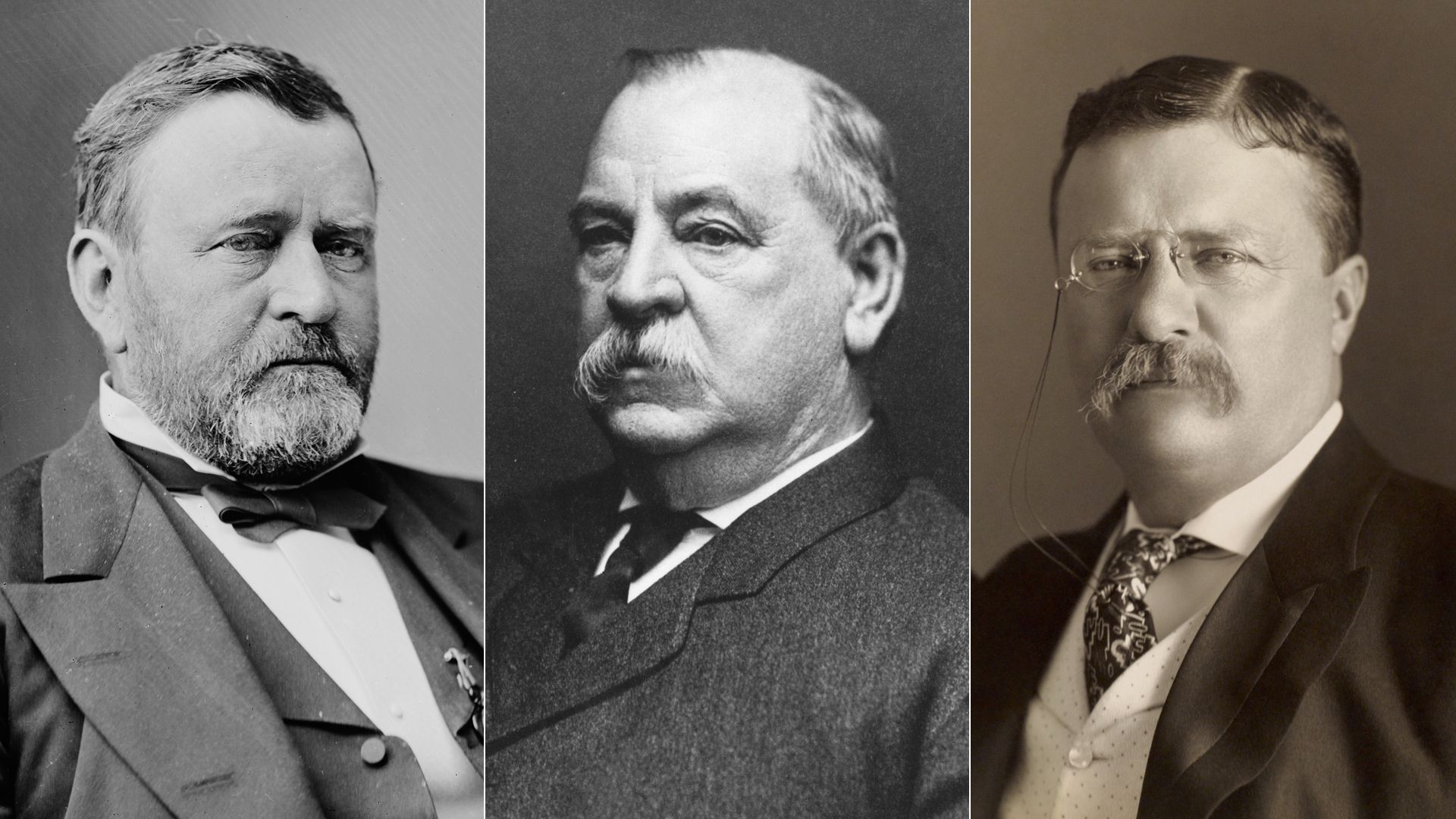
Ulysses S. Grant, Grover Cleveland and Theodore Roosevelt. Photos: Library of Congress, U.S. National Archives and Records Administration
President Trump isn't the first commander-in-chief to tease a third presidential term.
The big picture: There is a strange and unusual history of presidents considering third terms — until the 22nd Amendment made them illegal.
- The amendment, ratified in 1951 and widely promoted by Republicans following Franklin Delano Roosevelt's four-term presidency, made it impossible for presidents to seek a third term.
- Allowing a third term for a president would likely require amending the Constitution and repealing the 22nd Amendment. But doing so is an arduous process that's unlikely to succeed, as there is virtually no path that would see the required two-thirds of both chambers of Congress and three-quarters of the U.S. states agreeing to a repeal.
Driving the news: Trump didn't deny he would like a third term on Monday.
- "I haven't really thought about it," he told reporters on Air Force One, adding: "I would love to do it. I have my best numbers ever."
- Trump's comments echo similar statements from former White House adviser Steve Bannon, who has teased a 2028 Trump ticket.
- The White House declined to comment.
Reality check: The 22nd Amendment clearly states that "no person shall be elected to the office of the President more than twice." Trump won the 2016 and 2024 elections.
Yes, but: Before it was illegal, former presidents considered and even attempted running for third terms. The term limit was considered a tradition after George Washington decided not to run again following his two-term tenure.
- Term limits for presidents had been considered for years, but lawmakers failed to pass anything before World War II.
- During the Civil War, the Confederate States of America wanted one, six-year term.
Here's a look at presidents who considered third terms and why all but one didn't win them.
Ulysses S. Grant
Grant was considered for a third term in multiple elections.
- In 1872, after Grant won reelection, Republican political circles discussed the idea of a third term, with Grant running in 1876. However, there was widespread backlash from states to the idea, according to a University of Minnesota Law School review of presidential history.
- Grant also publicly discounted a third term, but said there was nothing to prohibit him from running.
- He revived a third-term campaign for the 1880 election, but Grant failed to secure the Republican nomination — which went to James Garfield, per the U.S. Constitution Center.
Grover Cleveland
Cleveland made history as the first president to serve nonconsecutive terms. He won the 1884 election, serving from 1885 to 1889. After losing the 1888 election, Cleveland returned to win the 1892 election, winning the White House.
- The two-term president was rumored to run for a third term in 1896, but lacked enough support.
Theodore Roosevelt
Roosevelt has a storied history with third terms.
- He became president in 1901, finishing William McKinley's term after the president was assassinated. He was then elected to a full term in the 1904 election. He declined to seek a third term in 1908.
- However, Roosevelt had a falling out with President William Howard Taft, which led him to seek a third nonconsecutive term in the 1912 election. Roosevelt failed to win as a third-party candidate for the "Bull Moose Party." Woodrow Wilson ultimately won the presidency.
- Roosevelt entertained the idea of running again in the 1916 election, but declined. That election was won, again, by Wilson.
Woodrow Wilson
After serving two terms, Wilson considered a third stint at the White House, too, believing that the close 1920 convention would lead to his nomination.
- However, Democrats declined to nominate him, instead picking James Cox — who lost to Warren G. Harding in the presidential election.
- Wilson "fantasized about running" for a nonconsecutive third term in 1924 before he died that year, per the University of Virginia's Miller Center.
Franklin D. Roosevelt
Roosevelt shattered the two-term precedent, serving as president from 1933 to 1945.
- Roosevelt was elected to serve a fourth term beginning in 1945, but died in April of that year — leading to Harry S. Truman's presidency.
- After FDR's death, momentum from lawmakers picked up to add presidential term-limits.
After the 22nd Amendment
Harry Truman sought a third term as the 22nd Amendment was ratified while he was in office. He was grandfathered in, with the language allowing him to run in 1952, the Constitution Center says.
- But Truman lost a primary election in New Hampshire, and he dropped out of the race.
Lyndon B. Johnson became president in 1963 following the assassination of President John F. Kennedy. He finished out the term and then ran for office in 1964, which gave him a second term.
- Johnson was eligible to run for a third nonconsecutive term since he served less than two years following Kennedy's death. He won a tight 1968 primary race in New Hampshire, but it was a sign of waning support.
- Ultimately, Johnson chose not to run again — a move that shocked many at the time.
President Trump has teased running for a third term for years. More recently, MAGA loyalists and pro-Trump groups have pushed for a third Trump presidency.
Go deeper:
Trump store sells hats teasing third term in 2028
