GM plans "eyes-off" self-driving car system in AI advancement

Add Axios as your preferred source to
see more of our stories on Google.
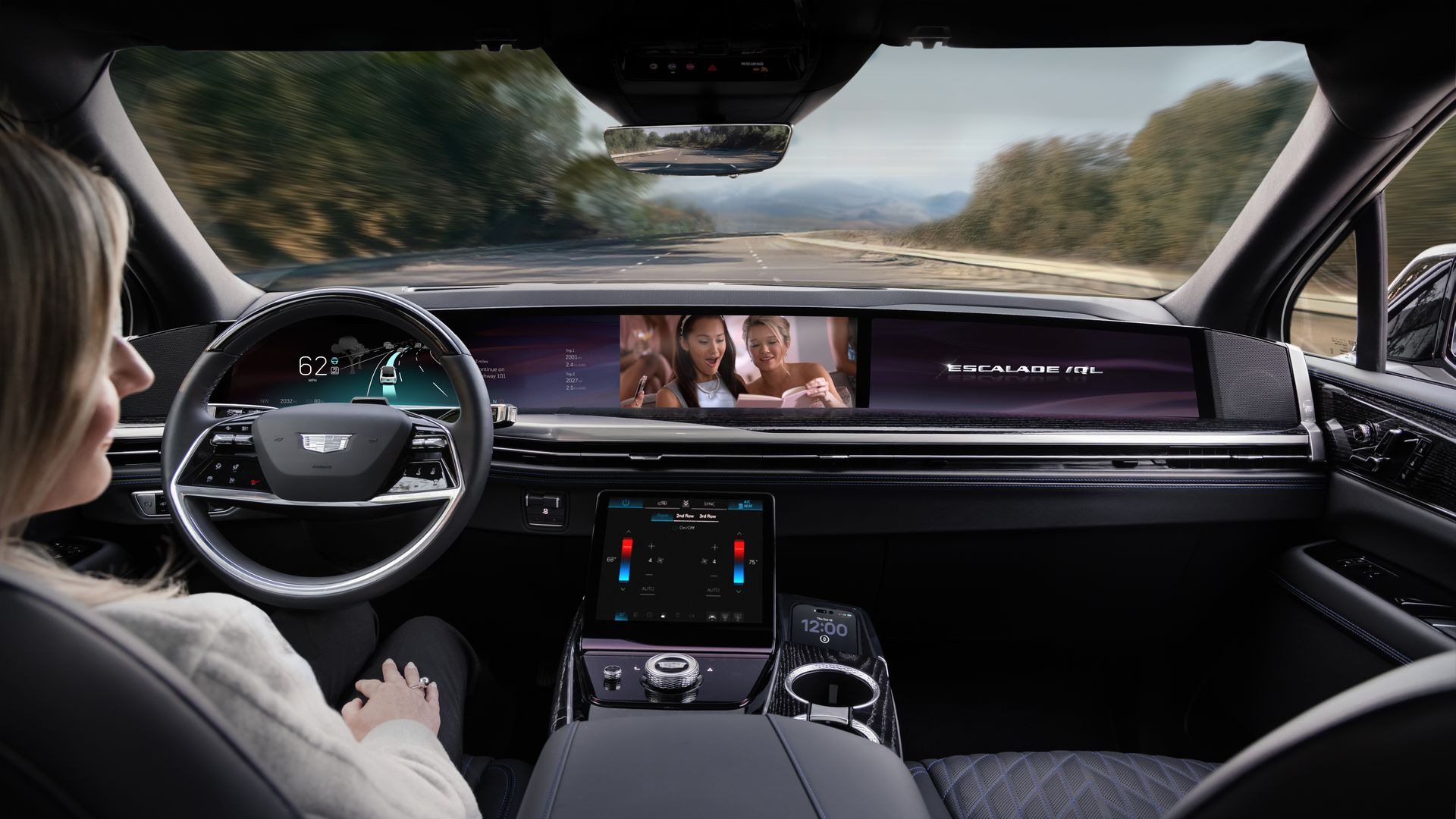
The Cadillac Escalade IQ will be the first vehicle to feature GM's new "eyes-off" driving system. Photo: GM
General Motors said Wednesday it will introduce an "eyes-off" autonomous driving system on a consumer SUV in 2028.
Why it matters: No major automaker has yet commercialized self-driving car technology that legally allows car owners to travel from place to place in their vehicle without keeping their eyes on the road.
- "It's more than just a vehicle," GM CEO Mary Barra said at a press event. "It makes your life easier, more streamlined, and, more importantly, safer."
Driving the news: The system will debut on the Cadillac Escalade IQ electric SUV, starting with highway driving and eventually transitioning to include urban roads.
- "This allows you to do something else at that time, connect with others, catch up on work, your favorite TV show," GM chief product officer Sterling Anderson told Axios in an interview.
What they did: GM customers have already driven 700 million miles using the company's current Super Cruise system, which drives the vehicle under certain conditions while using eye-tracking technology to ensure the operator is still paying attention to the road.
- The new "eyes-off" system builds off of Super Cruise's learnings, as well as the advancements made by the Cruise driverless car division that GM shuttered in late 2024.
State of play: Unlike GM's planned offering, Tesla's "full self-driving" (FSD) system drives the vehicle in many environments, but requires drivers to keep their eyes on the road.
- Waymo provides driverless rides in several major cities, but does not sell vehicles to the public.
How it works: GM's eyes-off system will use a mix of light detection and ranging (lidar), radar and cameras.
- That contrasts with Tesla's FSD, which uses only cameras. CEO Elon Musk says the transportation network was built for humans who drive only with their eyes, and thus self-driving cars should work the same way.
- GM's Anderson — who helped develop Tesla Autopilot and the Tesla Model X before cofounding autonomous trucking firm Aurora — said he disagrees with his former boss: "What I told him then, and what I'll remind him now, is humans have ears, noses, tongues, touch," Anderson tells Axios.
- "The evolutionary analog doesn't work here," he added. "Why do we have multiple modes? And why have we somehow managed to fuse them? And you don't think you can fuse LiDAR, radar and camera?"
The big question: What will it cost?
- GM executives declined to say, but the current Super Cruise system requires a monthly subscription of about $40.
GM also announced plans to launch a "conversational AI" system in its vehicles, using Google's Gemini platform.
- The system will "enable a more natural conversation" between driver and the vehicle, said David Richardson, SVP of software and services engineering.
- "It's practical AI that makes your life better," he said at a press event.
- GM plans to eventually introduce its own AI system capable of providing services such as proactively identifying maintenance issues or identifying dinner options.
- The company is also rolling out a "new centralized computing platform" beginning with the Escalade IQ that will operate all the systems in the vehicle. It will increase the company's ability to send wireless updates to its vehicles 10-fold and enable its vehicles to add more AI features in the future.
The big picture: The announcement comes a day after GM's stock soared, following a strong earnings report that signaled the company expects a far lower tariff bill than previously expected.
- The automaker raised its full-year outlook for adjusted earnings before interest and taxes to a range of $12 billion to $13 billion, up from a previous range of $10 billion to $12.5 billion.
What to watch: As GM seeks manufacturing efficiencies, the company plans to roll out collaborative robots, or cobots, in its factories, Anderson said.
- He said the company does not view them as a replacement for workers.
- "They take on some of the more physically demanding tasks that a human no longer has to do," he told Axios.
- Unlike Tesla's humanoids, which have legs, GM views wheels as a better solution for mobile robots, Anderson added.
- "If biological systems could have evolved the wheels, they probably would have," he said.
