Judge blocks federal agents from using force on journalists in Chicago

Add Axios as your preferred source to
see more of our stories on Google.
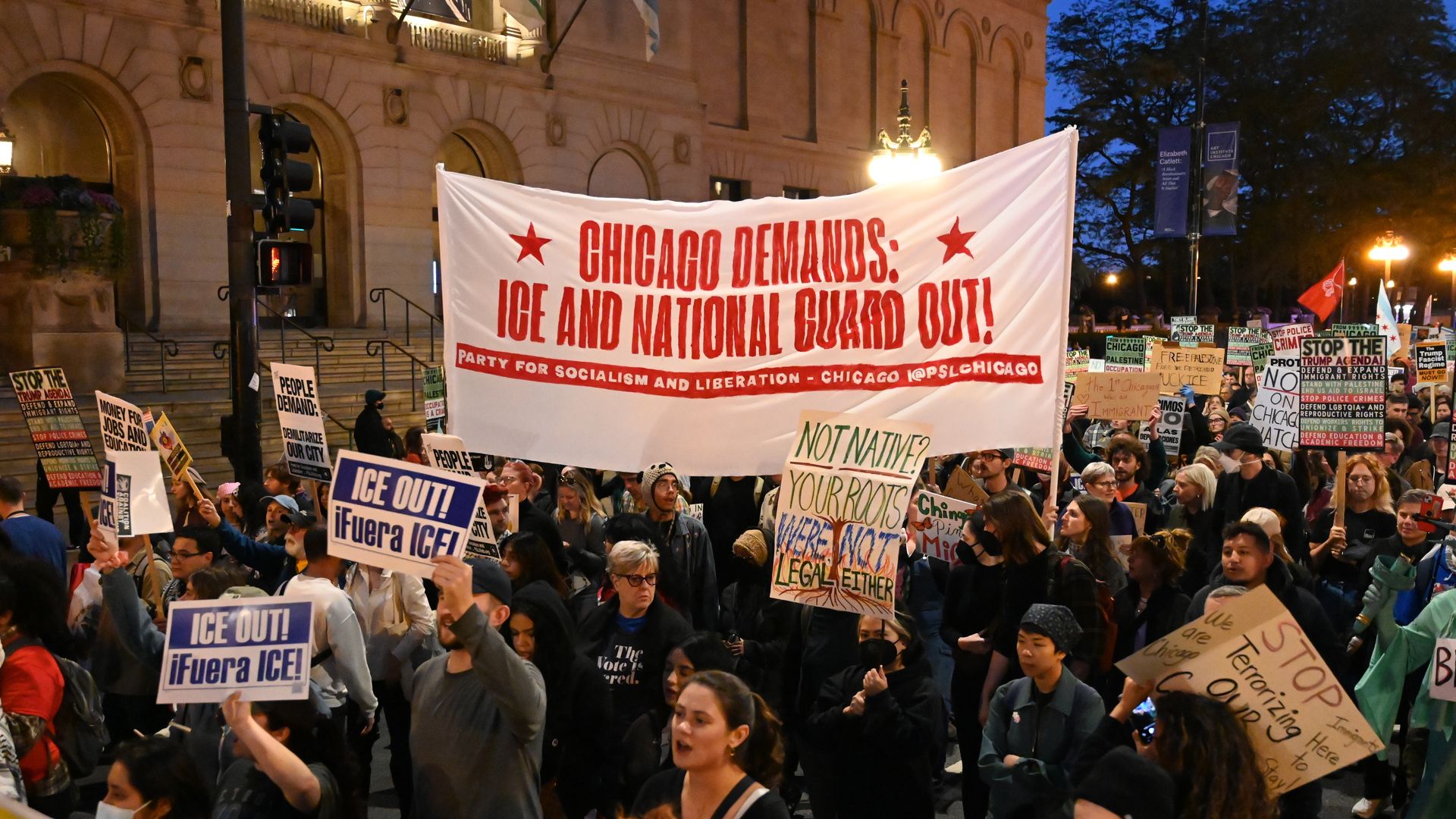
People gather in downtown Chicago for an emergency protest demanding immigrant and worker rights on October 08, 2025. Photo: Jacek Boczarski/Anadolu via Getty Images
Federal agents in Chicago cannot target journalists and protesters with riot control weapons, a federal judge ruled in a temporary order Thursday.
Why it matters: The ruling for now provides added legal protection for journalists and protesters in Chicago who alleged they were targeted with "extreme brutality" outside an ICE facility while exercising their First Amendment right to cover immigration enforcement.
State of play: Federal officers will be restricted from using physical force, arresting, threatening or dispersing anyone they "know or reasonably should know" is a journalist unless they "have probable cause to believe that the individual has committed a crime unrelated to failing to obey a dispersal order," per Ellis' ruling in Illinois.
- Riot control weapons, such as tear gas and rubber bullets cannot be used on reporters, protesters or religious observers unless they pose a safety threat to others or law enforcement officers, the Obama-appointed judge ruled.
- Under the order, Department of Homeland Security agents and other federal officials must give at least two audible warnings before deploying any riot control weapons.
- All federal agents must bear visible identification on uniforms or helmets, unless doing so conflicts with standard uniform protocol or undercover duties, per Ellis.
What they're saying: "Journalism is not a crime," said Jon Schleuss, president of The NewsGuild-CWA, in a statement responding to the ruling.
- "Every American must loudly condemn the Trump administration's assault on our First Amendment rights."
The other side: "We remind members of the media to exercise caution as they cover these violent riots and remind journalists that covering unlawful activities in the field does come with risks — though our officers take every reasonable precaution to mitigate those dangers to those exercising protected First Amendment rights," DHS Assistant Secretary Tricia McLaughin said in a media statement.
- Representatives for the White House referred Axios for comment to the DHS, which did not immediately respond to Axios' Thursday evening request for comment. Representatives for Immigration and Customs enforcement and the Justice Department, which are named in the suit along with Trump and the DHS, did not immediately respond to Axios' Thursday evening request for comment.
Catch up quick: Illinois is suing the administration in an attempt to bar the deployment of the National Guard to Chicago.
- U.S. District Judge April Perry temporarily blocked Trump from sending the National Guard to Illinois Thursday evening, putting an immediate stop to the approximately 500 members already stationed in the city.
- Trump has threatened to invoke the 1807 Insurrection Act, which allows the deployment of troops to settle unrest without state approval, if courts continue to bar him from his crime crackdown.
What we're watching: The ruling is due to remain in effect until Oct. 23.
Go deeper: Judge blocks Trump's deployment of National Guard to Chicago
Editor's note: This piece was corrected by removing a quote from a White House spokesperson who mistakenly commented on a different lawsuit. The story was also updated with a comment from DHS.
