Scoop: Republicans plan bill to consolidate government-funded broadcasters

Add Axios as your preferred source to
see more of our stories on Google.
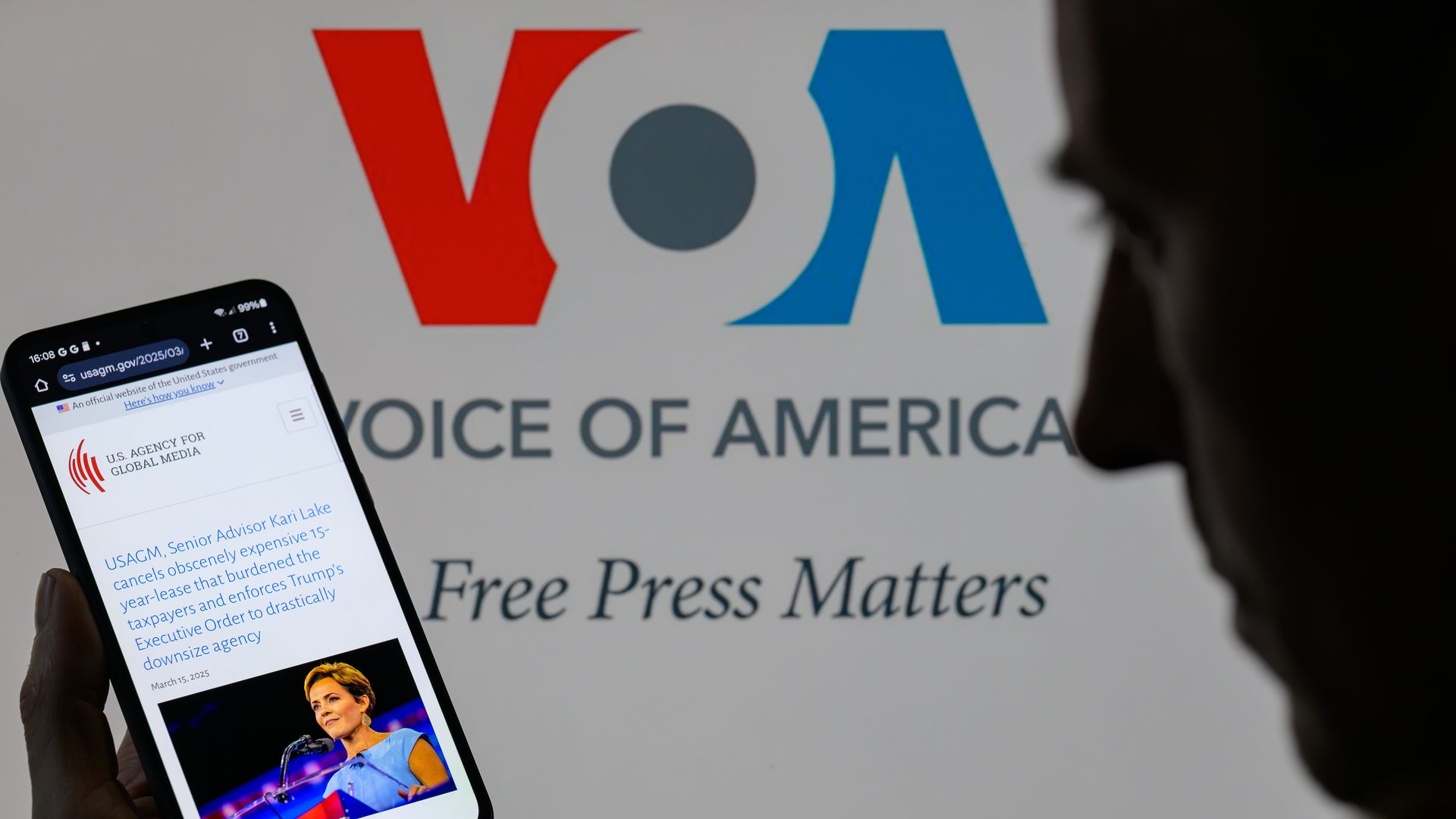
The U.S. Agency for Global Media website is displayed on a phone with Voice of America branding in the background. Photo: Jonathan Raa/NurPhoto via Getty Images
Rep. Young Kim (R-Calif.) on Monday is set to introduce a new bill to consolidate government-funded broadcasters overseen by the embattled U.S. Agency for Global Media and give the State Department more control as a way to preserve their funding and continue their efforts to counter foreign disinformation.
Why it matters: The bill aims to salvage decades-long efforts by government-funded broadcasters to provide news reports to countries with little or no access to independent reporting, while appeasing conservatives who think USAGM should be abolished.
Zoom in: The bill aims to consolidate three USAGM broadcasters — Radio Free Europe/Radio Liberty, Radio Free Asia and Middle East Broadcasting Networks — into one unified broadcaster that receives government funding through a State Department-distributed contract, according to draft text reviewed by Axios.
- It doesn't provide a name for the proposed unified broadcast entity, but calls for the assistant secretary for the Bureau of Democracy, Human Rights, and Labor at the State Department to become the issuer of its funding contract.
- The unified broadcasting unit would be governed by a single board, essentially eliminating the independent boards at each broadcaster, but the individual agencies would still be able to preserve their individual branding.
- Oversight of Voice of America, the largest government-funded broadcaster within USAGM, and the Office of Cuba Broadcasting, would be transferred to the State Department's Office of Global Media within the Bureau of Global Public Affairs.
- The bill calls for all broadcasters to receive the same amount of funding as they are currently appropriated by Congress.
Between the lines: The bill, titled "The Information Warfare Modernization Act of 2025," has a few Republican co-signers, including Rep. Joe Wilson of South Carolina, and Reps. James Moylan and Aumua Amata Coleman Radewagen, delegates from Guam and American Samoa.
Zoom out: The proposal would essentially kill USAGM and transfer more power and control over U.S. government-funded broadcasters to the administration.
- Such an effort is likely to face legal scrutiny, as it would challenge the existing firewall meant to protect independent broadcasters, like the VOA, from government influence.
- There have been several lawsuits waged against the administration by government-funded broadcasters and their employees alleging the executive branch has overreached in its efforts to dismantle USAGM, a congressionally appropriated agency.
- The administration has looked to continue firing USAGM employees, despite legal setbacks. Most recently, a U.S. district judge ruled in August that USAGM special advisor Kari Lake's effort to remove VOA Director Michael Abramowitz was unlawful.
Yes, but: While Kim's bill would certainly challenge some of the independence of government-funded broadcasters, it does aim to preserve their funding as adversaries overseas try to fill an information gap left by the gutting of those news agencies.
- "Every time we fail to speak the truth, our adversaries fill the void. We cannot hand the microphone over to China, Russia, Iran and North Korea," Kim said in a statement.
- "This bill allows our trusted broadcasting partners to continue critical coverage of human rights abuses and repression in countries where it is suppressed, while ensuring that every taxpayer dollar effectively advances U.S. national security interests. If we don't preserve this critical channel of influence, we risk losing hearts and minds around the world."
The big picture: VOA was created more than 80 years ago to combat Nazi propaganda during WWII. Its mission, to promote democracy and American interests abroad through fact-driven journalism, has been supported for many years by both Republicans and Democrats.
- President Trump looked to defund USAGM in his first term, but his efforts were stymied by legal challenges.
- In recent years, Republicans have taken aim at USAGM, formerly the Broadcasting Board of Governors, arguing those agencies were mismanaged.
- Kim hopes her new bill will address the "logistical, operational, and editorial issues that limited VOA's effectiveness under USAGM by bringing it under the State Department in support of U.S. public diplomacy," her office said in a statement.
Editor's note: This story has been corrected to reflect the proposal would make a State Department official the issuer (not grantee) of the funding contract.
