"Kissing bug" disease now seen as "endemic" in the U.S.

Add Axios as your preferred source to
see more of our stories on Google.
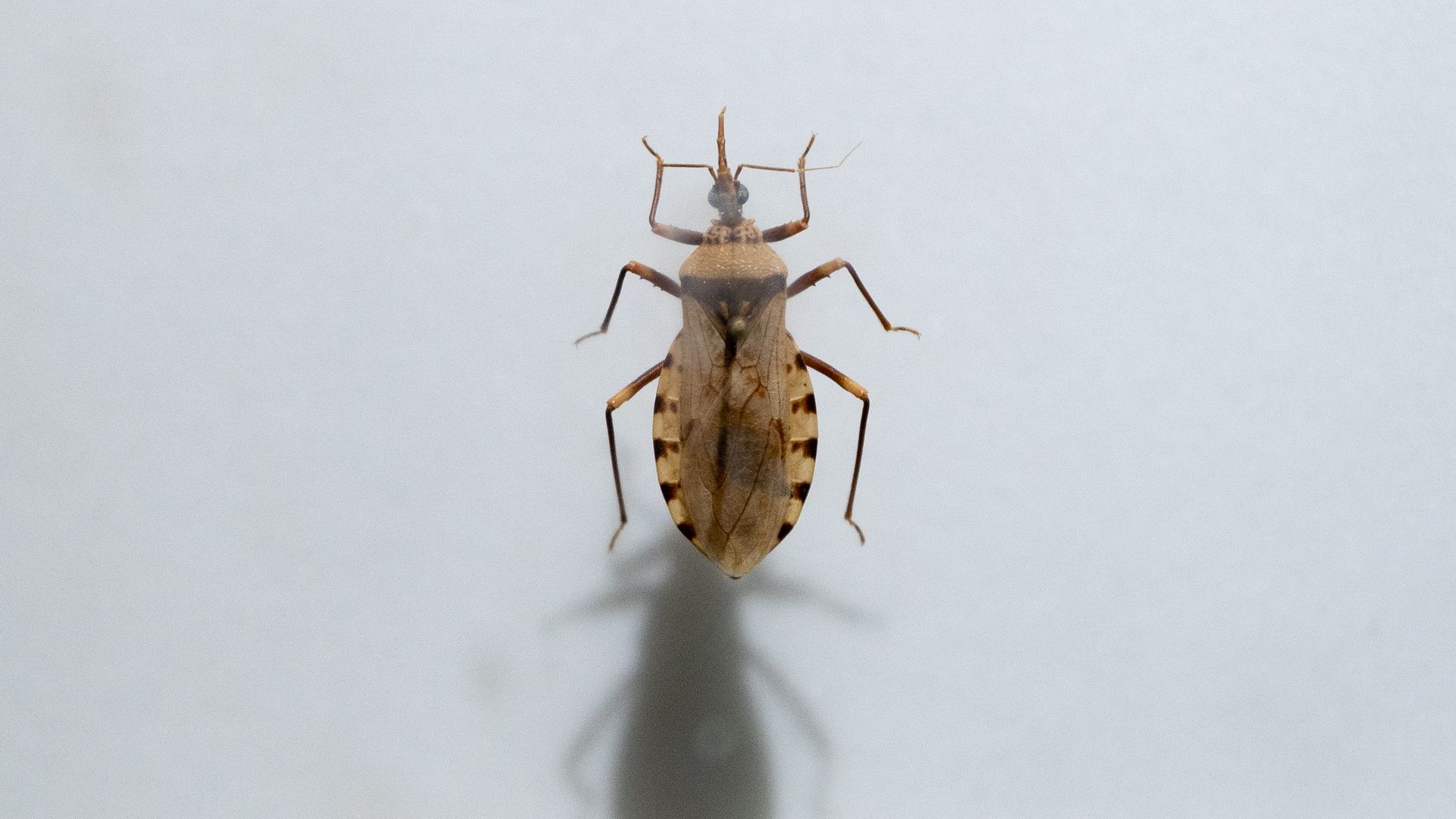
Close-up of a Panstrongylus megistus insect at Faunia zoo in Madrid, a known vector of Chagas disease. Photo: Marcos del Mazo/LightRocket via Getty Images
Worries about the spread of Chagas disease — which comes from an insect known as the "kissing bug" — are rising.
The big picture: Though experts have been concerned about the potentially fatal disease for years, the parasitic disease was only recently deemed endemic in the United States.
- "Endemic" status could allow for more Chagas education in medical schools, giving physicians a better chance to identify and diagnose patients early — a crucial step in avoiding fatalities.
- The label was recommended by multiple researchers in the September issue of the CDC's Emerging Infectious Diseases journal.
Driving the news: The September report published by the Centers for Disease Control and Prevention deemed the disease as endemic in the U.S., meaning it has a constant presence but is limited to a region, making its spread easier to predict.
- The disease was already endemic in 21 countries across the Americas.
- Labeling the disease as endemic "could improve surveillance, research, and public health responses," the CDC said, and "is crucial for achieving global health goals."
By the numbers: The CDC estimated about 280,000 people were infected with Chagas disease in the U.S., with 8 million globally last year.
- 45,000 people were infected in Los Angeles County alone, per a UCLA Health report from September.
- Fewer than 1% are diagnosed and treated in the U.S. due to low awareness.
What they're saying: "Most people living with Chagas disease are unaware of their diagnosis, often until it's too late to have effective treatment," said Judith Currier, chief of infectious diseases at UCLA Health, in a statement.
Here's what to know about the "kissing bug" disease.
What is Chagas disease?
Chagas disease, a parasitic and chronic illness, comes from the parasite Trypanosoma cruzi, which spreads by way of triatomine bugs — known as "kissing bugs."
- The disease usually spreads through bites but can also be transmitted via blood transfusions, organ transplants or contaminated food.
- The disease can also pass from mother to child during pregnancy.
- Chagas has been called "the new HIV/AIDS of the Americas" by researchers and a "neglected tropical disease" by the World Health Organization.
State of play: Eight states — Arizona, Arkansas, Louisiana, Mississippi, Tennessee, Texas, Utah, and Washington — and two jurisdictions — San Diego County and Los Angeles County — list Chagas as a notifiable disease, the CDC said.
Worthy of your time: People used to think the bugs only bit your eyes or lips, like kisses. Hence the "kissing bugs" name.
What are the symptoms of "kissing bug" disease?
Typical symptoms resemble the cold or flu — fever, headache, cough, swelling and abdominal pain.
- In advanced cases, it can cause heart conditions, including enlarged hearts, and gastrointestinal issues, like dilation of the colon.
One major symptom is "Romaña's sign" — when an eyelid swells, the CDC said.
- This can happen when the parasite enters your eyelid, which usually comes from rubbing bug feces into your eye or a nearby bite, the CDC said.
How is Chagas disease treated?
When caught early, symptoms can be treated successfully.
- "Early diagnosis and treatment can be lifesaving," the CDC said.
Yes, but: The early symptoms are common, so physicians don't always consider Chagas when diagnosing.
- Diagnosis requires a specific blood test to identify parasites.
How "endemic" status could help combat Chagas
What's next: CDC researchers say an "endemic" label status could unlock resources to battle the disease.
- This includes helping dog populations in the South, where the disease often goes unrecognized, the CDC said.
- "There is an opportunity to learn from the public health experiences in Mexico and other regions of Latin America that have long faced a high burden of human Chagas disease," the CDC said.
Go deeper: Understanding Chagas disease in the U.S.
Editor's note: This story has been updated with last year's figures of Chagas cases.
