Trump family crypto project breaks with key billionaire partner

Add Axios as your preferred source to
see more of our stories on Google.
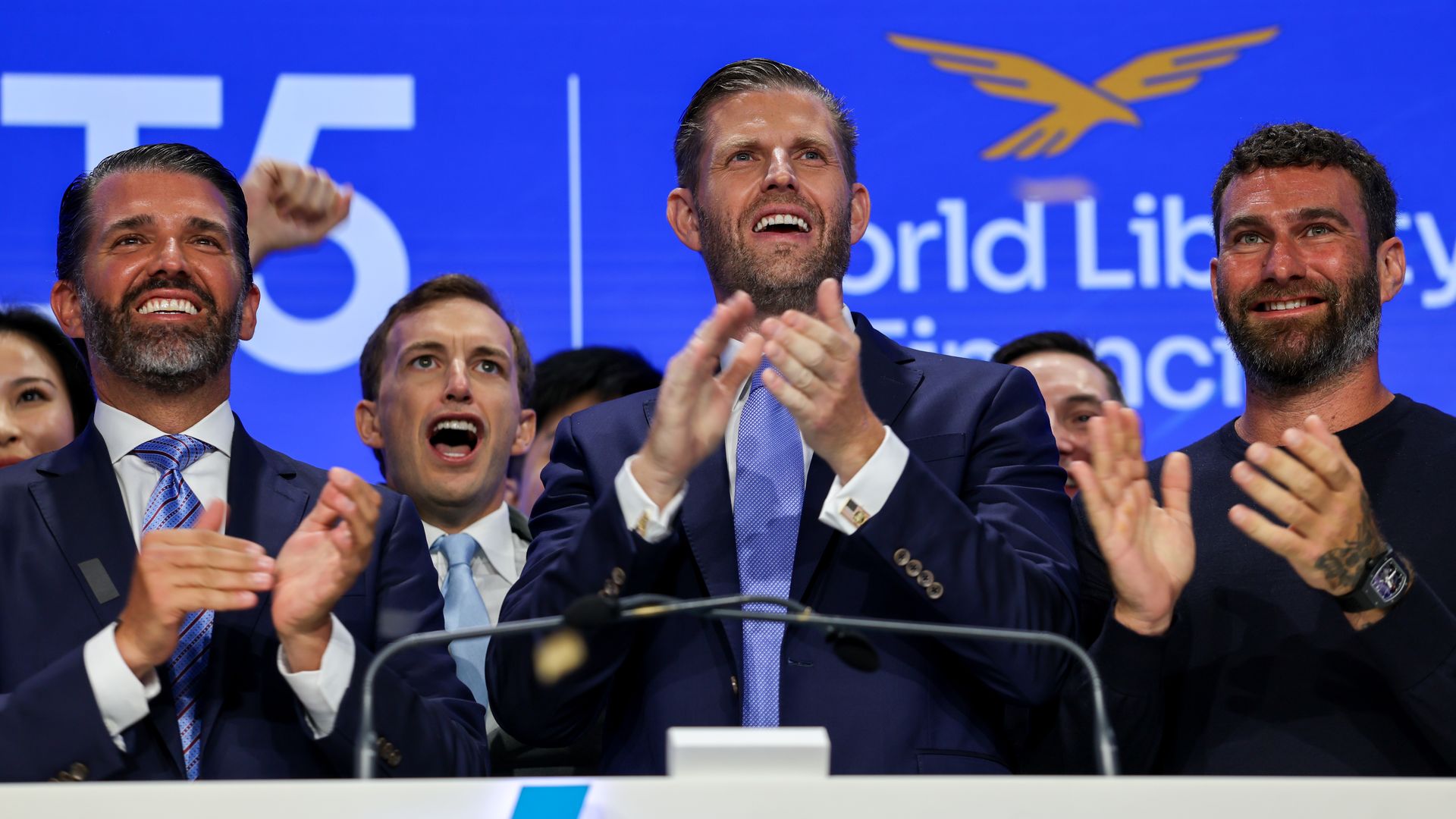
Donald Trump Jr. and Eric Trump standing with Zak Folkman, far right, CEO of World Liberty Financial, at the celebration of the partnership between Folkman's company and ALT5 Sigma, which invests in its token. Photo: Spencer Platt/Getty Images
Late in 2024, crypto billionaire Justin Sun was credited with reviving interest in the Trump family's decentralized finance project, World Liberty Financial — but this week it froze his investment, igniting scrutiny of the venture during its token's long-touted trading debut.
Why it matters: A project the Trump family embraced after its own experience of being cut off from traditional banks is now blocking some backers from accessing the tokens they paid for.
Catch up quick: Justin Sun, the founder of the Tron blockchain, a top-10 crypto network, made news last year when he made a huge investment in the otherwise lackluster pre-sale of World Liberty Financial's token, WLFI.
- He made a $30 million investment before the presidential election and then upped that to $75 million in January.
- Back in February, World Liberty execs were crediting Sun with generating the interest that enabled the project to meet its early fundraising goals.
Driving the news: WLFI began trading on public exchanges on Monday. Sun said that day that he had no intention of selling, even though — like other early investors — 20% of his holdings in WLFI were available to trade.
- Like many freshly released tokens, WLFI's value climbed quickly and then fell (this usually happens as early investors release lots of supply onto the market at once). World Liberty called the launch "historic" on social media.
- On Thursday Sun took to social media to explain why he had transferred some of his holdings to other wallets he controlled, which had caused speculation that he might be preparing to sell. He argued that the moves should have had no impact on WLFI's trading price.
- Late Thursday night he confirmed on social media that his tokens had been frozen.
Zoom out: Sun wasn't alone. World Liberty, in an unusual move, had put locks on a bunch of wallets that had bought WLFI — which meant they couldn't sell them, move them to different wallets or do anything with them.
- Staff at the crypto investing giant Galaxy Digital found over 200 addresses that invested in WLFI which saw their tokens frozen at various times before and after trading began.
What he's saying: "As one of the early major investors in World Liberty Financials, I have contributed not only capital but also my trust and support for the future of this project," Sun wrote on X Thursday night.
- "Unlock my tokens, and let's move forward together toward the success of World Liberty Financials."
World Liberty Financial has not replied to a repeated requests for comment from Axios. It also has not responded to Sun's posts on the topic.
How governance tokens work
WLFI is World Liberty Financial's governance token.
- Crypto projects frequently sell a token to raise money to build out operations. These tokens have value but, unlike stocks, they don't confer equity in the company creating the project.
- Sometimes the token has some function, and sometimes it's used to set the project's agenda, which allows creators to gradually release control of it to the public.
- World Liberty Financial sold a token to do the latter in private sales before it was free to trade, and Sun was one of the biggest buyers.
Flashback: Sun was also a large buyer of President Trump's meme coin early this year, which earned him a seat at Trump's notorious dinner for top holders back in May.
- In late February, the SEC dropped a lawsuit against Sun over prior alleged market manipulation, though there's no evidence that the agency's decision was tied to Sun's investments in WLFI or the meme coin.
The intrigue: The Trumps have said that their experience with getting debanked by traditional institutions brought them to crypto, as a financial medium that anyone can access, all the time.
- When debanked, people lose access to financial services because of their background or associations.
💭 Thought bubble: Locking or blacklisting is arguably the blockchain equivalent of debanking.
- It's a function that's been heavily used by stablecoin issuers in order to comply with law enforcement (locking up funds believed to be associated with a crime, for example), but seldom seen with other kinds of tokens.
- There's no locking for coins like bitcoin or Ethereum's ether, but creators of an individual token can opt to enable it.
The bottom line: "For WLFI's community, this episode is a test of narrative," Alex Thorn, head of research at the crypto investment firm Galaxy, wrote his most recent newsletter.
- "The project sells freedom and community rule, but the fine print centralizes authority and imposes aggressive control rights."
