Most of Trump's sweeping global tariffs not legal, appellate court says


Add Axios as your preferred source to
see more of our stories on Google.
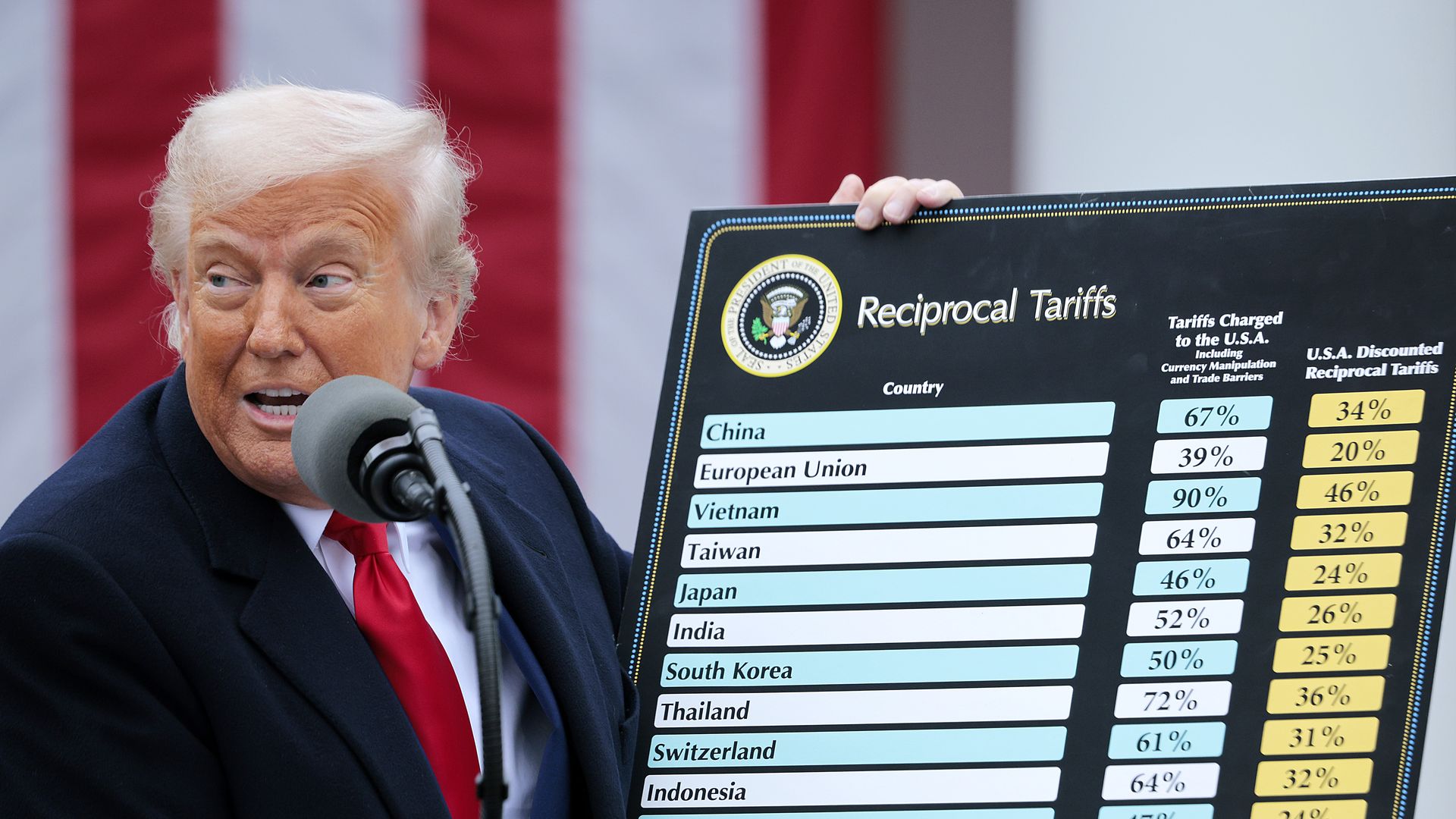
President Trump holding a list of tariffs. Photo: Chip Somodevilla/Getty Images
A federal appellate court on Friday upheld a lower-court ruling invalidating the bulk of President Trump's sweeping global tariffs.
Why it matters: The ruling could quickly upend the global trade order Trump has built, cutting off a major new source of cash for the government and raising huge questions about what businesses are supposed to do next.
- Trump said the ruling would "literally destroy the United States of America" if it stands, and promised an appeal to the Supreme Court.
The big picture: Trump has secured historic trade deals with major trading partners, including Europe and Japan, on a basis that two courts have now found illegitimate.
- With the details of many of those pacts still being hammered out, the ruling could lead both allies and adversaries to reconsider the value of negotiating with Trump's team for now.
Catch up quick: In late May, the Court of International Trade ruled Trump did not have the authority under the International Emergency Economic Powers Act (IEEPA) to impose tariffs, as he has done this year.
- A federal appellate court subsequently stayed that ruling, and held a hearing on the dispute in late July.
Context: In a 7-4 ruling issued on the Friday evening before Labor Day weekend, the court said it did not reach a conclusion on whether a president could authorize any tariffs under the emergency powers, only that Trump's reasoning for the tariffs did not constitute an emergency and go beyond the president's authority.
- The tariffs "are unbounded in scope, amount and duration," the ruling says. They "assert an expansive authority that is ... beyond the authority delegated to the President by IEEPA."
- The panel ordered the Court of International Trade to reconsider whether its universal injunction against the tariff executive orders Trump issued was appropriate, in light of recent Supreme Court rulings on injunctions against administration actions.
- But the court also held its ruling through Oct. 14 to give either side time to appeal to the Supreme Court.
Of note: The four dissenting judges — including the circuit chief judge, Kimberly Moore — said the plaintiffs in the case had not justified a judgment in their favor, arguing that IEEPA permitted tariffs and that the president had the appropriate legal authority to use it for that purpose.
For the record: "President Trump lawfully exercised the tariff powers granted to him by Congress to defend our national and economic security from foreign threats. The President's tariffs remain in effect, and we look forward to ultimate victory on this matter," White House spokesman Kush Desai said in a statement.
By the numbers: The tariff program is now generating about $30 billion a month in revenue, with expectations that would quickly grow after Trump imposed new rates on Aug. 1.
- The administration has sought to safeguard some of its trade agenda by imposing higher duties — on steel, aluminum and more — under separate authorities.
- In recent weeks, the administration has widened the scope of steel and aluminum tariffs and announced plans for tariff investigations to include furniture.
What they're saying: "ALL TARIFFS ARE STILL IN EFFECT! Today a Highly Partisan Appeals Court incorrectly said that our Tariffs should be removed, but they know the United States of America will win in the end," Trump said on Truth Social.
- Earlier this month, he warned a ruling against the tariffs could spark a second Great Depression.
What we're watching: Aside from an appeal to the Supreme Court, market watchers said Trump was likely to double down on tariffs under other trade authorities (like so-called Section 232 sectoral tariffs and Section 301 national tariffs) where IEEPA wasn't an issue.
- "The main takeaway is chaos and volatility," said Henrietta Treyz, director of economic policy at Veda Partners. "I would expect the White House to announce more Section 301 investigations and more Section 232 investigations."
Editor's note: This story has been updated with a White House statement.
