How a grand jury acted as "sword" and "shield" for D.C. sandwich guy

Add Axios as your preferred source to
see more of our stories on Google.
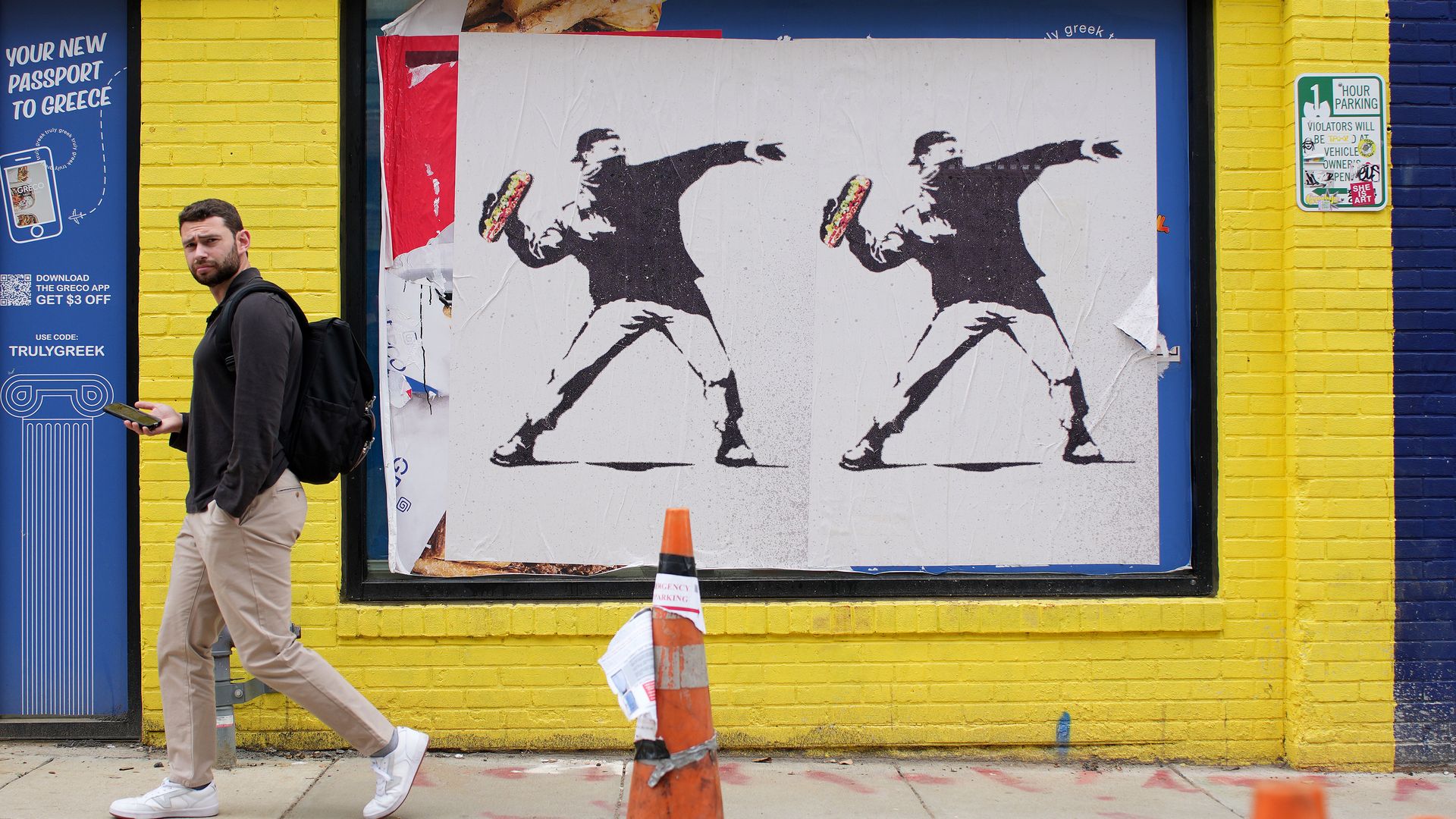
Banksy-style posters show a protester throwing a sandwich in Washington, D.C. Photo: Kevin Dietsch/Getty Images
A grand jury rejected federal prosecutors' bid to indict a man accused of throwing a sandwich at a federal agent this month, multiple outlets reported.
Why it matters: The grand jury's denial was another sign of D.C. residents pushing back on President Trump's mobilization of National Guard troops and federal agents to the streets of Washington.
- The "sandwich guy" case was high-profile, given there was a viral video, a public firing and outcry from top officials. But the grand jury, generally comprised of everyday citizens, saw things differently for "sandwich guy."
Catch up quick: Sean Charles Dunn, 37, was accused of throwing "a sub-style sandwich" at a Customs and Border Protection agent patrolling D.C. streets after Trump ordered an increased federal law enforcement presence in the District.
- Dunn, who was a Justice Department employee, allegedly screamed at the agent, "F**k you! You f**king fascists! Why are you here? I don't want you in my city!"
- Dunn was promptly fired by Attorney General Pam Bondi and charged with assaulting an officer by the U.S. Attorney's Office in D.C.
The intrigue: Dunn became a symbol of resistance among some in D.C., who labeled him as "sandwich guy" and celebrated him on shirts, murals and pins.
What's next: It's unclear if prosecutors will attempt to seek an indictment again, according to the New York Times, citing sources familiar with the case, or refile the charges as a misdemeanor.
- Dunn is expected to appear in federal district court next week, where a judge will determine if there's probable cause that a crime was committed, NYT reports.
Here's a look at how a grand jury works and what that meant for Dunn.
How a grand jury works
The grand jury serves as a "sword" and "shield" for suspected criminals, according to the federal handbook for grand jurors.
- The "sword" — it allows the government to prosecute suspected criminals.
- The "shield" — it protects people from "unwarranted or inappropriate prosecutions," the handbook says.
Zoom in: A grand jury does not determine innocence or guilt. Rather, it listens to prosecutors and sometimes, the defense (if they choose to share any evidence), and determines if there's probable cause that a crime was committed and, if so, who committed it, the handbook states.
- "If the grand jury finds probable cause to exist, then it will return a written statement of the charges called an 'indictment,'" the handbook reads. "After that, the accused will go to trial."
The grand jury generally hears from an attorney for the government, who is attempting to prove a crime was committed.
- The jury must then use this evidence to determine if the person should be tried for a serious crime.
- "As a general rule, no one can be prosecuted for a serious crime unless the grand jury decides that the evidence it has heard so requires," the handbook reads.
Yes, but: A person accused of a crime may waive the grand jury proceedings and agree to be prosecuted with a written charge, called "an information," according to the handbook.
- Even though a grand jury approves the indictment, a U.S. attorney still needs to sign it before someone can be prosecuted.
- "Thus, the government and the grand jury act as checks upon each other," the handbook says. "This assures that neither may arbitrarily wield the awesome power to indict a person of a crime."
Who is on a grand jury?
A grand jury includes 16 to 23 jurors, according to the U.S. government's official federal courts website.
- Jurors often serve up to 18 months, but can stay for 24 months with an extension.
- They generally consider multiple cases throughout their tenure.
However, grand jurors don't meet every day but throughout the calendar of their term. The number of meetings depends on the size of the district in which they work.
- They also hold their proceedings in private.
How a grand jury is selected
A grand jury is picked at random across the district or division where the jury sits, according to the federal grand juror handbook.
- "All citizens have an equal opportunity and obligation to serve," the handbook reads.
- The names are randomly drawn from registered voter or actual voter lists, the handbook explains. People who are picked will be summoned to appear as a grand juror.
- A judge can accept requests to be excused before selecting 23 qualified jurors. Only 16 are needed to hold a quorum.
The bottom line: It seems "sandwich guy" has beaten the wrap (so far) thanks to his fellow D.C. residents.
