How the death penalty works as Trump seeks new punishment for D.C. murders

Add Axios as your preferred source to
see more of our stories on Google.
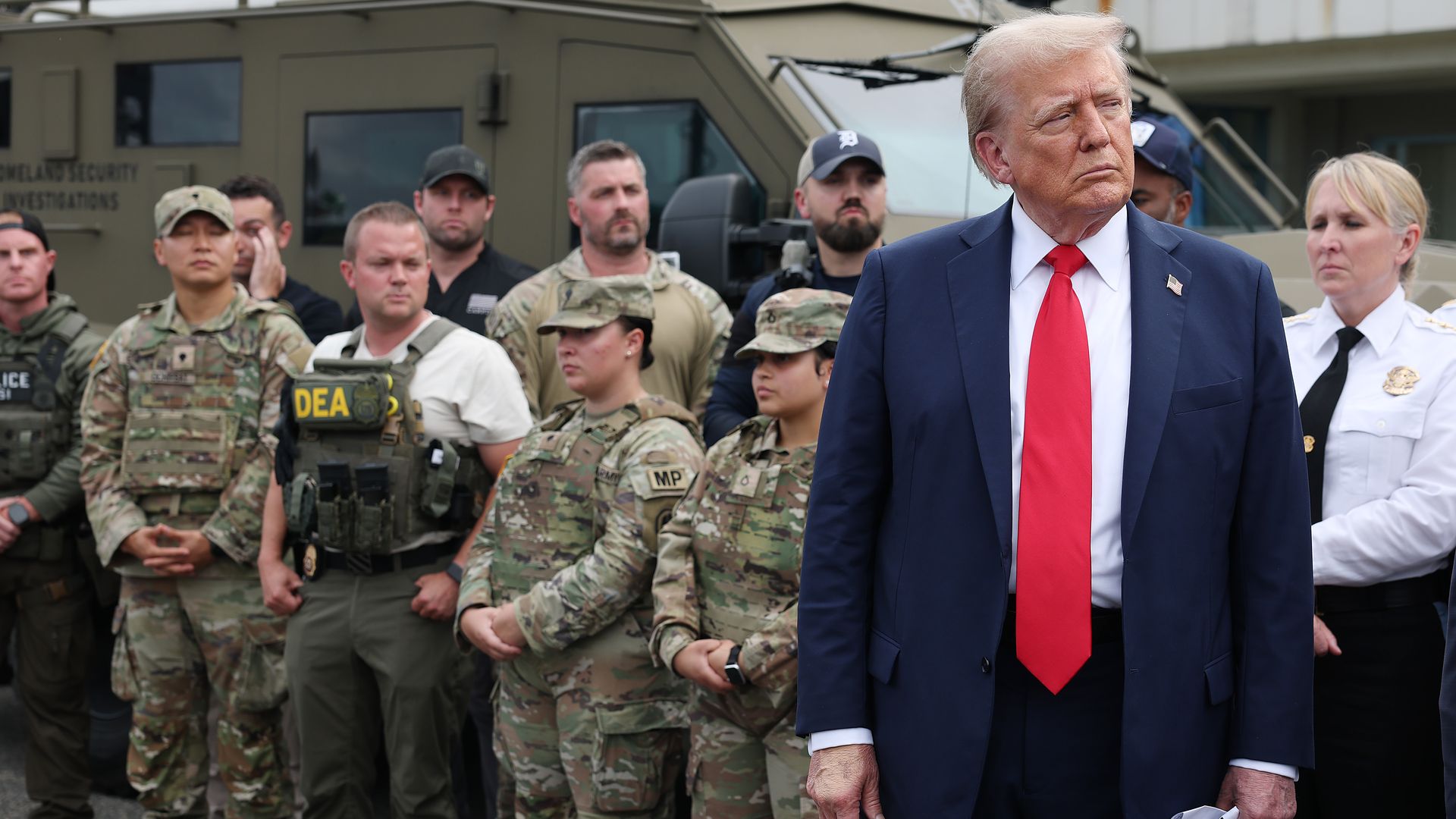
Donald Trump visits the U.S. Park Police Anacostia Operations Facility on Aug. 21 in Washington, D.C. Photo: Anna Moneymaker/Getty Images
President Trump's call for the death penalty as punishment for homicides in Washington, D.C., isn't a simple ask.
The big picture: Though capital punishment remains legal in more than two dozen states, it's not used in D.C. So how the federal government would actually use it there remains complicated.
- Trump's call for an increased use of capital punishment comes as his administration has taken direct and widespread control over Washington, D.C., due to what he called a "crime epidemic."
What he said: "If somebody kills somebody in the capital, Washington, D.C., we're going to be seeking the death penalty," Trump said Tuesday during a Cabinet meeting. "And that's a very strong preventative."
- "I don't know if we're ready for it in this country, but we have no choice," he added.
Yes, but: The use of the death penalty in places like D.C., which have stood against capital punishment, "has raised particular concerns about federal overreach into state matters," according to the Death Penalty Information Center, a nonprofit that provides data and information on capital punishment.
Here's what to know about how the death penalty works in D.C. and at the federal level.
Death penalty in D.C.
Context: The District of Columbia hasn't used the death penalty for decades.
- Prosecutors in D.C. can seek capital punishment for certain crimes under federal law, which includes some homicides. But it can only be carried out if a jury agrees to it, according to the Washington Post.
Flashback: D.C. abolished the death penalty decades ago and hasn't executed someone since 1957. Capital punishment was nullified there by the Supreme Court in 1972.
- Four years later, a high court allowed it to return with specific sentencing guidelines. In 1981, capital punishment was repealed by the D.C. Council.
- D.C. residents similarly voted against the death penalty in a 1992 referendum ordered by Congress.
- In 2003, prosecutors in D.C. made a case for the death penalty under federal law. But the trial of the convicted killers ended in life sentences since the jury could not agree on the capital punishment ruling.
How the death penalty works at the federal level
The federal government can call for death sentences over several crimes, including espionage, murder by drive-by shooting, genocide when the offender is a U.S. national and first-degree murder.
- On his first day in office this year, President Trump signed an executive order that urged the U.S. attorney general to pursue the death penalty for cases involving "murder of a law-enforcement officer" and/or "a capital crime committed by an alien illegally present in this country."
Any federal case seeking the death penalty needs to be approved by the attorney general, according to the Department of Justice.
- The DOJ will then review the case based on its Capital Case Section, which then makes a recommendation to the AG.
- From there, a jury would make the final decision at a sentencing hearing.
Yes, but: Federal executions are rare.
By the numbers: 80 defendants were sentenced to death from 1988 to 2024, with 16 federal executions carried out in that time, according to the DPCI.
- Trump set records with a spree of federal executions in his first term. In total, 13 executions took place between July 2020 and January 2021, per the DPCI.
- President Biden commuted death sentences for 37 men in December 2024.
- More recently, Trump's DOJ urged prosecutors to seek the death penalty against Luigi Mangione, the man charged with murder in connection with the killing of UnitedHealthcare CEO Brian Thompson
History of the federal death penalty
The death penalty was introduced, in a way, back in 1790, under the Crimes Act, which deemed 23 crimes, like treason, punishable by death. Before that, the death penalty was mandatory for most serious crimes.
- The Supreme Court ruled the federal death penalty unconstitutional in 1972 in three specific cases.
- Capital punishment was brought back years later but only under certain circumstances. The Federal Death Penalty Act of 1994 expanded the pool of offenses to nearly 60.
- In 2019, the DOJ said it would resume executions after two decades. But in 2021, Attorney General Merrick Garland called for a moratorium on federal executions so the DOJ could review its policies.
The bottom line: The death penalty has a complicated history with many legal precedents that could pose a roadblock for Trump's plan.
Go deeper: Trump vows to "vigorously pursue the death penalty" after Biden commutations
