Home insurance with a low credit score? That'll cost you

Add Axios as your preferred source to
see more of our stories on Google.
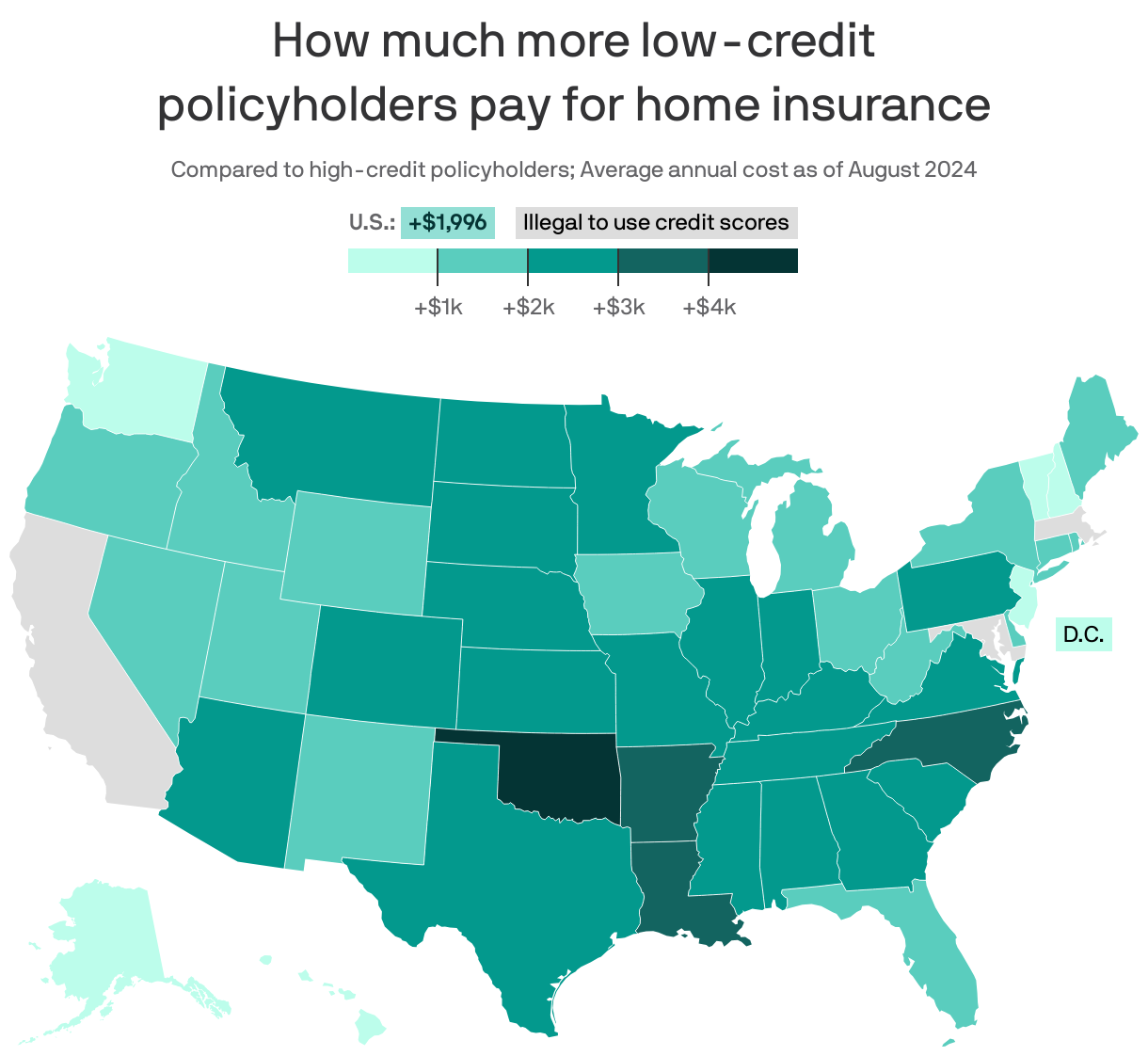
People with low credit scores can expect to pay nearly $2,000 more annually on average for home insurance compared to those with high scores, a new analysis finds.
Why it matters: Credit scores aren't necessarily indicative of somebody's ability to pay their bills — and tying them to insurance prices can disadvantage low-income and minority homeowners, among others.
Driving the news: U.S. homeowners with low credit are charged $1,996 more annually compared to otherwise identical homeowners with high credit, per a new report from the Consumer Federation of America and the Climate and Community Institute.
- That's based on over 600,000 nationwide "test quotes" representing "what a typical, hypothetical homeowner would be charged for homeowners' insurance."
- The researchers controlled for variables other than credit score. They defined a "low" score as about 630 on the 300-850 FICO range, and a "high" score as about 820.
Zoom in: In raw dollar terms, Oklahoma ($4,138), Louisiana ($3,754) and Arkansas ($3,083) have the biggest "credit penalties" — the difference between annual premiums for otherwise identical low-credit and high-credit policyholders.
- In percentage terms, Pennsylvania (181%), Arizona (168%) and Oregon (154%) have the largest penalties.
- Three states — California, Maryland, and Massachusetts — block insurers from using credit scores in pricing home coverage.
Between the lines: Homeowners' actual premiums are based on many factors, including the value, condition and materials of their house, their work and marriage status, and more.
- But credit scores are part of that mix in most of the country, putting many people at a disadvantage.
- Low-income people and people of color tend to have lower credit scores, for example.
- And young people just starting out in life need time to build up their credit history. Student loans can help if they're paid on time — otherwise they can be a crushing weight.
Stunning stat: On average nationwide, it's "more expensive to have a low credit score than to live in an area with a high disaster risk," the report finds — even as climate change forces painful reckonings across the insurance business.
- Higher premiums, meanwhile, can make it even harder for low-income Americans to move to less climate-vulnerable areas.
What's next: The researchers advocate for other states to follow California, Maryland, and Massachusetts' lead and bar insurers from using credit scores and history in pricing homeowner premiums.
- "Notably, this consumer protection does not lead to higher rates," they write. "All three states have average premiums that are about half the national average and less expensive than 39 other states."
Go deeper: Illinois targets alleged bias in car insurance pricing
