Aug 6, 2025 - Energy & Climate
These U.S. regions are blanketed in wildfire smoke. Here's what to know

Add Axios as your preferred source to
see more of our stories on Google.
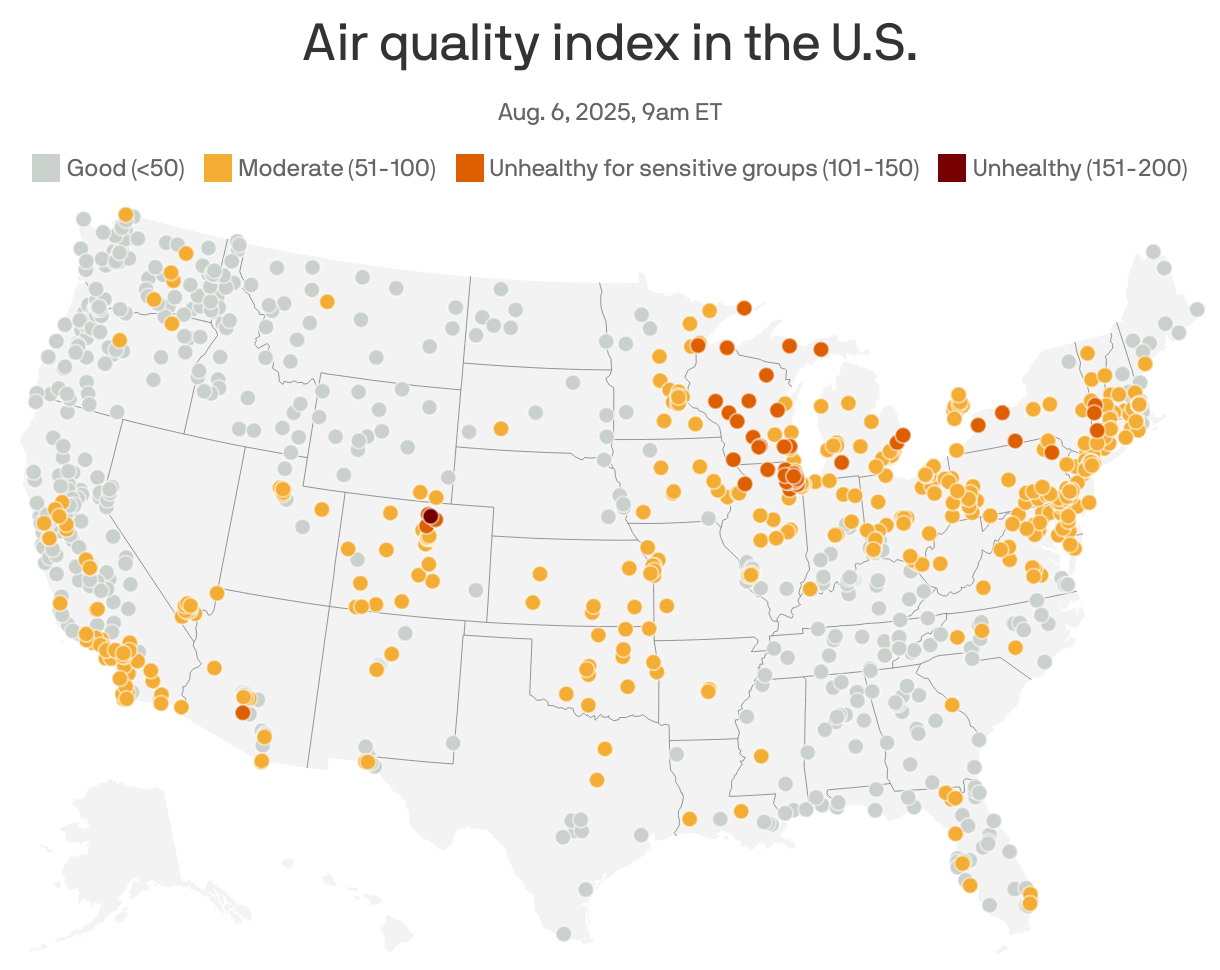
Air quality alerts are in effect for swaths of the Northeast and Midwest on Wednesday because of smoke from Canadian wildfires.
Why it matters: Breathing wildfire smoke has long-lasting health ramifications, as climate change exacerbates wildfires in and around the U.S.
- Climate change contributed to about 15,000 deaths from exposure to wildfire particulate matter between 2006 and 2020, according to a May report.
State of play: As of Wednesday, air quality advisories and alerts are in effect in Wisconsin, New York, Pennsylvania, Illinois, Vermont, Massachusetts, Minnesota, Delaware, Michigan and New Hampshire.
- In the West, Colorado and southern California were also under alert.
Flashback: The 2023 wildfire season more than doubled the previous record for fire-related air pollution in the U.S.
- The average American was exposed to 66% more air pollution than in 2021, the second-most polluted year at that point.
What is wildfire smoke?
- Wildfire smoke is a mixture of gaseous pollutants, like carbon monoxide, hazardous air pollutants, water vapor and particle pollution, according to the Environmental Protection Agency.
- Particle pollution is the main public health threat from wildfire smoke. It can travel into the lungs and even enter the bloodstream.
Who is most at risk?
- People more at risk include those with cardiovascular or respiratory disease, older adults, children under 18, pregnant women and outdoor workers, the EPA says.
- Studies have shown socially vulnerably communities also face disproportionate levels of wildfire smoke.
- Smoke can also exacerbate pre-existing lung and heart conditions and can trigger asthma and heart attacks, which can be fatal.
- Some studies have found links between exposure to wildfire smoke and an increased risk for dementia, fertility treatment issues and adverse birth outcomes.
How can I protect myself?
- Visit the EPA's AirNow website to view the most recent air quality reports and forecasts.
- The air quality index (AQI) ranges from 0 to 500. A level above 150 means its unhealthy for anyone to be outside.
- Limit smoke pollution inside homes by closing doors and windows and avoiding activities like high-heat cooking, using a wood or propane stove, burning candles, or vacuuming.
- Central air systems should be set to recirculate, and portable air purifiers should be run at the highest speed.
- If leaving the home, avoid strenuous activities, wear an N95 mask and wear long sleeves and pants.
Go deeper:
