
Tale of two countries: Home prices rise in one half of U.S., fall in the other


Add Axios as your preferred source to
see more of our stories on Google.
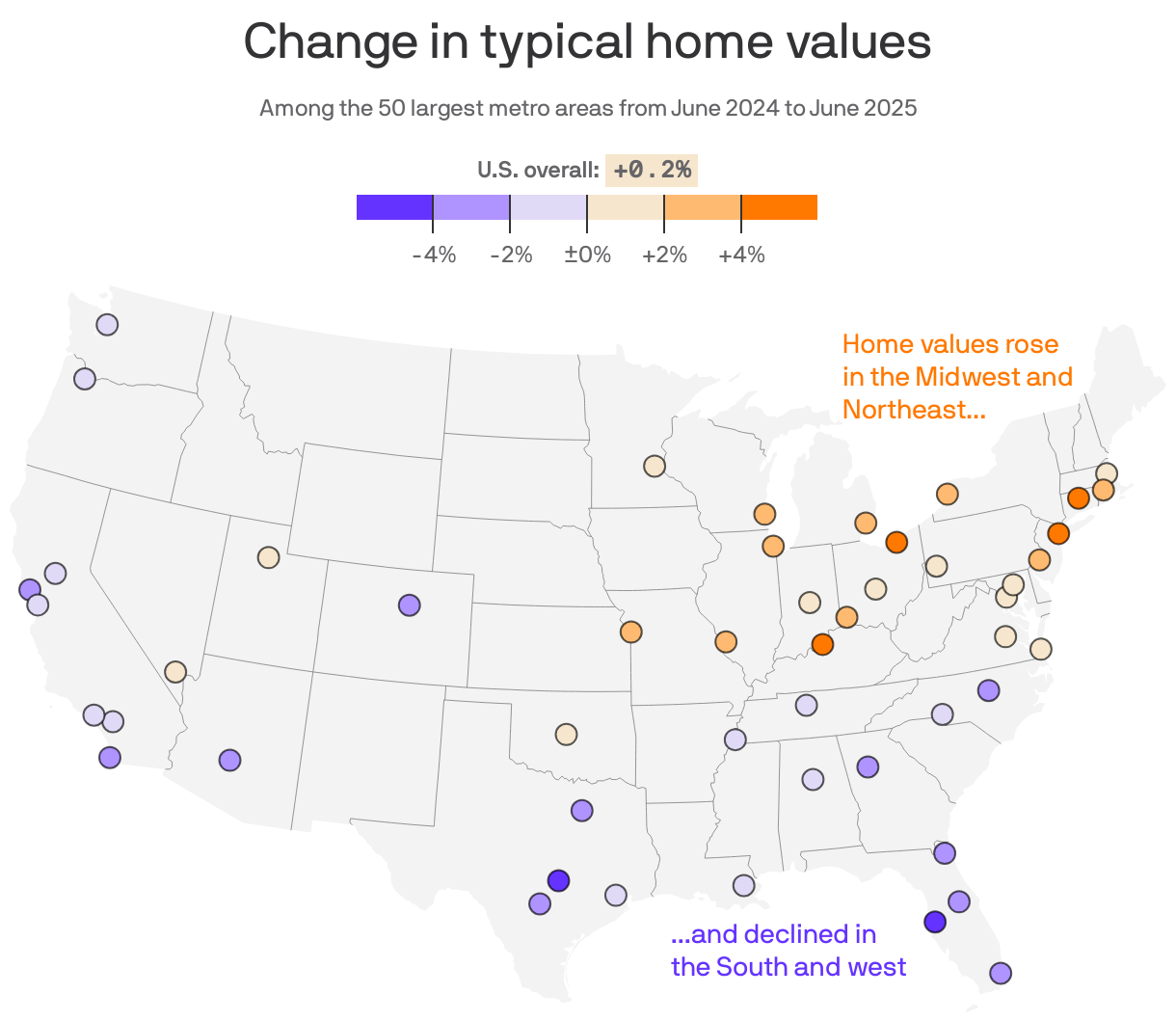
Real estate prices are all about "location, location, location," and right now that's particularly true — in half the country home prices are still going up, and in the other half they're falling.
Why it matters: The price data shows that the housing story is more complicated than affordability and still-high mortgage rates, which have cratered demand nationwide. Zoning laws, climate risks and economic vibes also play a big role.
- Ultimately, this tale of two housing markets is all about supply. In the places facing shortages of available homes, and less newly constructed housing, prices are holding up.
Zoom in: But areas in the South, particularly Texas and Florida, that had lots of new construction over the past few years, are seeing prices fall.
- And it's not just new homes; existing homeowners in these regions are also looking to sell and leave behind higher insurance costs, and climate risks.
- "In places like Florida and Texas, they're kind of tired of hurricanes," says Chen Zhao, head of economic research at Redfin. These folks are putting their homes on the market.
- These are also places where folks have second homes, she says. And you're seeing more people let those go, too.
By the numbers: The price of the typical home was down nearly 6% in the Tampa metro area this June.
- It fell 3% in the Jacksonville metro, and 6% in Austin.
- The Sun Belt, long a popular spot for home builders, is also seeing declining prices -- they fell 4% in the Phoenix metro area.
Meanwhile: In the Midwest and Northeast, the price of a typical home keeps rising. Home prices are up 4% in the New York City metro area from last June, 3% in Chicago and 2% in Minneapolis.
- These are regions where building new construction is much more difficult, due to zoning restrictions and lack of space.
Between the lines: "There's just this huge difference in supply between the Northeast and the South," Zhao says. "It's so much easier to do construction in the South. So you have a lot more new construction."
- New houses come to market a lot faster — whereas an existing homeowner can hold off on selling, and wait out the slow market, a homebuilder cannot.
- Instead, builders have to put homes on the market — and be willing to take a lower price.
"It's almost as if America is two countries right now from a housing perspective," said Atlantic writer Derek Thompson, who drew attention to the dichotomy in a recent episode of his podcast.
Reality check: Even if prices are down near you, they're still probably higher than they were in 2019, before a homebuying frenzy sent prices soaring.
- Typical home values nationwide sit roughly 46% above pre-pandemic levels, per Zillow.
What we're watching: Mid-size metros in the Midwest and Northeast were just named the summer's top housing markets by the Wall Street Journal and Realtor.com, in part for their affordability and "climate resiliency."
