The Trump trade order comes into focus

Add Axios as your preferred source to
see more of our stories on Google.
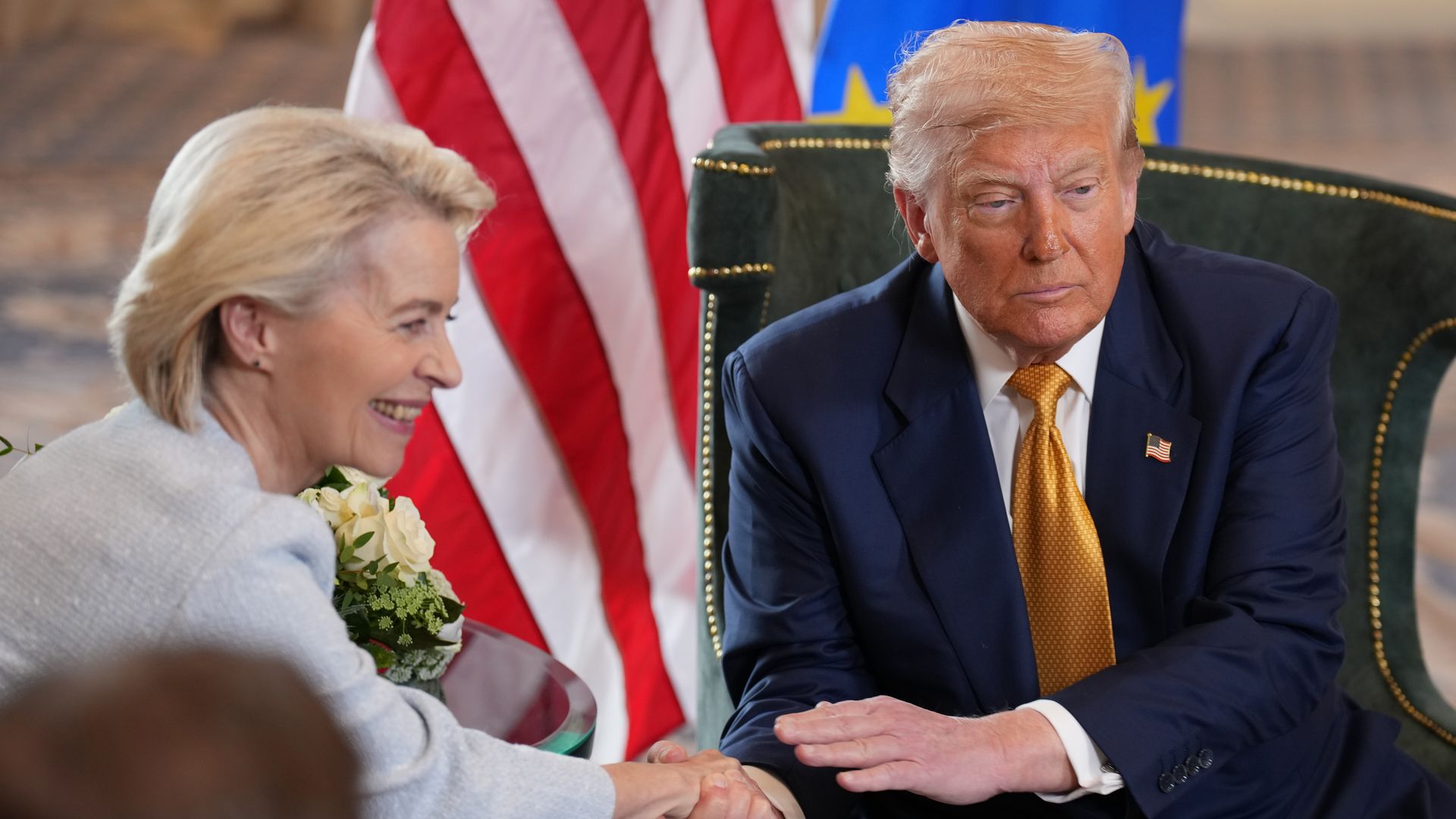
President Trump announced on Sunday a trade deal with the European Union after talks with European Commission President Ursula von der Leyen in Scotland. Photo by Andrew Harnik/Getty Images
We now have some semblance of clarity about what the Trump-era global trade system will look like. What we don't know is how durable this reset of global commerce will turn out to be.
The big picture: After deals with Japan and the European Union in recent days — and likely more before a key deadline on Friday — the global trade playbook is reasonably clear.
- U.S. imports from major trade partners will face a 15% minimum tariff going forward, with carve-outs and surcharges for some specific goods.
- Allies will just live with it, rather than retaliate — even if that causes pain to their domestic industries.
- They'll throw in some showy promises of new investment dollars and/or future purchases of energy, aircraft, or other American products.
- It's unknown how real those commitments will turn out to be, given the absence of formal written agreements.
State of play: It's worth taking a pause to reflect on how thoroughly this new framework amounts to a repudiation of the entire post-World War II project — led by the United States — of knitting together the planet's most important economies through trade.
- That project spanned multiple generations, with thousands of interested parties convening in places like Geneva, Doha, and Uruguay to try to hammer out deals, with varying success.
- The results of these trade deals were then debated at length in parliaments and Congress, generally passing with bipartisan majorities.
Zoom out: President Trump has ripped that order apart in just a few months, with agreements sketched out after comparatively short, high-level meetings with little paperwork and endless ambiguity about how details will be resolved.
- He is enacting the highest tariffs seen in decades, using an emergency legal authority that the courts have still not blessed (a key appeals court hearing is scheduled for Thursday), and without congressional involvement.
Zoom in: On the one hand, a 15% tax on imports from Europe and Japan — and likely other countries as dealmaking continues before Friday's deadline — is the highest seen in most Americans' lifetimes.
- It sets up a period of jockeying over what share of the cost is borne by foreign exporters, U.S. importers, and U.S. consumers.
- At the same time, markets have broadly rallied in the last week as investors take solace in the idea that this new trade regime is at least coming into focus.
Yes, but: It remains to be seen how durable a trade landscape handed down by fiat by the U.S. president will turn out to be.
- The old trade regime may have been slow-moving and bureaucratic, but that meant it had broad buy-in — from countries around the world, from varying business interests and political parties and force of law.
- Moreover, it's hard to know how long national leaders abroad can resist the domestic political pressure for retaliation.
What they're saying: "The global economy is being redrawn in real time," wrote Nigel Green, CEO of financial advisory firm deVere Group, in a note. "It's a new era of trade-by-force and the old assumptions no longer apply."
- The U.S.-EU deal "is a roadmap," he added. "It tells us where the US is going, what it wants, and how it's going to get it. Anyone ignoring this signal is going to be left behind."
