Exclusive: Why Hill and Valley is defense tech's "Rosetta Stone"

Add Axios as your preferred source to
see more of our stories on Google.
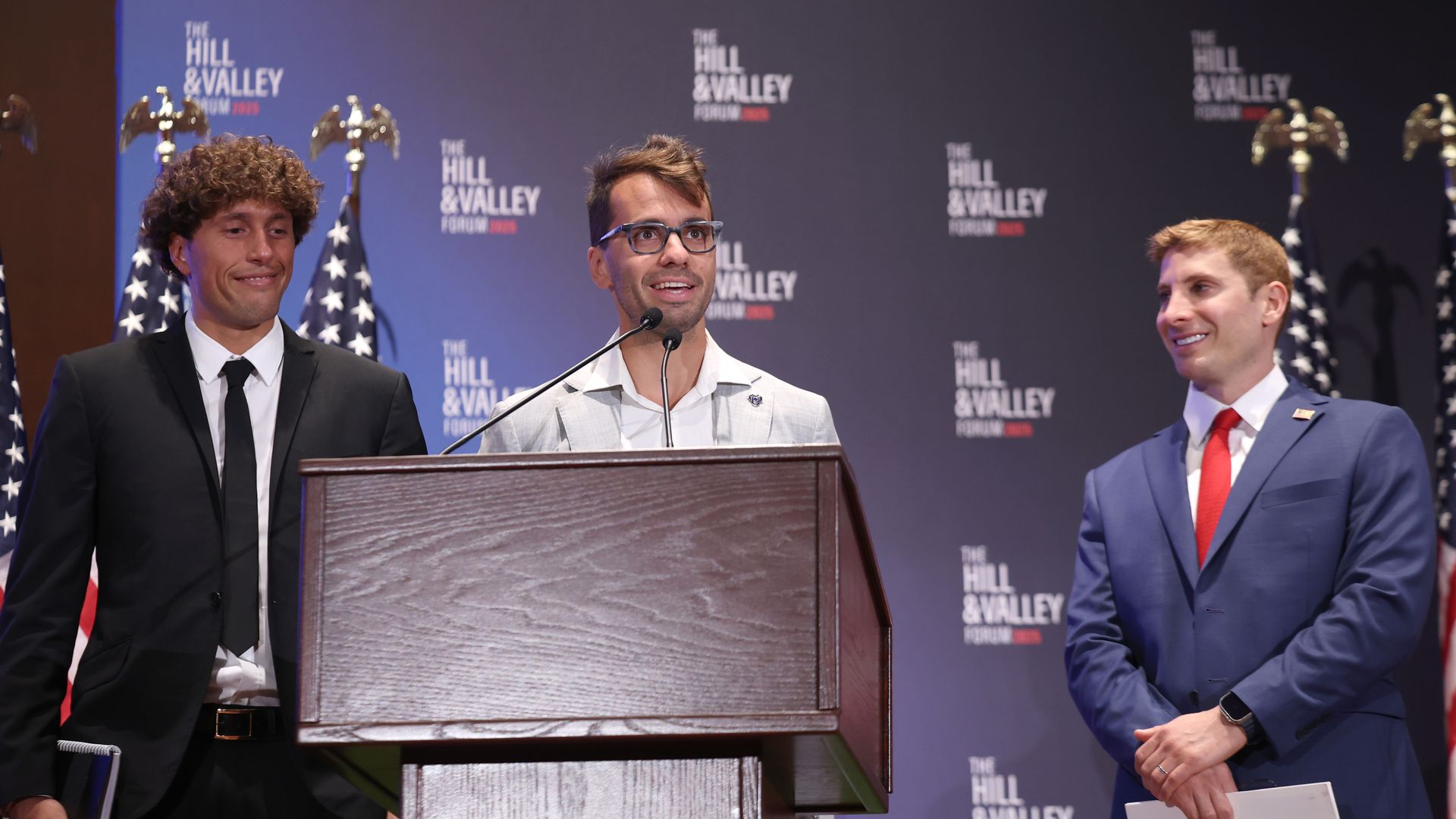
Christian Garrett, Delian Asparouhov and Jacob Helberg speak at the Hill and Valley Forum 2025. Photo: Tasos Katopodis/Getty Images for 137 Ventures
The Hill and Valley Forum sprang from an idea years ago for a 40-person get-together: four tables of 10 people discussing shared interests. Wednesday, it's cohosting an artificial intelligence summit in downtown Washington anchored by President Trump.
Why it matters: The group wields increasing influence at the intersection of policy, venture capital and American industry, including weapons production, at a time when powerful communities on the East and West coasts are getting cozy.
Driving the news: Axios interviewed Hill and Valley co-founders Jacob Helberg, Christian Garrett and Delian Asparouhov ahead of the "Winning the AI Race" event.
- The consensus? The opportunity to blunt China and ensure U.S. advantage is attractive to almost all political persuasions and business sectors.
The latest: Helberg, who was earlier this year nominated to be a top State Department economic policy and trade official, described Hill and Valley as "the Rosetta Stone," capable of translating the wants and needs of previously standoffish tribes.
- "Washington saw Silicon Valley as a collection of companies that acted as quasi-sovereigns, detached from national security priorities or detached from the national interest," he said. "Vast swaths of Silicon Valley at the time saw Washington as a nuisance and a roadblock to building transformative technologies."
- "While China had civil-military fusion, America had civil-military confusion."
Context: Wednesday's AI conference comes weeks after the Hill and Valley Forum confab at the Capitol, which drew some of the flashiest names in tech and politics.
- Speakers included Palantir CEO Alex Karp and Nvidia CEO Jensen Huang as well as Sen. Jack Reed (D-R.I.) and House Speaker Mike Johnson (R-La.).
What they're saying: "This is a unifying event, from a geographical perspective, among the U.S. and our allies. It is also a unifying event within Silicon Valley," said Garrett, who is also a partner at 137 Ventures.
- "People who usually compete with each other come together around this, and that obviously spreads to the D.C. dynamic."
- The 137 Ventures portfolio includes Anduril Industries, Hadrian, Ramp and SpaceX. Hadrian last week announced a $260 million raise and its factories-as-a-service model.
What we're watching: The ripple effects of the White House's AI action plan, expected to drop this week, on the Pentagon.
The bottom line: "This wasn't necessarily, from the get-go, meant to be this huge statement or intended to turn into this massive thing," said Asparouhov, also the co-founder of Varda Space Industries.
- "There were just a lot more companies that were being started up, and a lot more people that were turning their eye toward the national security community as somebody they really wanted to serve," he added.
- "I feel like we helped embolden that trend."
Go deeper: Tech's dance with the Pentagon speeds up
