Exclusive: Olympics have big AI plans

Add Axios as your preferred source to
see more of our stories on Google.
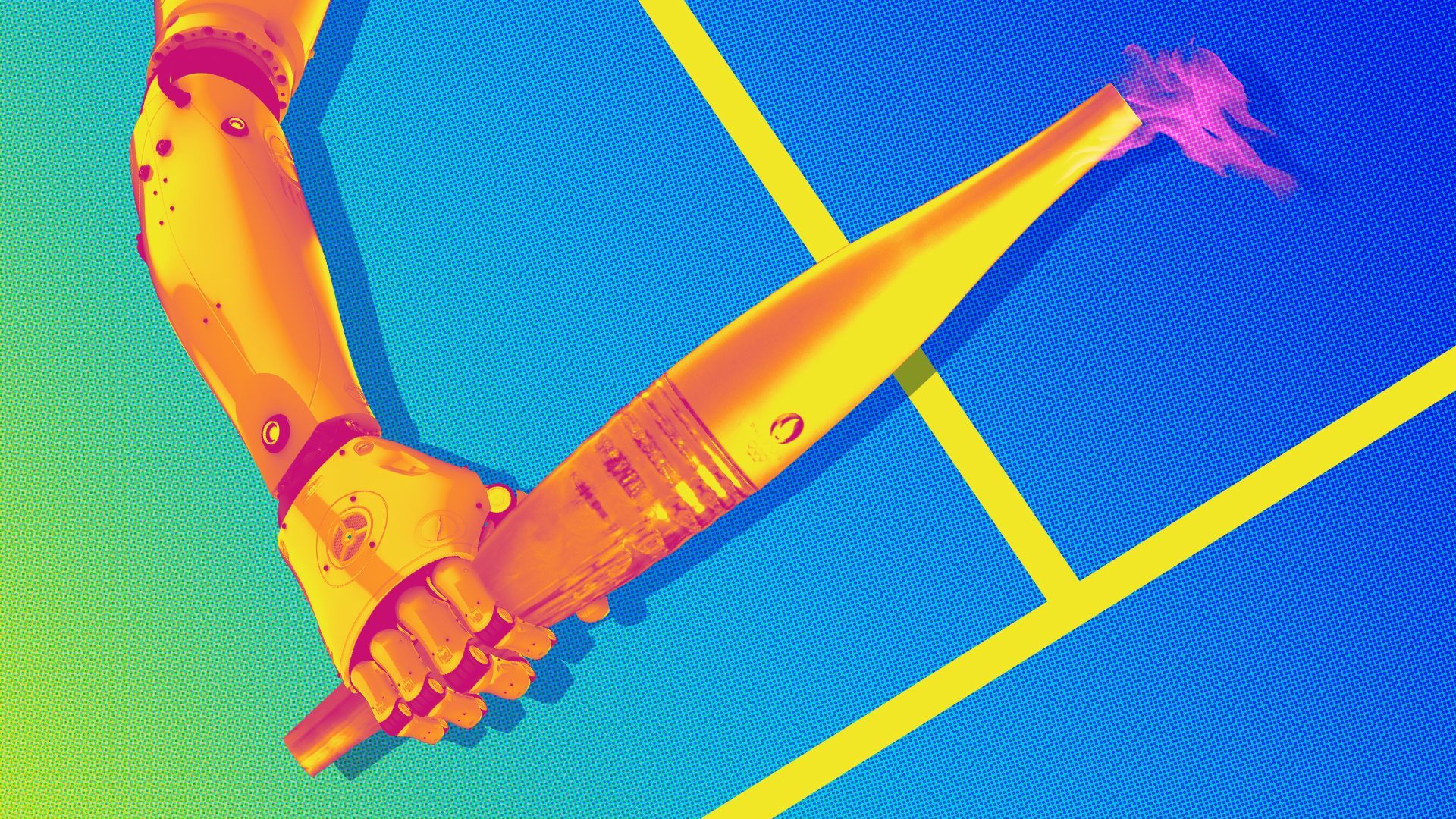
Photo illustration: Allie Carl/Axios. Photo: Christian Liewig - Corbis/Getty Images
The Olympics has a bold plan to use AI to make upcoming games in Italy and Los Angeles more efficient and to improve the experience for those watching on TV around the world.
Why it matters: As one of the most watched and lucrative global events, the games have long served as a testbed for new technologies.
The big picture: Ahead of last year's Paris Games, the International Olympic Committee unveiled a broad framework for AI use, to help in athlete training and event judging as well as to improve fans' experiences.
- However, AI played only a supporting role in Paris, with partners and sponsors using the event to showcase their chatbots and other technology.
For next February's Winter Games in Italy, organizers hope AI can help streamline the time-consuming contingency planning and scheduling that comes with unpredictable snow conditions.
- For the L.A. Summer Games in 2028, the organizers hope AI will help manage more than three dozen sports taking place across a broad swath of Southern California (plus softball and canoeing in Oklahoma City).
- "For me, it is, 'How can we actually use AI to help the operations of the games globally?' Olympics CIO and CTO Ilario Corna told Axios in an interview.
Zoom in: When it comes to the broadcasting of the games, AI is already speeding access to highlights from as many angles and athletes as possible, Olympic Broadcasting Services CEO Yiannis Exarchos told Axios.
- In Paris, OBS produced 11,000 hours of content, Exarchos said, with AI broadening the coverage and getting it to viewers faster.
- Using AI allowed those hours of footage to be sliced and diced into more than 100,000 separate highlight clips, in addition to the full coverage of each event.
- Not only could viewers choose to focus on a particular athlete in a particular sport, but broadcasters could create clips in different formats, such as horizontal video for social media.
That's important to broadcasters around the world who spent millions or even billions to broadcast the games in their country.
- "It gave them the opportunity to be constantly pushing very, very fast, customized highlights for their own audience, on social, on digital, on their programs," Exarchos said.
The use of technology was particularly noticeable with TV replays that made use of multiple cameras to show athletes in 3-D motion from multiple angles.
- As recently as a few years ago, it took around 20 minutes to generate a single such replay. "This made it practically useless for the live director," Exarchos said.
- With advances in AI and other technology, OBS was able to bring the creation of those highlights down to a matter of seconds, making it useful in live coverage.
Viewers end up with a better understanding of an event's dynamics — whether it's a diver's moves, the spin on a ping-pong ball or the path of an archer's arrows.
- "But what I keep on insisting and reminding ourselves, starting with myself, is that this is not about technology," Exarchos said. "It's about using technology to tell the stories of the greatest athletes in the world."
Between the lines: One reason the Olympics are able to push tech's boundaries is that they took the production of the raw videos for each sport in house in the 2000s with the creation of Olympic Broadcasting Services, which then distributes them to networks like NBC who've bought the rights.
- When each round of games had a different broadcaster in charge, they had to start from scratch each time.
AI also has a role helping athletes and their coaches better understand their performances.
- In Paris, Alibaba and Omega partnered to help understand what's happening during hurdles races, not just in terms of the outcome, but also by tracking athletes' steps between each hurdle and other metrics useful in training.
- Corna said he'd like to see such practices spread to far more sports.
Another job for AI could come in helping reduce the environmental impact of the games.
- In Paris, organizers used AI to help monitor energy use — spotting, for example, when one stadium left its lights on overnight and shutting them off.
- Using so-called digital twins of various stadiums and other venues cut down on the number of in-person visits by officials ahead of last summer's Olympics.
- In another case, AI helped identify a broken motor on a remote camera near the Eiffel Tower whose view kept unexpectedly drifting from its intended spot.
Yes, but: One of the big challenges is ensuring that new technologies don't unduly benefit the richest countries.
- "It is important that we give access to all," Corna said.
- Already, he said, the Olympics has provided AI training to national committees and international sport governing bodies from around the world.
- "The jury is still out, but I think that we are upholding these values," Corna said.
Editor's note: This story has been corrected to show that the Olympic footage was cut into more than 100,000 clips (not 97,000).
