NIH chief sidesteps controversy while other officials court it

Add Axios as your preferred source to
see more of our stories on Google.
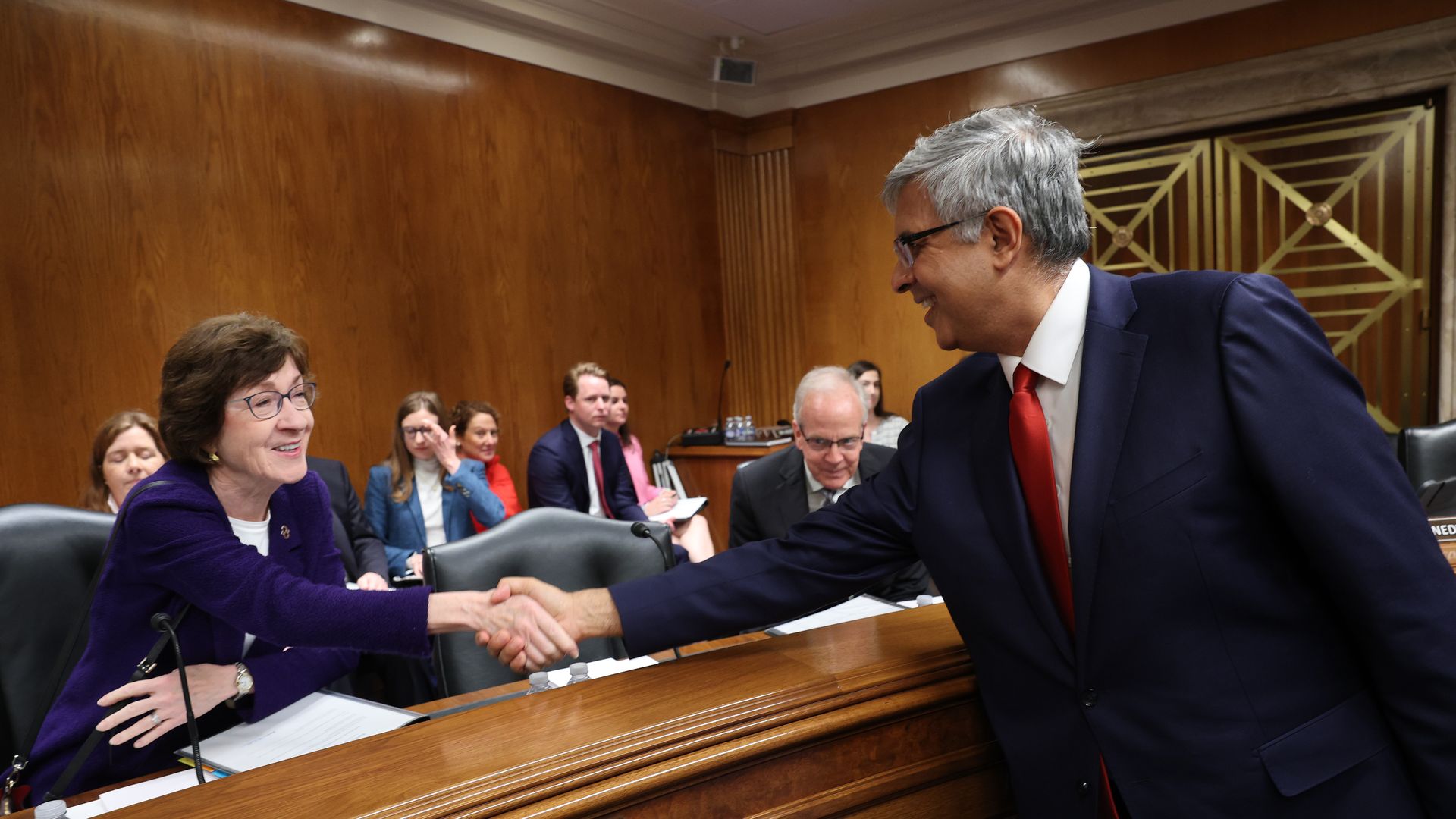
NIH director Jay Bhattacharya and Sen. Susan Collins. Photo by Win McNamee/Getty Images
National Institutes of Health director Jay Bhattacharya didn't aggressively push back and defend Trump administration budget cuts and grant freezes when senators grilled him last week about plans for his agency.
- An $18 billion cut in the 2026 NIH budget request was just a starting point for negotiations, he said.
Why it matters: The hearing showed how the former Stanford professor is trying to deflect controversy over the administration's health agenda while others on President Trump's health team under Health and Human Services Secretary Robert F. Kennedy Jr. have leaned into their roles as disruptors.
- That's raising questions about who has the final say over the government's biomedical research hub.
- Bhattacharya is "in a difficult position with limited influence," Capital Alpha Partners analyst Rob Smith wrote in a note on Friday. "RFK appears to be running the show at the subagencies he oversees as HHS Secretary. It's our understanding that very little happens without his input."
What they're saying: An HHS spokesperson told Axios that NIH and Bhattacharya are fully committed to advancing research, improving health outcomes and supporting scientific discovery. Constructive criticism pushes this innovation forward, they said.
The big picture: NIH is the largest public payer of biomedical research in the world. It funds academic research and develops and funds much of the science behind products that drug companies eventually commercialize. The Trump budget's plan to cut its funding 40% next year could kneecap pharma and the biotech industry.
State of play: Bhattacharya tried to find a middle ground during the Senate Appropriations Committee hearing, taking credit for fighting what he called "politicized science" while telling lawmakers he didn't accept the job to terminate grants.
- "This is my first time through this budget fight, and so I'm still learning, but I'll tell you what I understand is that this — the budget — is a collaborative effort between Congress and the administration," Bhattacharya said.
- "We have tremendous health needs that we have to address. It's only excellent research that's going to solve those problems," he said.
- His written testimony didn't mention the cuts, instead laying out the administration's policy priorities for NIH and the funding they are requesting.
Zoom in: It's true that the budget proposal is just the first step in a negotiation process, and Congress gets the final say on funding levels.
- But Bhattacharya's decision not to explicitly defend the budget cuts shows that his role remains cryptic on a health team that's eagerly pushing boundaries.
- Kennedy defended the cuts strongly when he appeared in front of the same panel last month.
- "All the money that we've been pouring into these programs for years has not resulted in better health for Americans. ... We won't solve this problem by throwing more money at it. We must spend smarter," Kennedy said.
The intrigue: Bhattacharya was sworn in as NIH director in April — just as mass layoffs at the agency ordered by Kennedy and DOGE went into effect. He quickly sent an all-hands letter to staff expressing gratitude for their work and pledging to implement changes "humanely."
- Bhattacharya has set up an appeals process to review grants that were terminated through keyword searches and other aggressive efforts to root out DEI initiatives.
- NIH was one of the first agencies to tell employees they didn't have to answer Elon Musk's "five things" weekly emails, and Bhattacharya reportedly called the task silly in an address to NIH staff.
But the frozen grants and budget request haven't earned him much of a grace period with Congress.
- Senate Appropriations Chair Susan Collins (R-Maine) said last week the proposed budget cuts would "delay or stop effective treatments and cures from being developed for diseases like cancer, Alzheimer's, Type 1 diabetes — I could go on and on."
- "A President's budget is not a 'negotiation with Congress,' it's a statement of priorities and values," Sen. Tammy Baldwin (D-Wis.), the ranking member of the committee's subpanel on health, told Axios in a statement.
Reality check: Bhattacharya is no stranger to controversy. During the pandemic, he was disparaged by the medical establishment for co-authoring the Great Barrington Declaration, a petition arguing for COVID to spread among young, healthy people to reach herd immunity faster.
- He's been receptive to the idea that NIH-funded research in China led directly to the spread of COVID, and he's cast doubt on the merits of gender-affirming medical care for kids.
- "I think Dr. Bhattacharya wants NIH to continue to set the pace for medical progress, but what matters is whether he acts on intention and stops the dismantling of American-led research," Ellie Dehoney, senior vice president of policy and advocacy at Research!America, told Axios in an email.
What we're watching: Bhattacharya is demurring, and there's bipartisan interest in keeping NIH well-funded. Congress in the near term is likely to maintain the status quo through stopgap spending measures.
- The question is whether Bhattacharya is in it for the long haul, and how hard he'll push to defund life sciences research.
- "We've questioned how closely the administration's views on NIH and medical research align with those of Bhattacharya," Capital Alpha's Smith wrote. "His tepid defense of White House claims that the agency needs a 40% cut to improve didn't change our views."
