Midsize businesses struggle with high tariff costs

Add Axios as your preferred source to
see more of our stories on Google.
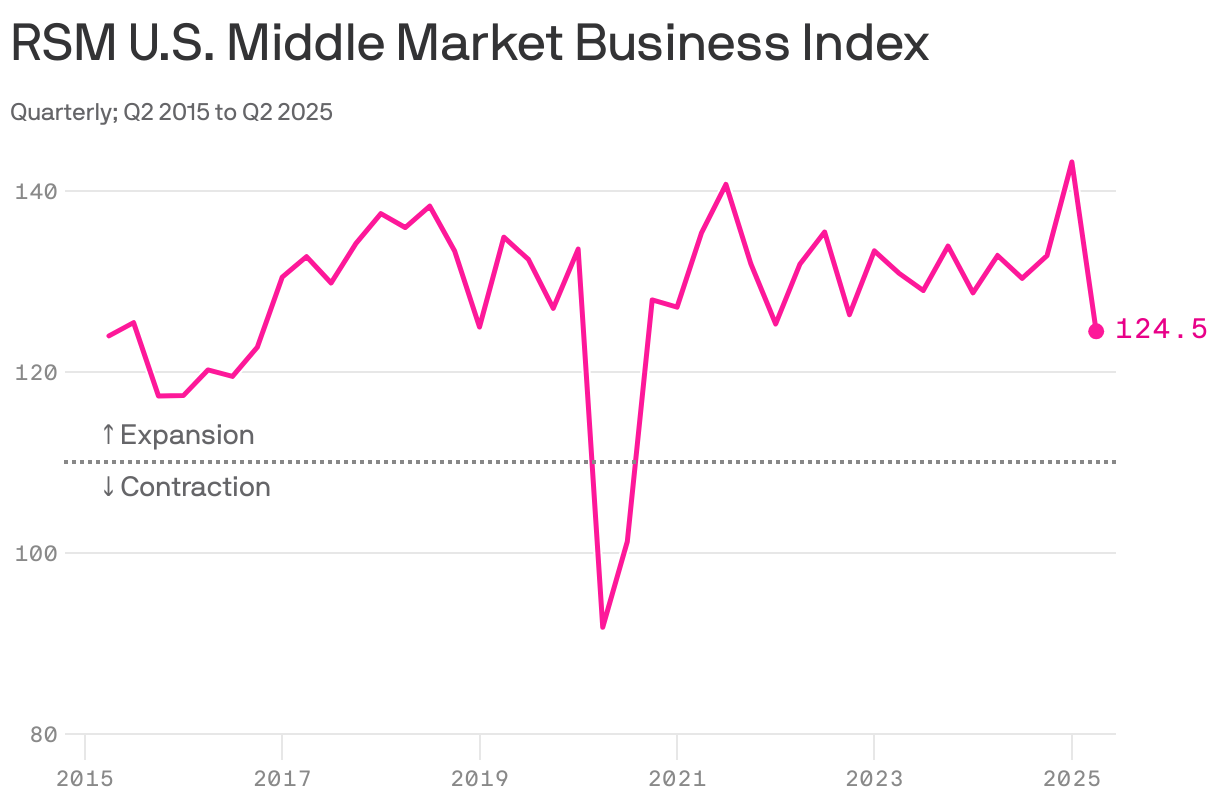
The trade war torpedoed the performance of midsize businesses in the U.S., according to a survey of executives at those firms out Thursday morning.
Why it matters: Tariff turmoil is hitting smaller companies especially hard, raising costs they're less able to absorb than the corporate giants.
The big picture: Though it will take some time, higher tariffs will likely slow the economy and raise consumer prices, the survey authors said, even if the headline inflation number reported Wednesday still looks relatively benign.
How it works: The RSM US Middle Market Business Index fell nearly 19 points to 124.5 in the second quarter.
- A number above 110 is in expansion, or positive, territory. But this was the biggest drop (outside of the pandemic) over the decade that consulting firm RSM and the U.S. Chamber of Commerce have fielded the survey.
"The trade war unleashed real, significant changes in trade policy and at best is going to result in a significant slowing in the U .S. economy," Joe Brusuelas, chief economist with RSM, said on a call Wednesday.
By the numbers: The index is based on a survey of 412 executives at middle market firms, defined roughly as those with revenue between $10 million and $2 billion.
- They were asked 20 questions about their businesses, including changes in gross revenue, net earnings and capital spending.
- About a quarter of executives reported declines in gross revenue and net earnings. There was also a 20% drop in capital expenditures, or spending on buildings, machinery, long-term projects and more.
- Hiring also slowed and executives expressed more economic pessimism.
- 57% of executives said they had raised prices in the current quarter, and 63% said they intend to do so over the next six months.
The fine print: The survey was conducted in the field from April 7 to April 29, so respondents had lived through both the "Liberation Day" shock and the tariff pause that followed, while absorbing the hikes that did go through.
- Effective tariff rates are substantially higher than at any time since 1937, according to the Yale Budget Lab, about 15.6% as of early June.
The intrigue: The deal announced with China on Tuesday doesn't change that number, and that's a particularly rough problem for these companies.
- Very large firms have profit margins at around 13%, Brusuelas said, but among midsize businesses the number is in the 5% to 7% range, which isn't sufficient to absorb at 15.6% increase.
The bottom line: Don't get complacent about prices.
