Behind the Curtain: ChatGPT juggernaut


Add Axios as your preferred source to
see more of our stories on Google.
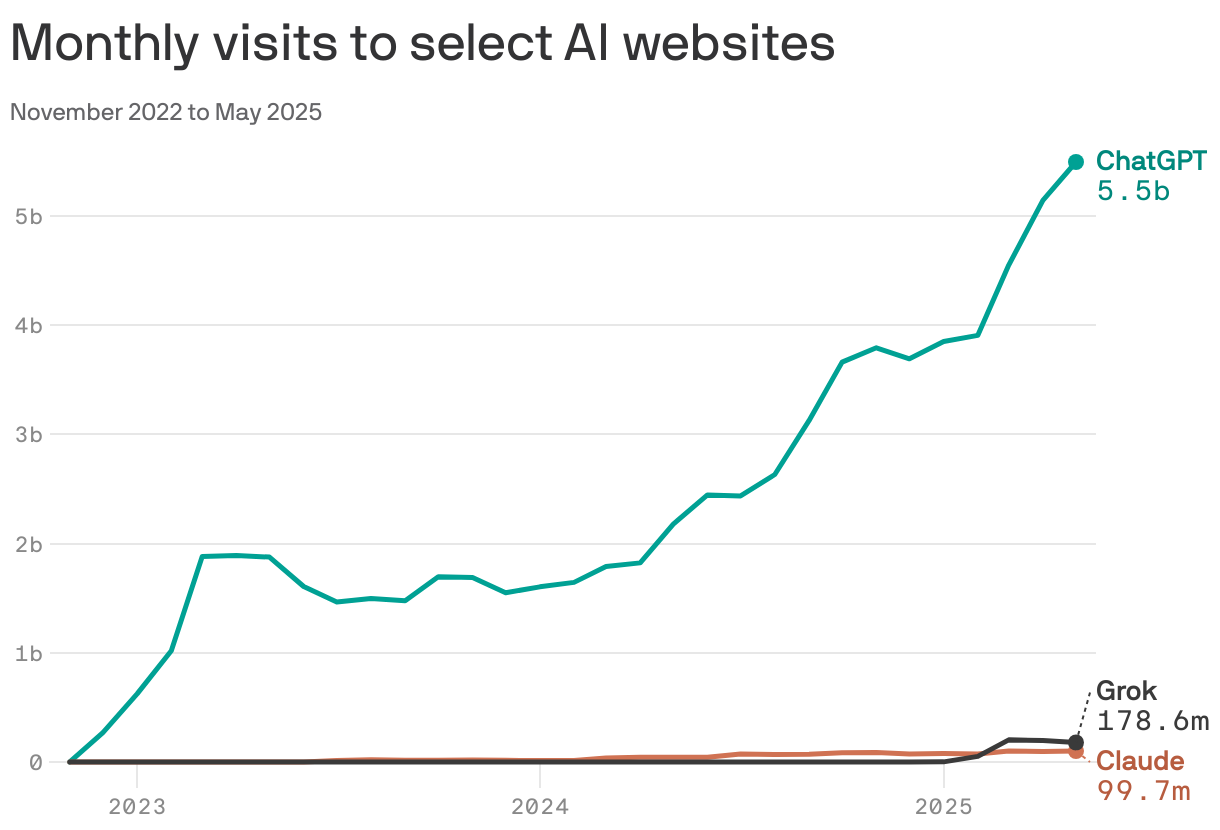
OpenAI's ChatGPT has been the fastest-growing platform in history ever since the chatbot launched 925 days — 2½ years — ago. Now, CEO Sam Altman is moving fast to out-Google Google.
Why it matters: OpenAI aims to replicate the insurmountable lead that Google built beginning in the early 2000s, when it became the world's largest search engine. The dream: Everyone uses it because everyone's using it.
- OpenAI is focusing particularly on young users (under 30) worldwide. The company is using constant product updates — and lots of private and public hype — to cement dominance with AI consumers.
The big picture: This fight is about winning two interrelated wars at once — AI and search dominance. OpenAI and others see Google as the most lethal rival because of its awesome access to data, and research talent, and current dominance in traditional search.
- This is probably the most expensive business war ever. Google, OpenAI, Apple, Amazon, Anthropic, Meta and others are pouring hundreds of billions of investment into AI large language models (LLMs).
- It's not winner-take-all. But it's seen as winner-take-control of the most powerful and potentially lucrative new technology on the scene.
Altman is selling himself — and OpenAI — as both the AI optimists and early leaders in next-generation search. Anthropic, by comparison, is warning of dangers, and focusing more on business applications.
- Two events — one private, one public — capture Altman's posturing:
1. Axios obtained a slide from an internal OpenAI presentation, featuring Similarweb data showing website visits (desktop + mobile) to ChatGPT skyrocketing in recent months, while Anthropic's Claude and Elon Musk's xAI Grok remained pretty flat. (See chart above with related data that Axios obtained directly from Similarweb.)
- ChatGPT is building a similar advantage in mobile weekly active users (iOS + Android), according to SensorTower data cited in the presentation. "ChatGPT's adoption continues to accelerate relative to other AI tools," the slide says.
- Altman proudly displayed the data on Tuesday during a closed-door fireside chat at a Partnership for New York City event in Manhattan that drew a slew of titans, including Blackstone Group co-founder and CEO Steve Schwarzman, KKR co-founder Henry Kravis and former Goldman Sachs CEO Lloyd Blankfein.
2. Also on Tuesday, Altman posted an essay called "The Gentle Singularity" — basically a bullish spin on ChatGPT and AI. "In some big sense, ChatGPT is already more powerful than any human who has ever lived," he boasted.
- The Singularity, a Silicon Valley obsession, is defined by Altman's ChatGPT as: "the hypothetical future point when artificial intelligence becomes so advanced that it triggers irreversible, exponential changes in society — beyond human control or understanding."
- Altman often talks about approaching AI from a position of cautious optimism, not fear. The piece reflects Altman's synthesis of tech, business and the world — a signal that he wants to be the leading optimist in the space, and thinks it's the long term that really matters.
Altman dances around the dangers — wiping out jobs or AI going rogue, for instance — and paints a utopia of humans basically merging with machines to cure disease, invent new energy sources and create "high-bandwidth brain-computer interfaces."
- "Many people will choose to live their lives in much the same way, but at least some people will probably decide to 'plug in,'" he writes.
The other side: Anthropic says the user data above paints an incomplete picture because Anthropic is currently more focused on enterprise applications — selling Claude's interface to business customers — than consumer adoption.
- Similarweb figures show Google Gemini catching fire lately, moving into second place after ChatGPT.
Between the lines: ChatGPT is beginning to lock people in, making it harder to leave — just like you're unlikely to switch to Android after you're deep in the Apple ecosystem. That's why OpenAI lets us create custom GPTs, put all our previous research in memory and build routines around ChatGPT.
- OpenAI is also branching out by making a cloud deal with Google, reported Tuesday, and a partnership with Apple last year to integrate ChatGPT into experiences within iOS, iPadOS and macOS.
- A lock-in that consumers can't see: OpenAI's API (application programming interface) powers loads of third-party apps.
The bottom line: If users keep plugging into OpenAI in mass numbers, Altman will realize his ambitions of being the next Steve Jobs — but more powerful.
Axios' Megan Morrone contributed reporting.
- Go deeper: Behind the Curtain: A white-collar bloodbath.
