Why more Americans are filing for Social Security this year

Add Axios as your preferred source to
see more of our stories on Google.

Illustration: Aïda Amer/Axios
Social Security is certainly beloved, but it's usually a little bit boring.
- Not this year.
Why it matters: There's been a surge in older Americans applying for benefits in 2025, and a large increase in the amount of money paid out.
Zoom in: That's happening for a host of reasons, including a new law that marks the biggest expansion to the program this century, a White House that made changes to the program and, of course, a growing elderly population.
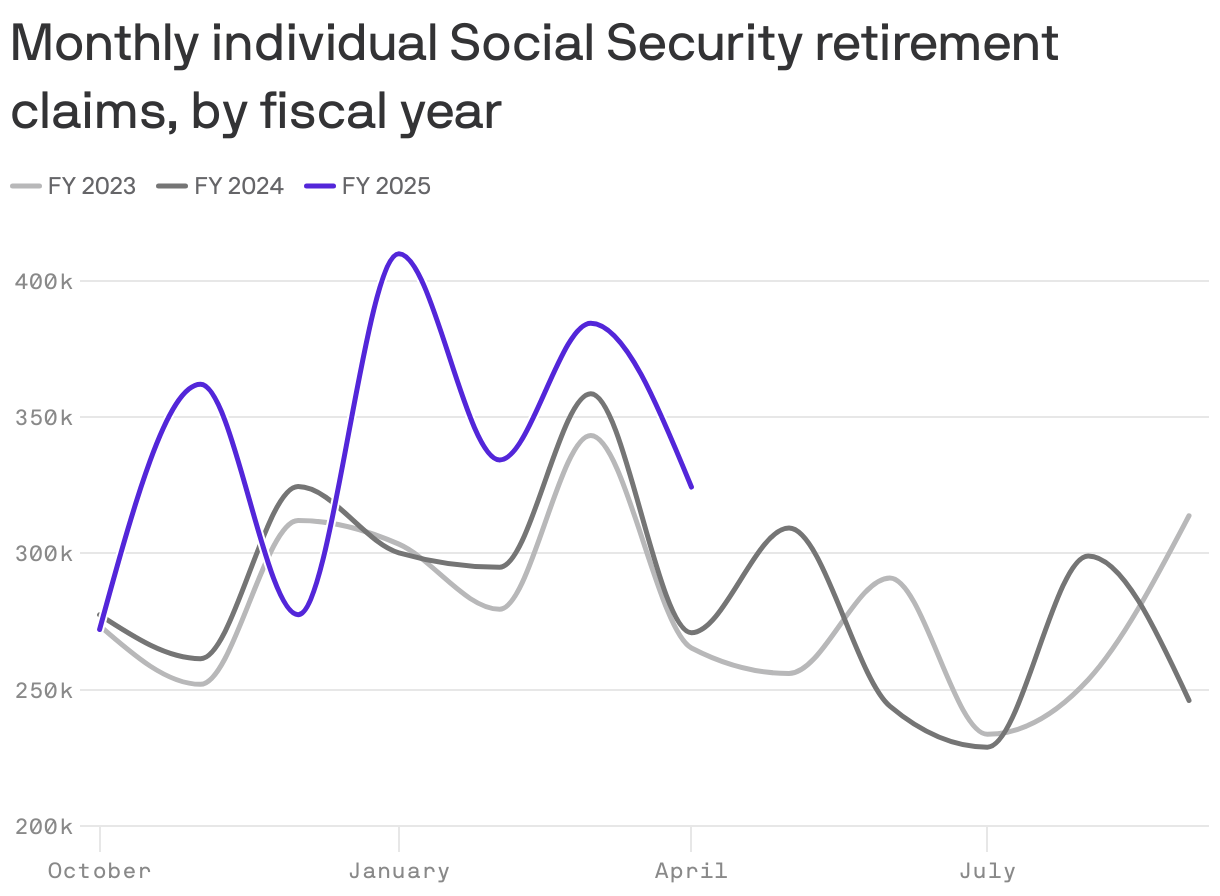
By the numbers: Social Security retirement claims are on track to rise 15% this year from 2024, per an analysis by the Urban Institute, a research group.
- From 2012 to 2024, claims increased by 3% per year, on average.
- At the same time, benefits payments surged in March and April, according to data from the Bureau of Economic Analysis released last week.
Between the lines: The benefits increase was so large that it boosted income data also released last week.
- "The economy has apparently been benefitting from a stealth form of income support for the past several months," writes Jonathan Levin in a column for Bloomberg Opinion. "Which may be giving some of us false confidence about the future."
The big picture: Many new applicants are filing for benefits earlier than planned out of anxiety over moves by the Trump administration on Social Security this year, according to the Urban Institute.
- High-earning individuals appear to be driving the rise in applications, says Jack Smalligan, a senior policy fellow at the Urban Institute.
Another piece of the increase is simply attributable to the growing population of retiring Baby Boomers.
- 2024 marked the start of the Peak 65 Zone, the largest surge of Americans turning 65 in U.S. history, the Social Security Administration points out.
- The agency emphasizes recent improvements in how it notifies spouses of Social Security recipients that they may be eligible for larger benefits.
Zoom out: For years, policymakers didn't mess with Social Security.
- This year has been different.
The Social Security Administration made a flurry of changes: staff and office cuts, updates to phone policies and other customer service changes.
- The messaging around the moves was confusing. New policies were announced, rolled back or changed. At the same time, the agency was experiencing more systems crashes.
- Meanwhile, Elon Musk called Social Security a Ponzi scheme, while Commerce Secretary Howard Lutnick made public statements about benefits fraud that also upset people.
That sent a surge of people to agency field offices, while others started calling in as well.
- "People were very concerned that their benefits were going to stop," says Jessica Lapointe, who works in a field office in Wisconsin, and is a union official. "The public really didn't understand what was going on."
For the record: "I am fully committed to upholding President Trump's promise to protect and strengthen Social Security," Frank Bisignano, the recently appointed agency commissioner, tells Axios in a statement.
- "Beneficiaries can be confident that their benefits are secure. We will deliver the highest standard of service, ensuring every payment is accurate, timely, and delivered to the right person."
- The agency has prioritized processing retirement claims this month and says it has reduced the number pending by nearly 13% over the past two weeks.
How the new law expands benefits
Some of the increase in applications — and most of the surge in benefits payouts — is due to the Social Security Fairness Act, which passed with overwhelming bipartisan support last year.
How it works: The law, the biggest expansion in the program over the past quarter-century, increases benefit payments to about 3 million people, mostly workers for state and local governments, like teachers, firefighters and police officers, who were previously shut out from receiving Social Security checks, or were getting smaller checks.
- Some of the payments increases are temporary. Many have been paid lump-sum checks this year for benefits dating back to 2024, elevating payouts over the last few months. That's expected to decline.
Between the lines: The new law is estimated to cost about $200 billion over the next 10 years. Critics have warned that it will speed up the depletion of the Social Security trust fund.
- It also comes at a time when Republicans are pushing for safety net cuts in order to rein in spending.
The bottom line: For years, policymakers didn't mess with Social Security.
- This year has been different.
