What to know about the court that paused Trump's tariffs

Add Axios as your preferred source to
see more of our stories on Google.
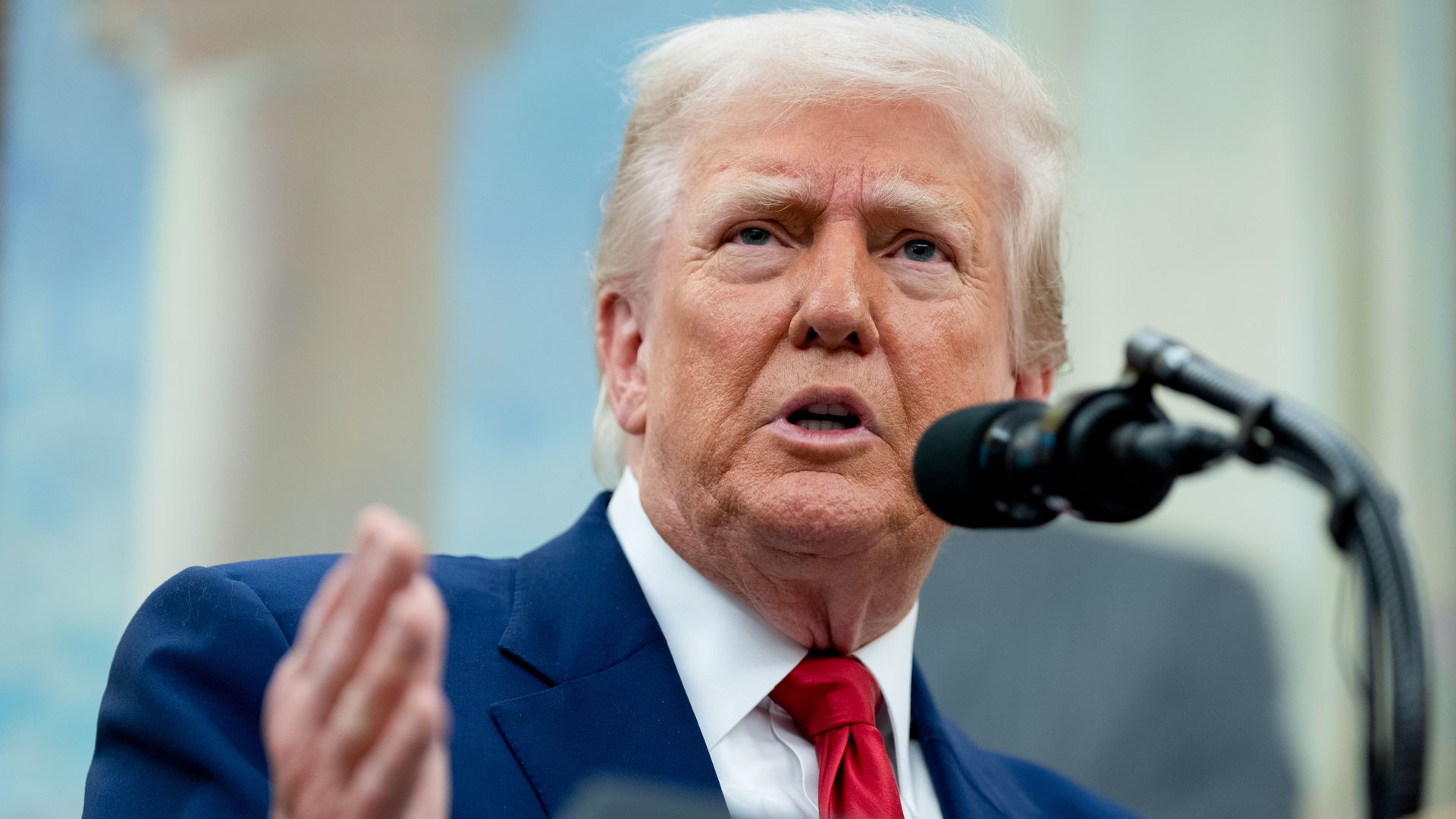
A federal appellate court on Thursday temporarily halted the ruling that paused Trump's tariffs. Photo: Chris Kleponis/CNP/Bloomberg via Getty Images
The U.S. Court of International Trade on Wednesday ruled President Trump does not have the authority under economic emergency legislation to impose his global tariffs.
Why it matters: The court's decision could potentially derail Trump's trade war, but the Supreme Court could also still overturn the ruling. A federal appellate court already stayed it temporarily.
Here's what to know:
What is the U.S. Court of International Trade?
The big picture: The federal court provides "a comprehensive system for judicial review of civil actions arising out of import transactions and federal transactions affecting international trade," according to Mark A. Barnett, the court's chief judge.
- According to Barnett, that system is rooted in several parts of the U.S. Constitution, namely Article I, Section 8, which says that "all Duties, Imposts and Excises shall be uniform throughout the United States."
- The Court of International Trade was officially created as part of the Customs Court Act of 1980, which reconfigured the U.S. Customs Court into the CIT.
- The court has existed in many different forms, however, throughout the U.S. history, per the official CIT website. That includes its iteration as the U.S. Customs Court, which Congress adapted in 1926 from the Board of General Appraisers, which had existed since 1890.
What did the court rule about tariffs?
Driving the news: The court issued a summary judgment concerning two separate cases – V.O.S. Selections v. United States and Oregon v. Department of Homeland Security — finding that Trump did not have the authority to impose tariffs under the International Emergency Economic Powers Act, or IEEPA.
- Trump had used the 1977 law, which had never before been invoked in a tariff context, to impose sweeping trade levies worldwide.
- The two groups of plaintiffs — businesses and states — sued on the grounds that the president's orders violated the Constitution's grant of authority over import duties to Congress.
State of play: "The question in the two cases before the court is whether the International Emergency Economic Powers Act of 1977 ("IEEPA") delegates these powers to the President in the form of authority to impose unlimited tariffs on goods from nearly every country in the world," the three-judge panel wrote.
- "The court does not read IEEPA to confer such unbounded authority and sets aside the challenged tariffs imposed thereunder."
- Tariffs imposed under a different legal authority called Section 232 — including on imports of autos, steel and aluminum — are unaffected by the ruling.
What is VOS Selections?
VOS Selections, a New York-based wine importer, led one of the lawsuits, which represented five small businesses in total. The businesses argued that Trump's tariffs represented a significant threat to their operations.
- The other plaintiffs include FishUSA, MicroKits, Terry Precision Cycling, and Genova Pipe.
What they're saying: "It takes us about two months to ship goods from Europe," Victor Schwarz, founder of VOS Selections, said during a reporter briefing on Thursday.
- "It's worse than a tax — a tax I would be paying maybe after a sale," he said. "These tariffs have to be paid upfront."
- "We don't have the cash to just bring in extra containers of champagne like LVMH," he told Axios, referring to the luxury brand that sells high-priced wines and spirits like Dom Perignon.
Who else was a part of the lawsuit?
The state of Oregon led the states' suit.
- Oregon Attorney General Dan Rayfield (D) said in a statement that they brought the case "because the Constitution doesn't `give any president unchecked authority to upend the economy."
- The ruling "reaffirms that our laws matter, and that trade decisions can't be made on the president's whim," he added.
Can Trump overturn the ruling?
- A federal appellate court on Thursday temporarily halted the ruling.
- "America cannot function if President Trump, or any other president for that matter, has their sensitive diplomatic or trade negotiations railroaded by activist judges," White House press secretary Karoline Leavitt said Thursday.
