Google leaders see AGI arriving around 2030

Add Axios as your preferred source to
see more of our stories on Google.
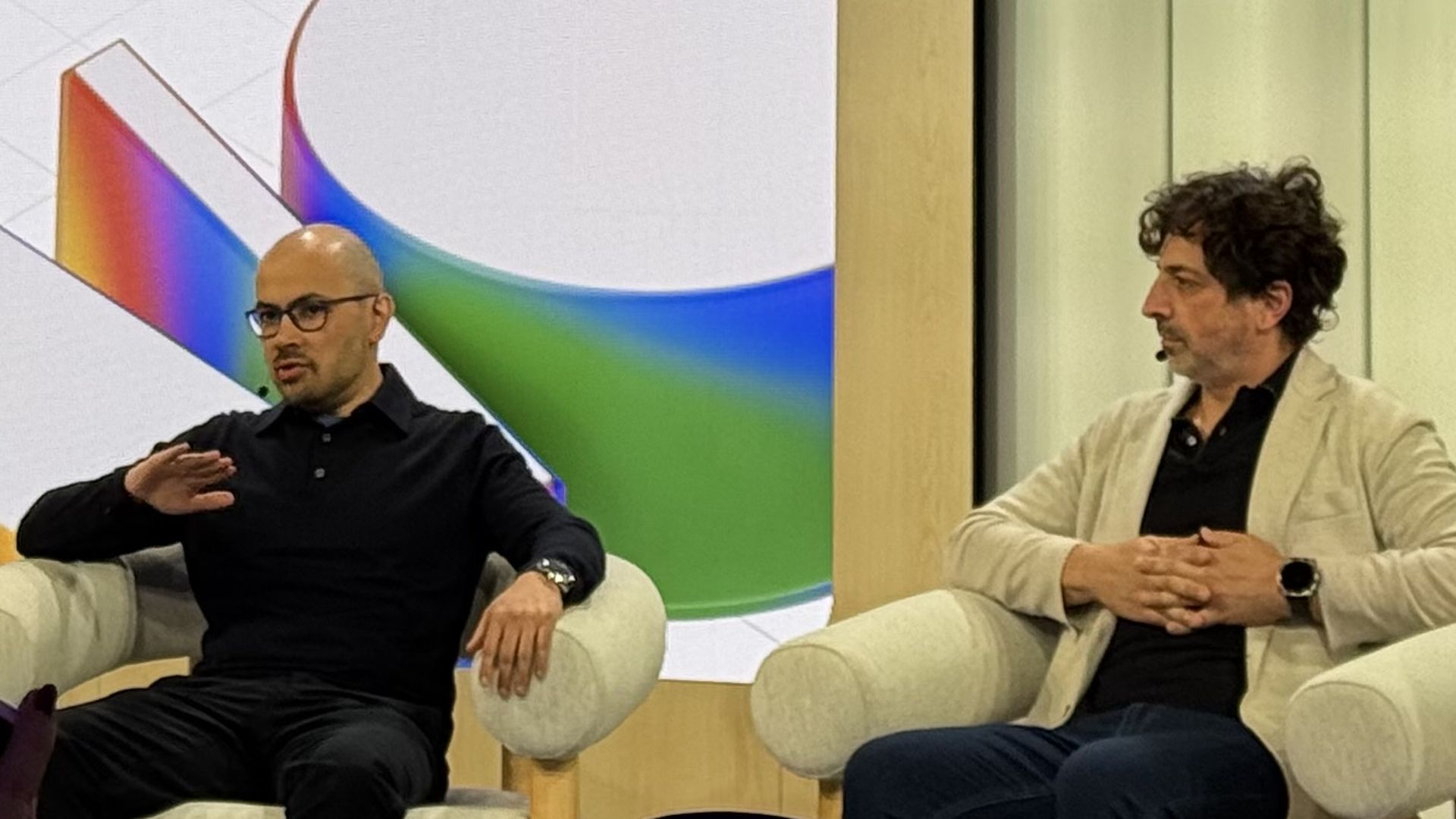
Google DeepMind CEO Demis Hassabis (left) and co-founder Sergey Brin at Google I/O on Tuesday. Photo: Ina Fried/Axios
So-called artificial general intelligence (AGI) — widely understood to mean AI that matches or surpasses most human capabilities — is likely to arrive sometime around 2030, Google's co-founder Sergey Brin and Google DeepMind CEO Demis Hassabis said Tuesday.
Why it matters: Much of the AI industry now sees AGI as an inevitability, with predictions of its advent ranging from two years on the inside to 10 years on the outside, but there's little consensus on exactly what it will look like or how it will change our lives.
Brin made a surprise appearance at Google's I/O developer conference Tuesday, crashing an on-stage interview with Hassabis.
The big picture: While much of Google's developer conference focused on the here and now of AI, Brin and Hassabis focused on what it will take to make AGI a reality.
Asked whether it will be enough to keep scaling up today's AI models or new techniques will be needed, Hassabis insisted both are key ingredients.
- "You need to scale to the maximum the techniques that you know about and exploit them to the limit," Hassabis said during the on-stage interview with tech journalist Alex Kantrowitz. "And at the same time, you want to spend a bunch of effort on what's coming next."
- Brin said he'd guess that algorithmic advances are even more significant than increases in computational power. But, he added, "both of them are coming up now, so we're kind of getting the benefits of both."
The big picture: Hassabis predicted the industry will probably need a couple more big breakthroughs to get to AGI — reiterating what he told Axios in December.
- However, he said that we may already have achieved part of one breakthrough in the form of the reasoning approaches that Google, OpenAI and others have unveiled in recent months.
- Reasoning models don't respond to prompts immediately but instead do more computing before they spit out an answer.
- "Like most of us, we get some benefit by thinking before we speak," Brin said — joking that it's something he often has to be reminded of.
Between the lines: Google detailed a couple of new approaches Tuesday that, while less flashy than some of the other AI features the company unveiled, hinted at other novel directions.
- Gemini Diffusion is a new text model that employs the diffusion approach typically used by image generators, "converting random noise into coherent text or code," per a Google blog post. The result, Google says, is a model that can generate text far faster than other approaches.
- The company also debuted a mode for its models called Deep Think, which works by pursuing multiple approaches to a problem and evaluating which is most promising.
What's next: On the timing of AGI, Hassabis and Brin were asked whether they thought it would arrive before or after 2030.
- Brin said he'd go with just before that date, while Hassabis chose just after.
- Hassabis joked that Brin, who is no longer part of Google's day-to-day management, only has to call for the advance to happen — while Hassabis, who oversees Google's far-flung AI efforts, has to figure out how to actually deliver it.
